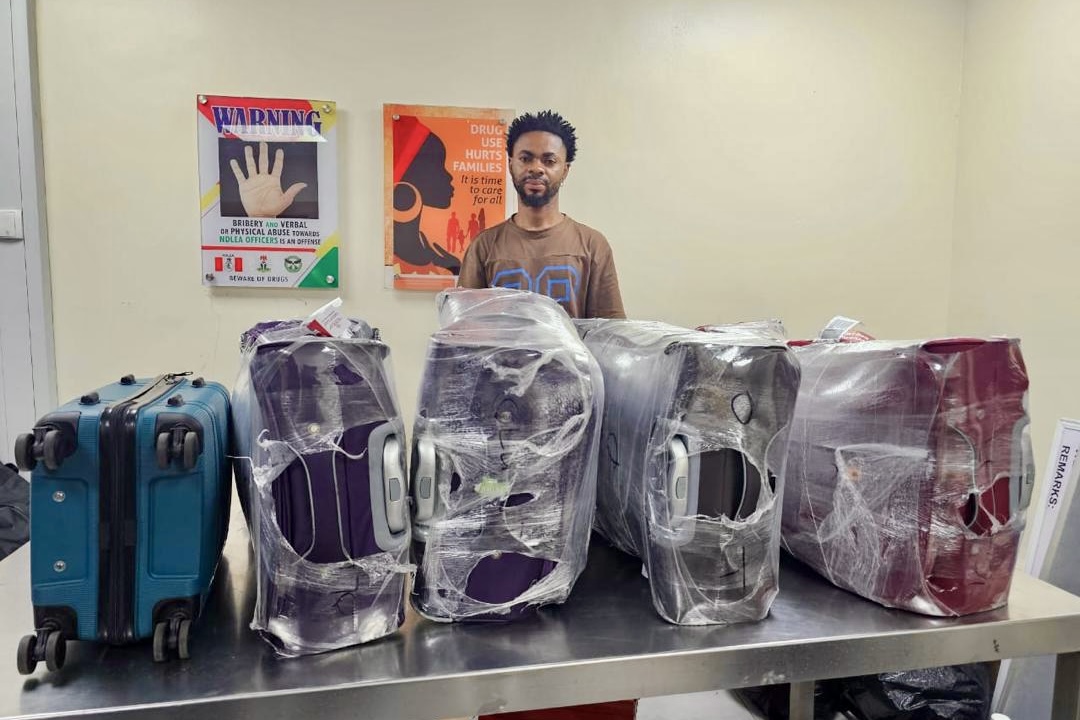
A businessman allegedly carrying 4.8kg of cocaine to Milan was stopped at Lagos airport. Days later, more than N5bn in drugs was intercepted at Nigerian ports. The deeper security question is who sits behind the couriers, cargo and cash.
The most important detail in the arrest of Philip Tunde is not the cocaine hidden inside eight pairs of shoes.
It is the route.
On September 27, 2026, NDLEA operatives stopped the 38-year-old businessman at the joint screening point of Terminal 2 of Murtala Muhammed International Airport, Lagos, as he prepared to board a Royal Air Maroc flight to Milan, Italy.
Inside the soles of eight pairs of trainers and canvas shoes were 16 parcels of cocaine. Another 195 wraps were allegedly concealed in the railings of four travelling bags.
The combined weight was 4.80 kilogrammes.
The NDLEA said Tunde told investigators he had paid N16 million in cash for the cocaine in the shoes. He allegedly said the consignment hidden in the bags was to be delivered to a partner in Italy.
He also reportedly said the N16 million came from compensation he received after suffering a workplace injury at a plastic manufacturing company in Italy, where he lost the tips of two fingers. These are allegations contained in the agency’s account and have not been tested in court.
On the surface, this looks like another airport drug seizure.
Taken with a series of other cases recorded by the NDLEA in recent months, it points to something more significant.
Nigeria’s drug trafficking challenge is increasingly being fought across several corridors at once. Passenger terminals, courier companies, commercial buses, seaports, imported vehicles and ordinary-looking consumer goods have all featured in recent seizures.
The question for investigators is no longer simply how a trafficker concealed a parcel.
It is who financed the shipment, who supplied the drugs, who recruited the courier, who organised the transport and who was waiting at the other end.
The shoes may have been the smallest part of the story
The discovery at Lagos airport was unusually elaborate for a passenger consignment.
Sixteen parcels were divided between eight pairs of shoes. A separate 195 wraps were reportedly hidden inside the structural railings of four travelling bags.
That means investigators were dealing with more than one concealment point on the same journey.
The NDLEA did not publicly identify Tunde’s alleged supplier, the partner in Italy or the person who organised the shipment.
That gap matters.
A courier arrested at a departure terminal may be the most visible person in a trafficking chain. He is not necessarily the person who controls it.
Tunde’s alleged payment of N16 million provides one potentially important investigative lead. The money trail could establish whether he was purchasing the drugs personally, acting on behalf of someone else or operating as one link in a wider network.
The NDLEA’s recent anti-narcotics cases show why that distinction matters.
In a separate case involving a much larger shipment, the agency charged Afolabi Kazeem Michael, popularly known as KC Luxury, and two others over alleged trafficking of 184.5kg of cocaine to the United Kingdom. The charges include alleged money laundering and conspiracy. Two other people named in the case were reportedly arrested in London. On October 2, a Federal High Court in Lagos denied bail to the defendants.
In that case, the NDLEA alleged that false identities, financial facilitators and overseas contacts were used to move the cocaine.
The agency’s chairman, Brig. Gen. Mohamed Buba Marwa, said investigators had identified a structure in which financial facilitators moved billions of naira on behalf of the alleged cartel.
That is the kind of investigation capable of reaching beyond the person physically carrying the drug.
Italy keeps appearing in the Nigerian cocaine files
Tunde’s alleged destination is significant because Italy has appeared repeatedly in recent NDLEA cocaine cases.
On August 2, the agency intercepted 500 grammes of cocaine concealed in the false bottom of a backpack being shipped to Italy through a Lagos logistics company. On the same operation, another consignment concealed cocaine inside a local mortar bound for China.
A week later, the NDLEA announced the arrest of another Italy-based businessman at Enugu airport. Joseph Cyril was allegedly carrying 98 wraps of cocaine weighing 1.510kg after ingesting them for a journey to Italy via Addis Ababa and France. The agency said another suspect had already been arrested in connection with that seizure.
Then came the arrest of 25-year-old newlywed businessman Lovely Chukwulobelu at Enugu airport. The NDLEA said he allegedly ingested 72 wraps of cocaine while preparing to travel to Portugal.
These incidents do not establish that the suspects belonged to one organisation.
They do establish a repeated pattern of Nigerian departure points being used in cocaine movements aimed at overseas markets.
And Italy is not appearing only as an incidental destination.
It is appearing in airport seizures, logistics consignments and cases involving people who the NDLEA says have links to the country.
That pattern deserves deeper international investigation.
From passenger luggage to shipping containers
The same week as the Tunde arrest, the NDLEA reported seizures at Apapa, Tin Can Island and Onne worth more than N5 billion.
The quantities were dramatically larger.
At Apapa Port, officers working with Customs subjected two containers from Bangkok, Thailand, to 100 per cent examination following intelligence. One container yielded 161 parcels of Thai Loud weighing 124kg and valued at N372 million.
The drugs were allegedly concealed inside two refrigerators and two cartons.
At Onne Port in Rivers State, two watch-listed containers were subjected to joint examination.
One contained 40 packs of Loud weighing 22kg, hidden in a travelling bag and three vehicles.
A second container held 109,600 bottles of codeine-based cough syrup with a total weight of 16,440kg.
The NDLEA said the container had travelled from India to Saudi Arabia, where its origin history was allegedly deleted before onward movement. The combined street value of the Loud and codeine consignments at Onne was put at N833.2 million.
At Tin Can Island Port, investigators searched a watch-listed container from Montreal, Canada.
They said they found 2,595 parcels of Canadian Loud weighing 1,297.5kg concealed inside a Toyota Sienna and a Hyundai Elantra, alongside 24 blue drums and six jumbo bags.
The NDLEA valued the consignment at more than N3.8 billion.
Taken together, the agency’s published figures put those three port consignments at more than N5 billion.
But the significance is not simply the monetary value.
The seizures show how traffickers are allegedly exploiting legitimate international commerce.
Refrigerators can become concealment spaces.
Vehicles can become concealment spaces.
Travelling bags can become concealment spaces.
Commercial logistics can become part of the delivery chain.
That makes the drug threat a border-security problem as much as a crime problem.
The intelligence battle is moving upstream
One phrase in the NDLEA statement deserves attention.
The agency said the port interceptions followed months of intelligence and tracking of the shipments from their ports of origin.
That suggests the most effective intervention may not always occur at the point where a container reaches Nigerian soil.
By the time a shipment arrives at Apapa, Tin Can or Onne, the most useful intelligence may already lie in its shipping history, ownership, route, declared cargo, financial records and communications.
The watch-listing of the Tin Can and Onne containers indicates that intelligence can allow investigators to target specific consignments rather than depend entirely on random physical examination.
That model is important because Nigeria’s ports process enormous volumes of legitimate trade.
A system that relies solely on opening containers after they arrive will always face a capacity problem.
Intelligence can narrow the field.
Financial investigation can expose the people behind the transactions.
International cooperation can identify the receivers.
The NDLEA appears increasingly conscious of that broader model.
On September 26, the agency signed a memorandum of understanding with the United Arab Emirates’ National Drug Enforcement Authority. Marwa said the agreement would deepen intelligence sharing and joint enforcement along the Nigeria-UAE corridor. The NDLEA disclosed that it had intercepted about 354.7kg of illicit drugs in consignments going to the UAE between 2021 and 2026, leading to 47 arrests and prosecutions.
That is a recognition of a simple reality.
Drug trafficking does not stop at a Nigerian border.
Neither can the investigation.
The domestic market is growing alongside the export route
International trafficking is only one part of the problem.
The NDLEA also reported the destruction of 20,234kg of skunk from an 8.0936-hectare cannabis farm in Area 4, Ife South Local Government Area of Osun State.
In Plateau State, officers arrested 41-year-old Agbo Dennis after allegedly recovering 385kg of skunk.
In Lagos, 209,000 tramadol tablets were recovered from an unoccupied compound in Divine Estate, Ago Palace.
A follow-up operation at Ladipo Spare Parts Market resulted in the arrest of 23-year-old Ekundayo Taiwo after the seizure of Colorado cannabis and methamphetamine. The methamphetamine was allegedly concealed inside an energy-drink bottle being transported as a waybill package.
In Kogi, officers intercepted a Lagos-Abuja commuter bus carrying a waybill containing 1kg of methamphetamine and later arrested the alleged owner of the consignment in Abuja.
In Edo, NDLEA officers reported recovering 32.2kg of cannabis from a residence and making another arrest involving Loud, Colorado, tramadol, methamphetamine, Swinol and Molly.
These seizures point to two markets operating alongside each other.
One is the international market, where high-value drugs are moved across borders.
The other is the domestic market, where cannabis, pharmaceutical opioids and synthetic drugs are distributed through houses, markets, roads, buses and informal delivery networks.
Each creates a different security challenge.
The unanswered question behind N16 million
The strongest unanswered question in the Tunde case is not whether cocaine was found.
The NDLEA says its field test identified cocaine.
The more consequential question is what the N16 million can reveal.
Cash can disappear quickly.
A financial trail is harder to erase.
Who received it?
How was the payment arranged?
Was the alleged N16 million the entire purchase price or only part of it?
Who supplied the shoes?
Who prepared the bag railings?
Who was the partner waiting in Italy?
Was the Italian contact a receiver, organiser or something else?
Those questions are not allegations against any person not named by investigators. They are the logical investigative questions created by the agency’s own account of the arrest.
The answers could tell investigators whether Tunde was operating independently or was allegedly being used as a courier by a larger network.
The distinction is crucial.
Arresting couriers can remove individuals from the chain.
Following the money can potentially remove the chain itself.
Nigeria is also being tested as a transit and logistics hub
The port seizures reveal another dimension.
The alleged shipments originated from different international locations, including Thailand, Canada and India. They involved multiple types of concealment and multiple forms of legitimate cargo.
That means Nigeria’s transport infrastructure can be targeted from several directions.
The risk is not restricted to cocaine.
Cannabis derivatives, opioids, methamphetamine and other controlled substances are entering the enforcement picture.
The NDLEA’s own recent statistics underline the scale of its response. At a September 26 meeting tied to its UAE cooperation agreement, Marwa said the agency had recorded more than 91,000 arrests between January 2021 and July 2026, including 243 alleged drug barons, and seized more than 15.5 million kilogrammes of illicit drugs and precursor chemicals.
Those figures demonstrate a major enforcement effort.
They also demonstrate the size of the problem.
A war on drugs cannot be measured only by the quantity destroyed.
It must also be measured by whether trafficking organisations lose their money, suppliers, logistics infrastructure and international connections.
The checkpoint is winning battles. The network remains the target.
The arrest at Lagos airport shows that passenger screening can work.
The port seizures show that intelligence-led container targeting can work.
The international cooperation agreement with the UAE shows that investigators are trying to extend that capability beyond Nigeria.
But the emerging pattern presents a tougher challenge.
Traffickers do not need to use one route.
They can allegedly shift between passengers, couriers, freight companies, containers, vehicles and waybills.
They can conceal drugs in consumer goods.
They can exploit legitimate commercial infrastructure.
They can use international partners.
The response therefore has to be equally flexible.
Marwa, while commending the officers involved in the latest seizures, urged the agency to sustain its “onslaught against drug trafficking networks” while maintaining what he described as a “balanced approach” to drug control.
That is the central test now.
Philip Tunde may face the court as the person allegedly carrying 4.8kg.
The N5 billion in port seizures may be recorded as another operational success.
But Nigeria’s bigger security victory will come only when arrests such as these lead investigators upward rather than stop at the person caught at the checkpoint.
Because the most valuable person in a drug investigation may not be the courier holding the package.
It may be the person who never touches it.
Follow us on our broadcast channels today!
- WhatsApp: https://whatsapp.com/channel/0029VawZ8TbDDmFT1a1Syg46
- Telegram: https://t.me/atlanticpostchannel
- Facebook: https://www.messenger.com/channel/atlanticpostng