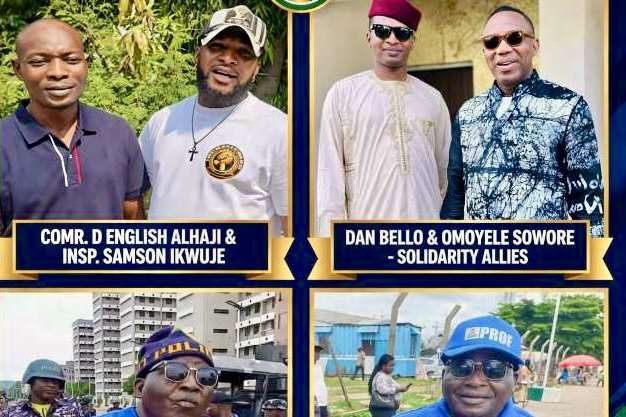
Omoyele Sowore, the indefatigable human-rights campaigner and former presidential hopeful, endured a harrowing early-morning assault at the hands of no fewer than eight Nigeria Police Force officers before being hauled off to an undisclosed location.
The dramatic incident unfolded at the Force Intelligence Department (FID) in Abuja at approximately 6 a.m. on Thursday, August 7, 2025, when Sowore—having steadfastly refused to leave his cell without his legal team and personal effects—was violently overpowered and secretly relocated under the cover of darkness.
“They invaded Sowore’s cell at 6 a.m. this morning; the police officers were led by a CSP. They said they were going to court, but he insisted they must bring his lawyers before going,” revealed a source privy to the operation. “So they pounced on him; there were eight of them who pounced on him, and they were led by a police CSP. They tried to drag him out of the cell, but he insisted he could not be dragged out without his clothes. Right now, his right hand is twisted. They broke his hand.”
According to insiders, the raid was orchestrated by a unit from the IGP Monitoring Unit under DCP Akin Fakorede, though the CSP involved reportedly answers to Force Spokesman Muyiwa Adejobi.
This latest incident epitomises a troubling pattern of state-sanctioned intimidation and physical abuse directed at vocal critics of the federal government.
Sowore himself had only arrived at FID Abuja the previous day, honouring what he described as a “defective and riddled with legal errors” invitation from the Inspector-General of Police’s Monitoring Unit.
He arrived precisely at 12:16 p.m., flanked by his legal team—Barristers A.K. Musa and Marshal Abubakar—and a throng of supporters chanting anti-government slogans.
His packed travel bag, symbolically containing toiletries, books and spare clothes, was a tacit declaration that he was prepared for arbitrary detention.
Human-rights observers have decried the assault as a blatant violation of due process and an alarming escalation in police impunity. Amnesty International promptly condemned the secret transfer and use of force against Sowore, warning that such actions “further erode public confidence in the rule of law and signal a chilling warning to all who dare to dissent”.
Behind Sowore’s ordeal lies a broader crisis of police brutality in Nigeria. In the wake of the #EndSARS protests three years ago, Amnesty International reported that at least 15 demonstrators remain arbitrarily detained—many without trial—in Lagos correctional facilities.
Official inquiries into the October 2020 Lekki Toll Plaza shootings remain mired in controversy, with government figures conflicting sharply with eyewitness accounts of fatalities.
Meanwhile, the disbanded SARS unit was nominally replaced by SWAT, yet allegations of unlawful stops, extortion and violence persist, highlighting systemic failures to reform law-enforcement agencies.
The pattern extends beyond the police. A recent Reuters investigation into the Nigerian military’s conduct in the north-east revealed that dozens of women and girls who escaped Boko Haram captivity were unlawfully detained—some for up to four years—and subjected to abuse while in military custody.
These parallel accounts of secret detentions and physical coercion underscore a pervasive culture of impunity across security services.
Comparatively, other democracies have grappled with similar crises. In the United States, the 2020 Black Lives Matter protests prompted nationwide scrutiny of excessive force and “qualified immunity” protections for officers.
Yet nowhere has the backlash been as politicised as in Nigeria, where critics argue that existing oversight mechanisms—such as the Police Service Commission and the National Human Rights Commission—lack both the mandate and the will to hold perpetrators accountable.
“The relentless harassment of dissenters like Sowore reveals a government unwilling to tolerate scrutiny,” notes constitutional law expert Professor Adewale Oni. “When the state resorts to clandestine arrests and brutality, it betrays its own founding principles.”
His words resonate especially in light of Sowore’s long-standing campaign for judicial reform and accountability, which has repeatedly placed him at odds with successive IGPs.
As night fell over Abuja on Thursday, the whereabouts of Omoyele Sowore remained shrouded in secrecy. His supporters vow to mount mass resistance should any harm come to him, while international observers await formal explanations.
Yet if history is any guide, transparent inquiry—and justice—may be in peril of becoming the latest casualties of this shadow war on free speech.
In a nation yearning for stability, such episodes only deepen mistrust. Without urgent, systemic reform, Nigeria’s security architecture risks becoming a tool of political repression, not of public service—a prospect all too vividly illustrated by the brutal dawn raid on one of its most prominent activists.
Follow us on our broadcast channels today!
- WhatsApp: https://whatsapp.com/channel/0029VawZ8TbDDmFT1a1Syg46
- Telegram: https://t.me/atlanticpostchannel
- Facebook: https://www.messenger.com/channel/atlanticpostng