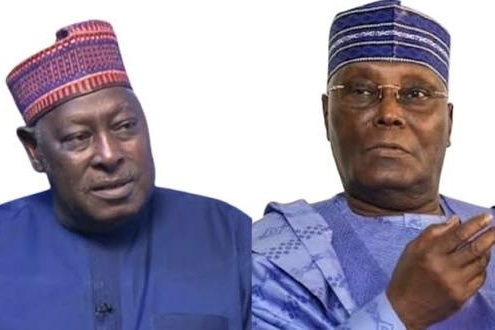
The African Democratic Congress has been thrown into another loud and revealing internal storm after Babachir Lawal dumped the party and accused its presidential primary of being rigged in favour of Atiku Abubakar.
Atiku’s media office has now answered with a blistering statement that does more than defend the former vice-president.
It also exposes the widening fault lines in the opposition bloc, the struggle for control of the 2027 platform, and the familiar Nigerian habit of turning political disappointment into public theatre.
According to the reports, Lawal resigned from the ADC on Monday, 1 June 2026, insisting that the party’s recently concluded presidential primary was “massively rigged” in Atiku’s favour.
He also said he would not be part of what he described as Atiku’s “rigging machine” in the 2027 general election. In his own words, he claimed the results were “written or rewritten” to favour the former vice president and described the process as a “disgraceful charade”.
The Atiku Media Office has rejected that charge as reckless, unsupported and deeply personal. In its statement, the office said Lawal’s attack was “post-primary bitterness” dressed up as moral outrage and insisted that “no amount of post-primary bitterness can alter reality”.
It argued that the former SGF had not produced “any documents, any verifiable facts, any credible witnesses” to back his allegations, while dismissing his claims as political fiction rather than evidence-based complaint.
The counterattack did not stop there. Atiku’s camp reminded the public that Lawal himself is no stranger to controversy, noting that he was removed from office under what it called the cloud of the infamous grass-cutting scandal.
The statement’s message was clear. It was not only rejecting Lawal’s accusation. It was attacking his credibility as a critic of electoral integrity and presenting him as the last person qualified to lecture Nigeria on transparency, conflict of interest or public morality.
The language used by the Atiku side was unusually severe even by Nigeria’s standards of intra-party warfare. It described Lawal as a “notorious conflict entrepreneur”, accused him of seeking power through “primordial sentiments”, and said he was projecting his own character onto Atiku.
The release also rejected his attempt to frame the quarrel in religious terms, insisting that accusing Atiku of religious bigotry or nepotism was one of the “laziest and most ridiculous lies” anyone could spread against him.
That is a crucial line in the row. Lawal’s resignation statement, as reported by Guardian and Channels, did not merely complain about procedure.
It also reached into Nigeria’s most combustible fault lines by describing Atiku and his circle as “religious hegemonists” and by arguing that working for Atiku would amount to handing President Bola Tinubu “an automatic ticket to a second term”.
That kind of rhetoric ensures the dispute is no longer just about internal party democracy. It has become a battle over identity, loyalty and the politics of fear.
The broader political context matters. Channels Television reported that the ADC said Atiku secured 1,846,370 votes to defeat Rotimi Amaechi, who polled 504,117 votes, while Mohammed Hayatu-Deen received 177,120 votes.
The party chairman, David Mark, said the exercise was free, admitted it was not perfect, and said there was room for improvement.
In other words, the party is already trying to present the primary as legitimate enough to stand, even as one of its loudest former insiders is now trying to blow it up from outside.
What makes this episode especially revealing is that both men are speaking to different audiences.
Lawal appears to be speaking to a northern conservative base that distrusts Atiku and fears another round of elite bargaining dressed as reform.
Atiku, on the other hand, is speaking to a national audience and trying to cast himself as the victim of bitterness, not the author of manipulation.
His camp’s repeated emphasis on evidence, process and inclusivity is designed to make Lawal look emotional, selective and politically unserious.
There is also a deeper strategic reading. The opposition has been trying to gather strength ahead of 2027, but every fresh alliance seems to arrive with its own grenade.
When one faction begins to accuse another of rigging, religious prejudice and hidden loyalties, the public does not just see disagreement. It sees a coalition struggling to trust itself.
That is dangerous for any party hoping to sell unity as an alternative to the ruling establishment. In this case, the fight is not only about who won a primary. It is about who gets to define the moral ownership of the opposition space.
Atiku’s camp has tried to close the matter with a blunt warning. Lawal, it said, should “search his conscience” and stop feeding division and bigotry for selfish gain. That is the central political takeaway from the episode.
The quarrel is not simply a personal feud between two northern political actors. It is a public demonstration of how fast ambition, grievance and tribalised language can corrode a coalition before it even reaches the ballot box.
For Atiku, the immediate task is to prevent one angry resignation from becoming the story of his 2027 project. For Babachir Lawal, the risk is that his protest may be remembered less as principle and more as a bitter breakup dressed in the language of righteousness.
Follow us on our broadcast channels today!
- WhatsApp: https://whatsapp.com/channel/0029VawZ8TbDDmFT1a1Syg46
- Telegram: https://t.me/atlanticpostchannel
- Facebook: https://www.messenger.com/channel/atlanticpostng