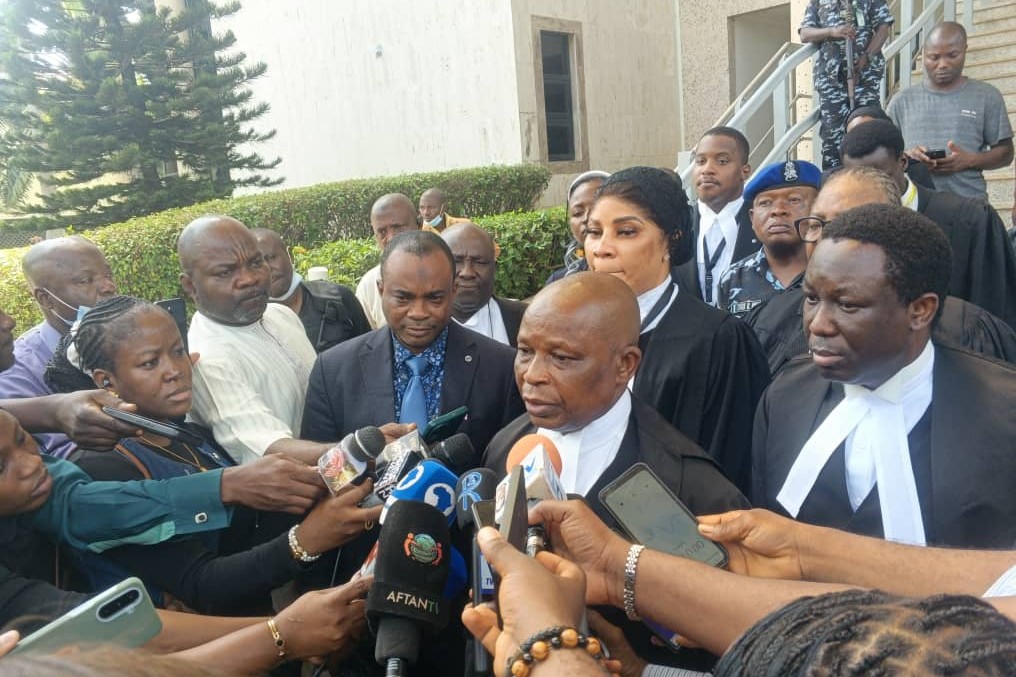
The Nigeria Security and Civil Defence Corps Mining Marshals have thrown down a fresh gauntlet in the escalating war over illegal mining enforcement, dismissing as “false and misleading” a viral report that linked one of their officers to over N2 billion in suspicious transactions and tied the allegation to the death of a colleague, Deputy Superintendent of Corps Agada Levi.
The unit says the figures are wildly exaggerated, the narrative is politically and operationally contaminated, and the matter should be moved away from the police to the Department of State Services for what it describes as an impartial review.
A Viral Claim That Ignited A Security Row
The dispute centres on a widely circulated headline alleging that police had arrested three NSCDC officers over the death of a colleague and traced more than N2 billion to a suspect’s bank account. The Mining Marshals say that version of events is wrong at its core.
In the statement now driving the controversy, the unit insists the account belonging to Jibrin Labaran recorded a total credit of N760,129.85 and a total debit of N760,457.25 over the last year, amounts it says reflect routine emoluments rather than illicit wealth.
Both The Guardian and PUNCH reported the same figures as part of Onoja’s rebuttal.
That denial matters because the story has moved beyond a simple argument over bank transactions. It has become a battle over credibility, institutional turf, and who gets to control the narrative around the death of an officer deployed in one of Nigeria’s most contentious enforcement theatres: illegal mining sites in Nasarawa State and beyond.
The Marshals say the story is being weaponised to smear the unit and distract from the real issue, which is the enforcement war against illegal miners and the interests said to be threatened by it.
Why The Mining Marshals Matter
The Mining Marshals are not a routine NSCDC squad. They were formally presented in March 2024 as part of government’s strategy to tighten enforcement around mineral resources, curb illegal extraction and protect revenue from the mining sector.
The Federal Ministry of Information and National Orientation said the new unit was meant to strengthen security and maximise revenue from the mineral sector, while the NSCDC framed it as a specialised force for protecting critical national infrastructure.
That background is important because the current row is unfolding against a wider national crackdown.
In April 2025, the Ministry of Solid Minerals Development said the Marshals dismantled a heavily fortified illegal mining site at Rafin Gabas in Kokona Local Government Area of Nasarawa State, describing the site as one that had long evaded law enforcement and was reportedly protected by compromised security personnel.
The ministry said three foreign nationals were arrested in that operation.
The same Nasarawa corridor has remained a flashpoint. PUNCH reported in June 2025 that the Marshals were challenging a Federal High Court order restricting their access to a mining site in Rafin Gabbas, with police affidavits alleging underage labour, hard drugs and unsafe mining conditions.
That legal battle helps explain why the latest allegations about interference, arrests and retaliation are being read by the Marshals as part of a longer and more dangerous institutional struggle.
A Long-Running Rift With The Police
At the centre of the new allegation is a claim that operatives of Team N of the Force Intelligence Department repeatedly interfered with lawful Mining Marshals operations at the Nasarawa site.
Onoja is reported to have said there has been “a history of consistent blackmail” by the police team for over a year, with repeated disruption of operations, previous arrests of Marshals personnel and attempts to frustrate prosecutions against suspected illegal miners.
The Guardian, PUNCH and other outlets carried this same thrust from the statement.
The unit also says the most recent police action cannot be treated as neutral because of that history.
In the statement, it argues that the officer allegedly leading the investigations had previously been involved in confrontations at the same site, including an earlier episode in which more than thirty police operatives were said to have entered the area and another in which four Mining Marshals officers were arrested before an intervention secured their release.
Those claims remain allegations from the Marshals’ side, but they are clearly central to their demand that the matter be transferred away from the police.
The request for a DSS review is therefore not a side note. It is the heart of the unit’s argument that the investigating authority has become too deeply entangled with a longstanding operational dispute to be seen as impartial.
PUNCH reported that the Marshals’ commander formally petitioned the Inspector-General, asking that the probe into Levi’s death be moved to the DSS for impartial handling, while The Eagle reported that the petition was dated 27 May 2026.
The Death Of Agada Levi And The Family Contact
The Marshals do not deny that Agada Levi died while attached to their operations. What they reject is any suggestion that management had anything to do with his death.
PUNCH reported Onoja’s line plainly: “We are not denying that Agada Levi died in the line of duty, sadly. But none of the Management Team of Mining Marshals knows anything about his death.”
The unit says the death was its first fatality since the creation of the special enforcement operation more than two years ago.
The statement also seeks to show the unit’s conduct after the death as evidence of care rather than concealment.
Onoja said he called the family into his office, set up a burial committee, and funded the burial without asking the family for money. He added that friends of the operation later raised N3 million for the widow.
PUNCH and The Guardian both reported those claims, which the unit presents as proof that it was acting in support of the family, not in opposition to it.
The Marshals also say they held engagements with members of Levi’s family in Kaduna and produced WhatsApp exchanges with the deceased officer to show that he had been cautioned against operating outside his assigned jurisdiction.
That is a significant claim because it suggests the unit is preparing a documentary trail for any independent investigator, not merely offering a public defence.
The statement says those materials have been retained as evidence and attached to correspondence sent to the Inspector-General.
Detentions, Arrests And The Separate Allegation Of Blackmail
Another serious layer is the allegation that some Marshals officers were themselves detained after trying to check on the family of the deceased officer.
According to the statement, officers Simeon Anyebe and Ayefu Ibrahim were sent to confirm whether Levi’s elder brother knew anything about the matter, but they were allegedly detained and handed over to FID operatives.
The Marshals deny that they were arrested while trying to see a suspect on remand, insisting that version of events is “entirely false”.
The unit further claims that on 31 May 2026, after some of its personnel were released, FID operatives attempted to arrest Ojo Toluwatope Alex, the lead prosecution counsel to the Marshals, at his home in Sauka, Abuja.
That allegation, if independently confirmed, would deepen the impression of a sprawling inter-agency conflict rather than a narrow homicide investigation. It also helps explain why the Marshals are urging the public to treat the most dramatic claims in the viral report with caution.
What The Numbers, Allegations And Timeline Suggest
Considered collectively, the public record points to three intersecting issues: a disputed death, a disputed financial allegation, and a disputed investigation.
The police-linked viral report says one thing. The Mining Marshals say the bank data is nowhere near N2 billion, that the investigation is compromised by prior operational clashes, and that external interests tied to illegal mining may be stoking the controversy.
What is not yet visible in the public domain is a full police response addressing the specific rebuttals. PUNCH notes that the police have yet to publicly respond to the Marshals’ allegations.
That silence matters. In a case already crowded with claims of interference, blackmail, unlawful detention, foreign sponsorship and competing versions of events, the lack of a detailed police counterstatement leaves the field open to speculation.
Until there is a transparent, independently verifiable account of what happened before and after Agada Levi’s death, the story will continue to be read less as a closed homicide file and more as a proxy war over illegal mining, enforcement power and institutional trust.
For now, the Mining Marshals are standing on one clear line: they say Levi’s death was tragic, they say it was not their doing, and they say attempts are being made to exploit the loss to weaken an operation that has become central to Nigeria’s fight against illegal mining.
Whether the DSS ultimately takes over the matter, or whether the police answer every allegation in full, will determine whether this controversy is resolved as an investigation or escalates into a far more damaging institutional rupture.
Follow us on our broadcast channels today!
- WhatsApp: https://whatsapp.com/channel/0029VawZ8TbDDmFT1a1Syg46
- Telegram: https://t.me/atlanticpostchannel
- Facebook: https://www.messenger.com/channel/atlanticpostng