Protesters storm police headquarters over the October 30 Ekiti assault, as allegations of political sponsorship, missing CCTV recordings and possible security-service involvement raise questions about the credibility of the investigation.
The question hanging over the alleged attack on human rights activist Omoyele Sowore in Ekiti State is no longer simply who assaulted him and members of his team. It is whether the institutions responsible for investigating the incident can be trusted to uncover everyone involved, including anyone who may have organised, financed or facilitated the violence.
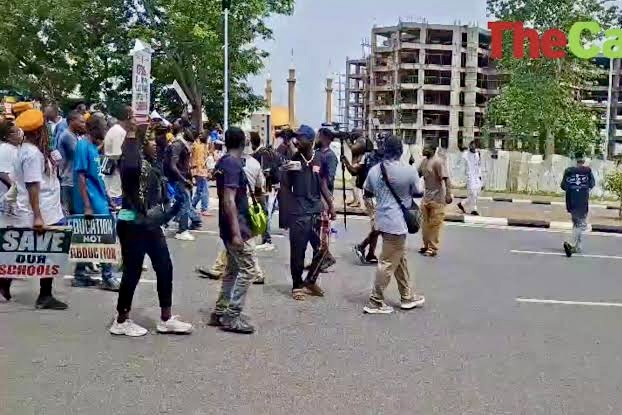
That question followed protesters to the headquarters of the Nigeria Police Force in Abuja on Tuesday, November 3, where demonstrators demanded the immediate arrest and prosecution of those allegedly responsible for the October 30 assault in Ado-Ekiti.
The protesters called for an independent investigation, insisting that police authorities must look beyond the individuals who physically attacked Sowore and establish whether political actors or security operatives participated in planning or executing the operation.
Singing and chanting anti-government songs, they also demanded accountability for any police or Department of State Services (DSS) personnel found to have participated in the violence or interfered with the investigation.
Their demonstration comes as the controversy surrounding the incident moves beyond competing accounts of what happened at Tawakalitu Restaurant in the Dalimore area of Ado-Ekiti.
It now involves 11 arrests, allegations of political coordination, a stolen phone reportedly tracked to government premises, claims of erased CCTV recordings and a formal demand for the Inspector-General of Police to take control of the investigation.
At the centre of the dispute is a question that could prove more consequential than the arrests themselves: Can Nigerian law enforcement independently investigate allegations that implicate people connected to political power and the security establishment?
From alleged restaurant altercation to accusations of a coordinated assault
The incident happened on Friday, October 30, shortly after Sowore attended an interview at MIDAS FM 90.5 in Ado-Ekiti.
The AAC presidential candidate said he and members of his team were subsequently attacked by armed individuals at Tawakalitu Restaurant.
He alleged that the attackers had initially intended to target his team at the radio station but tracked their movements before confronting them at the restaurant.
Sowore also accused security operatives of following and harassing his team before the incident.
According to his initial account, DSS operatives had been monitoring their movements since their arrival in Ekiti and allegedly supplied the attackers with information about their location.
In a statement posted on social media, he declared:
“We have been brutally attacked and injured by well armed government-sponsored thugs in Ado-Ekiti, Ekiti State.”
He further alleged:
“Since our arrival yesterday, DSS (SSS) operatives have been trailing and harassing us. They even threatened the manager of the first place where we ate, warning him never to allow us to use his premises again.”
The Ekiti State Police Command initially offered a different account.
Its spokesperson, Abutu Sunday, said preliminary information indicated that Sowore had been involved in an altercation with individuals at a restaurant.
The command maintained that officers responded to a distress call, rescued those involved and took Sowore to the Police Hospital in Ado-Ekiti, where he received medical attention for what the police described as minor injuries.
It stated:
“The Command wishes to categorically clarify that Mr Sowore was not kidnapped. Rather, preliminary information indicates that he had an altercation with some individuals at a restaurant around Dalimore area, Ado-Ekiti, following which the Police were immediately alerted.”
The Commissioner of Police, Falade Adegoroye Michael, subsequently ordered an investigation.
Sowore rejected the police characterisation.
“There was no altercation! We were attacked!” he responded.
The distinction matters. An altercation suggests a confrontation between parties, while an organised assault involving armed attackers raises potentially different questions about criminal responsibility, political intimidation and public safety.
The investigation must establish what actually happened rather than allowing competing descriptions to become substitutes for evidence.
Eleven arrests, but who allegedly organised the operation?
The police announced on October 31 that 11 suspects had been arrested in connection with the incident.
The suspects were reportedly apprehended by operatives of the Rapid Response Squad at their hideouts in the Atikankan area of Ado-Ekiti at approximately 10pm on Friday, following intelligence received by the police.
Items reportedly recovered included two walkie-talkies, 13 mobile phones, seven ATM cards, eight international passports, vehicle keys, a flash drive, a mobile internet device and substances suspected to be Indian hemp and Colorado.
The police said the suspects were in custody and that investigations were continuing to establish their individual roles, possible connections with the incident and the identities of other people involved.
The Commissioner of Police assured residents that anyone found culpable would be brought to justice.
But for Sowore, the arrests do not resolve the central issue.
He argues that identifying and apprehending people allegedly present during the assault is only the beginning. Investigators must establish who financed, coordinated and directed the operation.
He specifically demanded the arrest of Adenijo Olusola, popularly known as Solar, whom he accused of coordinating the attack alongside Governor Biodun Oyebanji’s Chief Security Officer, CSP Ayodele Akinlua.
He also identified Omotuyi Temitope, popularly known as Tope Jinadu Small, as an alleged participant.
These allegations have not been established in court.
The criminal records controversy requires careful examination
The historical records surrounding some of the individuals named in Sowore’s allegations require particular care.
Solar was among seven defendants prosecuted over the September 2014 murder of former Ekiti State chairman of the National Union of Road Transport Workers, Chief Omolafe Aderiye.
However, the Ekiti State High Court discharged and acquitted all seven defendants in January 2018 after finding that the prosecution had failed to establish their complicity in the murder.
That acquittal must not be misrepresented as a conviction or evidence of guilt.
Solar was also arrested and arraigned alongside two other defendants over violence during the March 2021 Ekiti East Constituency 1 by-election in Omuo-Ekiti.
The defendants faced allegations including conspiracy, murder and attempted murder following shootings and killings during the election.
Available reports establish their arrest, arraignment and remand. The records reviewed for this report do not establish a subsequent final judgment convicting Solar in that case.
These distinctions are essential. Previous charges, arrests and allegations cannot establish participation in a separate incident years later.
Tope Jinadu Small also has a documented criminal justice history.
In June 2024, the Ekiti State Police Command confirmed his re-arrest, stating that he had previously been remanded at the Ado-Ekiti Correctional Centre following charges involving conspiracy and armed robbery.
Police said he had escaped during the 2012 jailbreak in which 220 inmates fled the facility.
Nevertheless, that history does not independently establish his involvement in the October 30 incident. His alleged participation must be determined through evidence relating to the present investigation.
The Governor’s Lodge phone allegation raises a serious evidence question
One of the most politically sensitive developments emerged on Sunday, November 1.
Sowore alleged that a mobile phone stolen from a member of his team during the assault had been electronically traced to the Ekiti State Governor’s Lodge.
He declared:
“One of the phones stolen from a member of our team during Friday’s brutal attack in Ado-Ekiti has now been traced to the Governor’s Lodge in Ekiti State.”
He subsequently demanded that the police and DSS release the CCTV recordings from Tawakalitu Restaurant.
“The @PoliceNG and @OfficialDSSNG must immediately release the CCTV footage from Tawakalitu Restaurant to the public. You cannot bury the evidence,” he said.
The phone allegation deserves independent examination.
A device’s reported location does not, by itself, establish who possessed it, who took it there or whether anyone inside a government facility participated in an offence.
Investigators should obtain the original tracking records, establish their accuracy, examine the location data and compare the results with evidence concerning the theft and recovery of the devices.
That process would either strengthen or undermine the allegation.
Dismissal without examination would be equally unacceptable.
Sowore alleges CCTV recordings were erased
The CCTV controversy has added another dimension to the dispute.
On November 2, Sowore released a video which he said showed individuals involved in the assault.
The footage appears to show men carrying cutlasses and sticks during a confrontation, while another man dressed in a black suit is seen being dragged.
The recording could provide investigators with important leads, although the identities and specific roles of the individuals shown require independent authentication.
More troubling is Sowore’s allegation that police officers and DSS operatives took possession of the restaurant’s CCTV equipment before returning it with the recordings erased.
He claimed that restaurant management confirmed that the equipment had been returned without the recorded footage.
He described the development as evidence of a coordinated cover-up.
Those are serious allegations and have not been independently established. The original equipment, its storage media, backup systems and any available copies should therefore be secured for forensic examination.
Police and DSS authorities must also explain who authorised the removal of the equipment, where it was taken, who had access to it and the condition in which it was returned.
Premium Times reported that it contacted the Ekiti Police Command’s spokesperson over the latest allegations. He asked the reporter to call back later.
The police must provide a substantive account of the equipment’s custody and the status of the CCTV investigation.
New allegations reach the Presidency and Federal Housing Authority
Sowore has also extended his allegations beyond Ekiti State’s security establishment.
He accused President Bola Tinubu’s Senior Special Assistant on Student Engagement, Sunday Asefon, of being among the alleged ringleaders.
He further alleged that Oyetunde Oladimeji Ojo, Managing Director of the Federal Housing Authority, mobilised Solar for the operation.
Ojo’s position as Managing Director of the Federal Housing Authority and Asefon’s presidential appointment are verifiable. Their alleged involvement in the assault, however, has not been established by a court or supported by independently verified evidence presented in the reporting reviewed.
Sowore also identified Asefon’s bodyguard, Ayodeji Akintade Ifeoluwa, as the individual he alleged was seen wearing a green polo shirt and wielding a machete during the assault.
All the allegations against these individuals require independent investigation and a fair opportunity for those named to respond.
Public office, political connections and personal relationships cannot establish criminal responsibility.
Equally, holding public office cannot place anyone beyond investigation where credible evidence raises questions about possible involvement in violence.
Why Sowore wants the Inspector-General to take over
On Monday, November 2, Sowore formally petitioned Inspector-General of Police Olatunji Disu, demanding that the Force Headquarters take over the investigation.
His lawyers argued that fresh allegations and emerging evidence made an investigation independent of the Ekiti State Police Command necessary.
The petition requested an investigative team drawn from outside the state command and reporting directly to the Inspector-General.
It also demanded that investigation files, witness statements, recovered property, exhibit registers and operational records be transferred to the proposed team under a documented chain of custody.
The petition stated:
“The fresh material and allegations emerging since the incident require an investigation conducted independently of the Ekiti State Police Command.”
Another significant element concerns earlier requests for police protection.
Sowore’s lawyers referred to letters dated August 27 and September 23, 2026, seeking police protection and security support for his movements and public engagements. They acknowledged that two police personnel had been deployed following the requests.
This raises a further public safety question: what security arrangements were in place when the attack occurred, and were those arrangements sufficient?
The petition also asked investigators to preserve the original video, identify the people appearing in it and compare them with the 11 suspects already arrested.
These demands go beyond an ordinary request for arrests. They concern the independence of the investigation and the integrity of the evidence on which any prosecution would ultimately depend.
Independent Newspaper Nigeria+1
Ekiti Government denies involvement
The Ekiti State Government has rejected accusations linking it to the incident.
In a statement issued on October 31, Chief Press Secretary Olayinka Oyebode said the government dissociated itself totally from the incident and called on police authorities to investigate the allegations and prosecute anyone found responsible.
The statement questioned Sowore’s allegations but left the determination of the facts to the appropriate authorities.
Its position is clear: the government denies involvement and says the police should establish what happened.
That denial must form part of the investigation, just as Sowore’s allegations must be tested against verifiable evidence.
The government should cooperate with any independent inquiry, including the preservation of relevant surveillance footage, visitor records and security documentation.
The police and DSS should similarly make clear whether their personnel had operational contact with the individuals involved and whether any agency took possession of the restaurant’s surveillance equipment.
Ekiti State Government Website+1
A test of Nigeria’s democratic accountability
The Abuja protest signals that the controversy is no longer confined to a restaurant in Ado-Ekiti.
It has become a test of whether political competition in Nigeria can take place without intimidation and whether security institutions can investigate allegations involving people connected to government without compromising their independence.
The immediate task is not to endorse Sowore’s accusations or dismiss them as political rhetoric.
It is to establish the facts.
Who attacked the activist and his team? Who were the people carrying weapons? Were the 11 suspects directly involved? Were additional individuals responsible for coordinating the operation? What happened to the stolen devices? Were CCTV recordings removed or erased? Did any police or DSS operative facilitate the incident or interfere with evidence?
Those questions require answers supported by records, witness testimony, authenticated recordings and forensic findings.
The Ekiti Government’s denial does not remove its obligation to cooperate. The police arrests do not establish that the investigation has reached everyone responsible. And allegations against public officials cannot become convictions simply because they have generated public outrage.
For Sowore, the confrontation has become another chapter in his longstanding political and human rights activism.
Despite the assault, he vowed to continue his activities, declaring:
“We survived the brutal attack, and the revolutionary struggle must continue.”
But survival should not be the final measure of accountability.
The real test will be whether the Nigerian authorities can establish what happened, identify everyone culpable and prosecute those against whom admissible evidence exists, regardless of their political connections or official positions.
Without that, the arrests of 11 suspects could become another headline without a satisfactory conclusion.
For the demonstrators at Force Headquarters, justice means more than finding the people allegedly caught wielding weapons.
It means finding out who sent them, who supported them and whether anyone in a position of authority helped them escape accountability.
Follow us on our broadcast channels today!
- WhatsApp: https://whatsapp.com/channel/0029VawZ8TbDDmFT1a1Syg46
- Telegram: https://t.me/atlanticpostchannel
- Facebook: https://www.messenger.com/channel/atlanticpostng