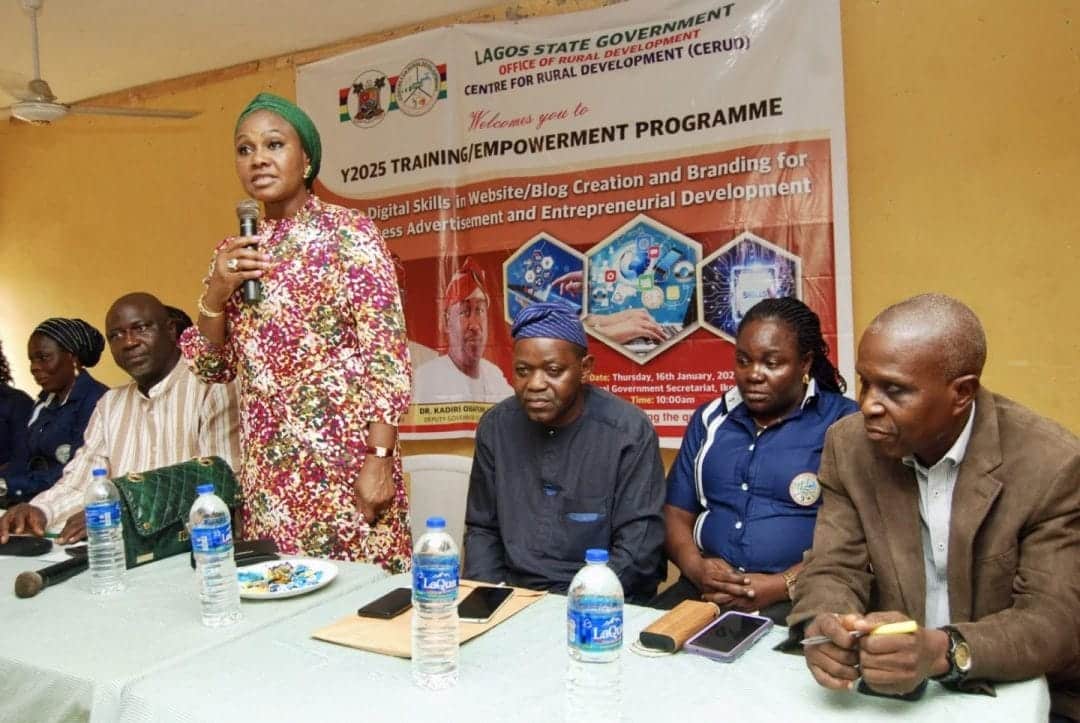
LASG revolutionises rural development by training Ikorodu youths in digital skills, empowering them to build brands and boost Lagos’ economy. Discover the impact!
IKEJA, Lagos State — In a significant stride towards bridging the digital divide and fostering economic inclusivity, the Lagos State Government has initiated a comprehensive digital skills training programme targeting youths in rural communities.


This initiative, orchestrated by the Centre for Rural Development (CERUD), recently conducted a one-day intensive workshop in the Ikorodu rural division, equipping participants with essential digital competencies such as niche carving, branding, blog creation, and online marketing. The overarching goal is to empower these youths to effectively market their products, services, and talents, thereby enhancing their entrepreneurial capabilities.
Aligning with the THEMES Plus Agenda
This training aligns seamlessly with Governor Babajide Sanwo-Olu’s THEMES Plus Agenda, which aims to build a 21st-century economy while ensuring inclusivity for all demographics, particularly youths in rural areas. The THEMES Plus Agenda encapsulates key developmental pillars: Traffic Management and Transportation, Health and Environment, Education and Technology, Making Lagos a 21st Century Economy, Entertainment and Tourism, Security and Governance, with the ‘Plus’ emphasising social inclusion, gender equality, and youth development.
By focusing on digital skill acquisition, the administration underscores its commitment to integrating rural communities into the state’s burgeoning digital economy.
Empowering Rural Youths: A Strategic Imperative
The decision to target rural youths stems from a strategic imperative to foster balanced development across Lagos State. Rural areas often grapple with limited access to quality education and employment opportunities, leading to economic disparities and social challenges. By providing digital skills training, the government aims to create pathways for self-employment and entrepreneurship, enabling youths to leverage technology for economic advancement. This approach not only mitigates urban migration but also stimulates local economies, fostering sustainable development.
The Ikorodu Training: A Microcosm of Potential
The Ikorodu training session serves as a microcosm of the potential inherent in such initiatives. Participants were immersed in practical sessions on niche carving—identifying and targeting specific market segments—branding, blog creation, and online marketing strategies.
These skills are pivotal in today’s digital age, where online presence and effective digital communication are critical to business success. By mastering these competencies, the youths are better positioned to showcase their products and services to a broader audience, transcending geographical limitations.
Leadership Perspectives: Commitment to Youth Development
In his keynote address, Dr. Nurudeen Yekinni Lanre-Agbaje, the Special Adviser to the Governor on Rural Development, urged participants to capitalize on the training, emphasising the vast opportunities that technological innovations and new media present. He also indicated the possibility of future governmental support in providing necessary digital tools, contingent upon positive outcomes from the current exercise. This statement reflects a responsive governance approach, where further investments are considered based on measurable success and impact.
Mrs. Kikelomo Bolarinwa, the Permanent Secretary of the Ministry of Local Government Chieftaincy Affairs and Rural Development, expressed satisfaction with the participants’ rapid assimilation of new skills. Her observations during the practical demonstrations underscored the effectiveness of hands-on training methodologies. She affirmed the decision to inaugurate the program in Ikorodu, highlighting the community’s receptiveness and potential as a catalyst for similar initiatives across other rural divisions.
CERUD’s Vision: Building Unique Brands
Mr. Musibau Muyiwa Balogun, Director of CERUD, advised participants to utilise their newly acquired skills to build unique personal brands while promoting the Lagos brand, renowned for innovation and excellence. This guidance aligns with contemporary marketing paradigms, where personal branding and storytelling are integral to business differentiation and customer engagement. By fostering a culture of innovation and excellence, CERUD aims to position rural youths as competitive players in the digital marketplace.
Facilitator’s Insight: Elevating Trades through New Media
Mr. Michael Orumamona, Creative Director of Ikorodu News Network and facilitator of the training, elucidated the program’s motive: to impart knowledge and drive participants to elevate their trades and small businesses using new media. He emphasised that digital platforms offer unprecedented opportunities for market expansion and customer engagement, enabling small businesses to compete on a larger scale. This perspective is particularly pertinent in the Nigerian context, where digital penetration is increasing, and e-commerce is becoming a vital component of the economy.
Participants’ Response: Gratitude and Commitment
The participants conveyed their gratitude to Governor Babajide Olusola Sanwo-Olu and CERUD for their dedication to enhancing the socioeconomic lives of youths in rural communities. They pledged to leverage the knowledge and skills acquired to improve their businesses and contribute to the continuous growth of the Lagos State economy. This response indicates a positive reception and a willingness to apply the training practically, which is crucial for the program’s long-term success and sustainability.
Critical Analysis: Beyond Training—Ensuring Sustainable Impact
While the initiative is commendable, its sustainability hinges on several critical factors:
- Continuous Support and Mentorship: Post-training support mechanisms, including mentorship and access to resources, are essential to help participants navigate challenges and effectively implement their skills.
- Access to Digital Tools and Infrastructure: Provision of affordable internet access and digital devices is crucial. Without these tools, the application of acquired skills may be severely hindered.
- Market Access and Financial Inclusion: Facilitating access to markets and financial services will empower these budding entrepreneurs to scale their businesses. Initiatives such as micro-financing and inclusion in digital marketplaces can be beneficial.
- Monitoring and Evaluation: Establishing robust monitoring and evaluation frameworks will help assess the program’s impact, identify areas for improvement, and ensure accountability.
Comparative Perspective: Lessons from Broader Initiatives
This initiative mirrors broader efforts across Africa to bridge the digital skills gap. For instance, the Tony Elumelu Foundation (TEF) has empowered 20,000 entrepreneurs across 54 African countries, creating 400,000 jobs and generating over $2.3 billion in revenue.
TEF’s approach combines funding, mentorship, and business training, particularly in fragile regions, addressing youth unemployment and fostering economic growth. Such models underscore the importance of a holistic approach that combines skill acquisition with financial support and market access.
Across the globe, governments and organisations are prioritising digital skill acquisition as a critical tool for economic empowerment. For example, India’s “Digital India” initiative has transformed rural villages by enhancing internet connectivity and offering digital literacy programmes. This campaign has not only provided tools for economic growth but has also empowered marginalised communities to participate actively in the digital economy.
The Lagos State Government’s training programme, therefore, aligns with global best practices, showcasing its commitment to ensuring no community is left behind in the quest for technological advancement. However, Lagos must also learn from these initiatives, particularly in integrating post-training financial inclusion mechanisms and ensuring infrastructure expansion reaches even the most isolated areas.
The Promise of a 21st-Century Economy: Lagos’ Strategic Intent
Governor Babajide Sanwo-Olu’s THEMES Plus Agenda reflects a broader vision to position Lagos as Africa’s digital hub. By investing in youth empowerment programmes, the administration is creating a pipeline of digitally savvy entrepreneurs who can contribute to the state’s economy. However, achieving this vision requires sustained commitment and collaboration with private sector stakeholders to expand opportunities for rural youths.
Challenges on the Horizon
Despite the commendable nature of the initiative, several challenges loom:
- Digital Divide: While urban centres in Lagos boast high internet penetration, rural areas remain underserved. This disparity could hinder the full potential of the program.
- Funding Constraints: Empowering participants with digital tools, as promised by the Special Adviser to the Governor, requires substantial investment. Without adequate funding, these promises may remain unfulfilled.
- Scalability: Replicating the program across all rural divisions of Lagos State poses logistical and financial challenges, especially in reaching the most marginalised communities.
Addressing these challenges will determine whether this initiative becomes a transformative force for rural development or another well-intentioned program constrained by systemic limitations.
Conclusion: A Call for Sustained Action
The Lagos State Government’s digital skills training program for rural youths represents a bold step towards inclusive economic growth. By equipping participants with critical digital competencies, the state is laying the groundwork for a more equitable and prosperous future.
However, the success of this initiative hinges on sustained investment, robust infrastructure, and a commitment to addressing the systemic barriers that impede rural development. As Lagos moves forward, it must embrace a holistic approach that combines skill acquisition with financial support, infrastructure expansion, and market access.
Governor Sanwo-Olu’s vision of a 21st-century economy can only be realised if the digital empowerment of rural youths translates into tangible economic and social transformation. The participants in Ikorodu have taken their first steps; it is now up to the government, private sector, and community stakeholders to ensure that these efforts culminate in a success story that inspires similar initiatives across Nigeria and beyond.
For Lagos State, the path to a digital future begins in its rural communities—and the journey has only just begun.
Additional report by Taiwo Adebowale
Atlantic Post Senior Business Correspondent