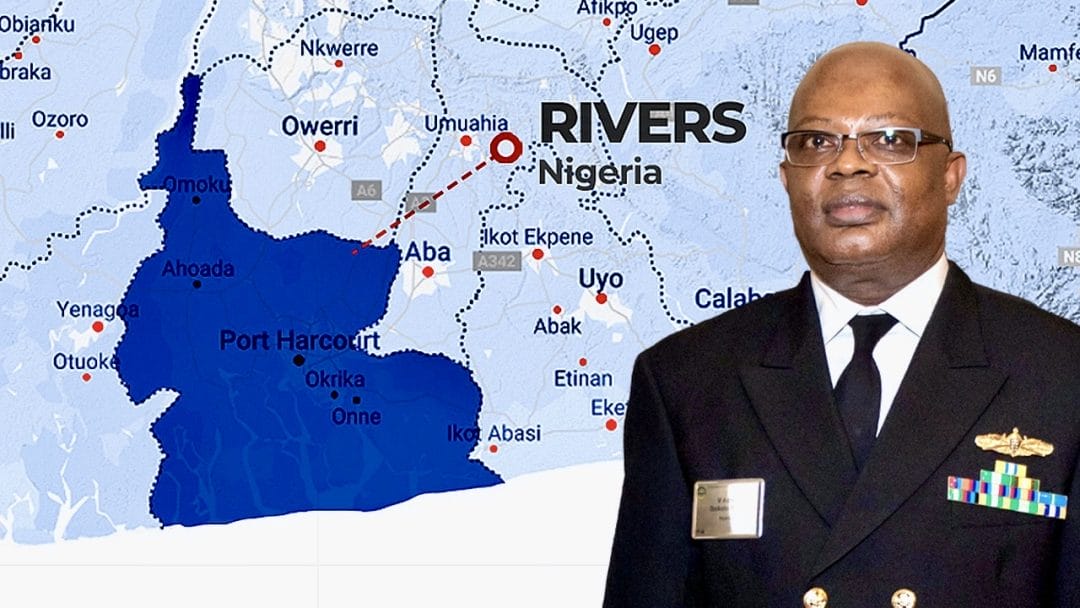
Rivers State, Nigeria, has appointed administrators for its 23 Local Government Areas amidst a state of emergency declared by President Bola Ahmed Tinubu. This move, initiated by Sole Administrator Ibok-Ete Ekwe Ibas, aims to restore governance amid political turmoil and security threats. Critics warn of constitutional implications, while supporters claim it’s necessary for order.
PORT HARCOURT, Nigeria – In a bid to restore order amid escalating political and security turmoil, Rivers State has taken a controversial yet decisive step by appointing administrators for its 23 Local Government Areas (LGAs) under the newly proclaimed state of emergency.
Retired Vice Admiral Ibok-Ete Ekwe Ibas, the Sole Administrator of the state, has overseen the appointments effective from 7 April 2025—a move widely seen as integral to enforcing the emergency measures declared by President Bola Ahmed Tinubu on 18 March 2025.
This bold decision comes at a time when the state is reeling from a constitutional and political crisis that has reached fever pitch. The appointment of LG administrators is not merely a political reshuffle; it is a cornerstone of the state’s emergency strategy aimed at restoring governance and stability amid persistent legal challenges and escalating security threats.
Critics and supporters alike agree that the LG structure is critical for local governance, serving as the primary conduit for implementing state policies and maintaining grassroots order. However, the backdrop of this appointment is anything but routine.
A Federal High Court in Port Harcourt had earlier issued an interim injunction on 28 March 2025, which barred Ibas from making such appointments pending a substantive hearing set for 14 April. Yet, the state’s leadership has pressed ahead, justifying the appointments as a necessary measure to prevent the collapse of local administration in the face of widespread disorganisation.
Central to the controversy is the recent Supreme Court ruling dated 28 February 2025, which nullified the local government elections held on 5 October 2024. This decision left a governance vacuum that the state’s executive sought to fill by installing caretaker administrators.
The Rivers State emergency administration of Vice Admiral Ibas has defended the move as an urgent response to the constitutional crisis, arguing that the state of emergency provides the legal and operational framework to bypass standard electoral procedures in favour of immediate, decisive action.
Proponents contend that the emergency proclamation is not only justified but necessary to re-establish the rule of law and ensure that essential services are maintained during this period of national instability.
Adding a further layer of complexity to the unfolding drama is the threat posed by Ijaw ethnic militant groups. Known for their long history of militancy and demands for resource control, these groups have issued stark warnings that target further disruptions to the state’s oil and gas infrastructure—a sector already reeling from years of neglect.
Their explicit threats to target critical energy installations have intensified the pressure on the state government to act swiftly. The appointment of LG administrators is thus seen as a strategic move to ensure that local governance can more effectively coordinate security responses and manage community-level crises, ultimately safeguarding vital economic assets.
From a constitutional perspective, the situation is fraught with tension. Legal experts warn that the reliance on emergency powers to restructure local government could set a dangerous precedent, potentially eroding the balance of power enshrined in Nigeria’s democratic framework.
However, supporters of the state’s approach maintain that in times of acute crisis, extraordinary measures are required to prevent anarchy and ensure that the state’s administrative machinery remains functional.
As the state braces for the imminent court hearing and navigates a minefield of legal challenges, the coming days are expected to be critical.
The administration’s commitment to reconstituting local government through these appointments is seen as a pivotal step in the broader strategy to counter both political deadlock and emerging security threats.
In a state where every decision carries significant implications, the appointment of LG administrators under the state of emergency stands as a testament to the desperate need for order in a region on the brink of chaos.
- Additional report from Kalada Jumbo, Atlantic Post National Politics Reporter