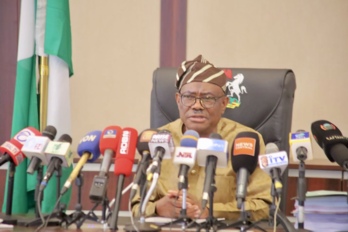
Minister of the Federal Capital Territory, Nyesom Wike, has once again placed Rivers State at the centre of Nigeria’s 2027 political chessboard, insisting that the emerging “rainbow coalition” in the state will calculate its strength area by area and vote accordingly.
Speaking during an inspection of ongoing infrastructure projects in Abuja on Monday, 11 May 2026, Wike said the coalition is not built on sentiment, but on political arithmetic.
“That is the essence of the rainbow coalition in Rivers State. We’ll look at where we have strength, compare notes and vote accordingly,” he said.
The remark is significant because it suggests a hard-nosed alliance model, not a conventional party bloc, in a state where Rivers politics has remained volatile and highly personalised ahead of the 2027 general election.
Wike also moved quickly to shut down speculation linking him to the screening of aspirants in Rivers State by the All Progressives Congress, saying he had no role in the process.
“I’m not a member of the APC, so I don’t know what is happening in their screening. Even if they publish the results, why would I comment? I don’t know the reasons they have,” he said.
He added that he would not speak on matters outside his political sphere, stressing:
“What pertains to me is what I will talk about, not what does not concern me. I’m not a native doctor, neither am I a prophet.”
That dismissal matters because Rivers politics remains tangled in rumours, defections, counter-loyalties and backroom calculations.
At the national level, the opposition’s own 2027 unity push has been weakened after key figures Peter Obi and Rabiu Kwankwaso exited a coalition effort, Reuters reported last week, underscoring how fragile alliance politics has become across Nigeria.
In that climate, Wike’s “rainbow coalition” sounds less like a slogan and more like a tactical response to a fragmented political landscape.
In Rivers, the term itself is loaded. Wike has repeatedly used it to describe a broad-based political arrangement built across party lines, with support drawn from different blocs rather than one rigid structure.
The latest remarks, reported by NAN and The Nation, show that he is still presenting the coalition as a vehicle for competitive strength rather than ideological unity.
His phrasing suggests a plan to identify strongholds, consolidate local influence and convert those pockets into electoral advantage in 2027. That is an inference, but it is a reasonable one given the language he used.
The FCT minister’s Abuja comments were not only about Rivers politics. He also used the tour to praise the pace of work on major infrastructure projects across the capital, saying several schemes lined up for commissioning during President Bola Tinubu’s third-anniversary celebrations were nearing completion.
Voice of Nigeria reported that he inspected key projects including the Jahi–Gwarimpa Interchange, Airport Road–Kuje corridor, Kuje–Gwagwalada road, City Gate project and Wuse/Central Area link roads, while saying contractors had been urged to meet deadlines.
At the Jahi Interchange, Wike said the job was nearing completion and predicted that progress would cross the 95 per cent mark within two weeks.
On the Airport Road to Kuje Junction project, he said the administration expected it to be wrapped up by the end of the month.
He was equally upbeat about the City Gate project, describing it as a landmark development that would change the face of Abuja’s entry point.
“Very good, beautiful work. In the next one month, anyone coming to Abuja will see a different landscape,” he said.
Those remarks fit a pattern. In February, Wike announced a technology-driven plan to tackle streetlight vandalism in Abuja, with new contracts for companies including CCECC and CGC featuring advanced security systems and a centralised monitoring setup.
He said the system would reduce the need for physical guards at every pole and help protect public infrastructure from criminal damage. That earlier policy explanation gives added context to his latest claim that streetlights on some roads would soon be completed.
He specifically said contractors handling streetlight works had promised delivery before the end of May. He identified Green Book and Lubrix on one side, while another project executed by CCCC had already been completed except for the streetlights.
He said the Dutse-Alhaji-to-M5 road was moving steadily and that the contractor had promised to finish the lighting within days.
These details are important because they show that the minister is trying to turn infrastructure delivery into a political proof of competence ahead of the Tinubu administration’s anniversary.
Wike also touched on a more localised governance issue, the complaints about alleged harassment by Abuja Municipal Area Council officials during tax enforcement operations.
He said tax collection remains difficult because many residents resist compliance, but noted that no formal complaint had reached the FCT Administration. NAN quoted him as saying,
“There must be a civilised way of collecting taxes, but knowing our taxpayers, people don’t like to pay tax. When tax collectors come, they find one excuse or the other.”
Taken together, the remarks reveal a politician running two parallel campaigns at once. In Abuja, he is projecting results through roads, bridges, streetlights and revenue enforcement. In Rivers, he is quietly positioning a coalition built on strength, survival and local calculation.
The deeper message is that 2027 is already being fought state by state, bloc by bloc, and Wike clearly intends Rivers to be treated as a strategic battleground rather than a sentimental home front.
That reading is supported by the way he framed the coalition and by the broader national collapse of coalition discipline elsewhere.
What makes the development politically explosive is not just Wike’s confidence, but the ambiguity around who exactly stands where in Rivers politics.
For now, he is refusing to be drawn into APC screening drama, refusing to speculate, and refusing to speak for rivals. Yet by insisting that the rainbow coalition will “look at where we have strength” before voting, he has effectively confirmed that Rivers 2027 is already being mapped with surgical precision.
Follow us on our broadcast channels today!
- WhatsApp: https://whatsapp.com/channel/0029VawZ8TbDDmFT1a1Syg46
- Telegram: https://t.me/atlanticpostchannel
- Facebook: https://www.messenger.com/channel/atlanticpostng