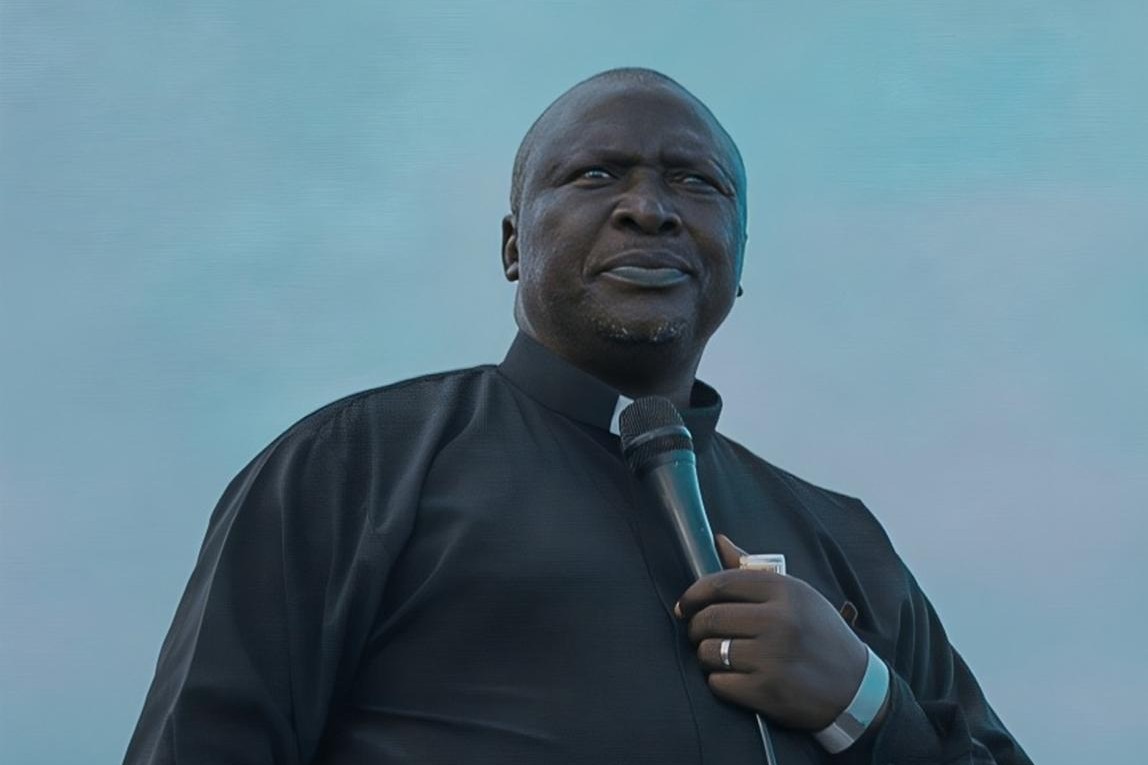
Reverend Ezekiel Dachomo says four more people have been killed near his church, renewing fears over Plateau State’s escalating violence. But with curfews, security deployments and diplomatic engagements yet to guarantee safety for vulnerable communities, a more urgent question confronts Nigeria’s authorities: who is protecting those who survive each attack only to bury their neighbours?
A pastor who should be preparing sermons, comforting grieving families and leading his congregation in worship has found himself performing a different, increasingly unbearable duty: burying the people he was called to protect.
For Reverend Ezekiel Dachomo, Regional Chairman of the Church of Christ in Nations (COCIN), the funerals appear to have become endless.
Days after standing beside a mass grave to mourn members of his congregation killed in an earlier attack, the Plateau-based cleric says another four people have been murdered near his church.
His latest appeal, published on X on Sunday, 1 November, is directed beyond Nigeria’s political leadership. He wants the United States Government and the American people to intervene.
But beneath the emotional appeal lies a much bigger question about Nigeria’s security architecture: how many attacks can communities endure before repeated government assurances translate into actual protection?
“I am heartbroken again. How many more tears must I shed before the world hears our cry?” Dachomo wrote.
He described the latest deaths as another devastating blow to families already struggling with the consequences of recurring violence.
“Four more innocent people have been killed near my church. Four more families have been thrown into mourning. Four more homes have been filled with unbearable silence,” he stated.
The pastor did not identify the victims or specify the precise location, date and circumstances of the latest killings in the post. That information remains important for independent verification and for establishing whether the deaths relate to another recently reported attack in Barkin Ladi.
His message, nevertheless, exposes a disturbing reality in Plateau: the growing insecurity facing communities where ordinary activities, including farming, travelling and attending religious services, can become occasions of mortal danger.
The pastor who fears becoming the next funeral
Dachomo’s statement is particularly striking because it moves beyond the familiar language of condemnation and mourning.
He openly questions whether he will survive the violence.
“And who knows whether I am next?” he asked.
“Who can guarantee that tomorrow I will not be the one lying in a grave while my congregation gathers to mourn me? Who will stand beside my family if the next attack takes my life?”
The questions reveal the psychological consequences of prolonged insecurity, particularly for religious and community leaders who remain physically present among vulnerable populations.
Pastors, traditional rulers and local activists often become the first points of contact for traumatised families following attacks. They help organise burials, communicate with authorities, mobilise relief and document incidents that might otherwise receive little attention.
But these responsibilities can expose them to personal danger.
Dachomo described the contradiction confronting him as a spiritual leader:
“I am a shepherd. My responsibility is to protect, pray for, comfort, and lead my flock. But what happens when the shepherd is constantly forced to bury the very people he was called to care for?”
He added:
“My beloved, I am tired of burying my people. I am tired of seeing innocent blood spilled. I am tired of watching children become orphans and women become widows.”
His words describe more than grief. They capture the gradual erosion of the basic conditions that allow communities to function.
When families fear that their relatives may not return from a journey, when farmers question whether their fields are safe and when worshippers worry about attacks around their places of worship, insecurity begins to dismantle everyday life.
For children growing up in these circumstances, violence risks becoming their earliest understanding of community and belonging.
Four more deaths and an unanswered question
The latest allegation comes against the background of independently reported attacks across Plateau.
On 30 October, Premium Times reported that four people had been killed when gunmen attacked Sabon Angwa community, around Bet/Zat in Barkin Ladi Local Government Area, on Thursday evening, 29 October.
A resident, Bulus Jok, said the attackers struck at approximately 8pm despite the curfew imposed in parts of the state.
“The gunmen struck the community around 8 p.m. despite the curfew in place and started shooting sporadically,” he said.
Jok also alleged that authorities had received an early-warning alert a day before the attack.
“It is very sad, especially as there had been an early warning alert sent to the relevant authorities a day before the attack,” he added.
The Publicity Secretary of the Berom Youth Moulders-Association, Rwang Tengwong, also confirmed the attack and called for a stronger security presence.
Separately, security-focused publication Zagazola Makama reported that four people were killed at an illegal mining site in Ungwan Sabo, Barkin Ladi, on the same date. The report, citing security sources, said troops discovered the victims with gunshot wounds and subsequently launched a manhunt for the attackers.
It is not established whether the Sabon Angwa and Ungwan Sabo reports describe the same incident or whether Dachomo’s latest account concerns another attack altogether.
That distinction matters. The pastor’s post contains no victim identities or location details that would allow the latest deaths to be conclusively matched with either report.
The Plateau State Police Command should therefore provide a clear account of the incident, including the location, identities of the victims, circumstances of the killings and any investigation undertaken.
The absence of precise information should not become another reason for these deaths to disappear into the statistics of Nigeria’s insecurity crisis.
Six killings in Gero expose the wider security problem
The latest distress follows another deadly attack on Gero community in Jos South Local Government Area.
On 27 October, the Plateau State Police Command confirmed that six people were killed when unidentified armed men invaded the community and opened fire on residents.
The police revised an earlier community-reported death toll of seven to six.
Governor Caleb Mutfwang subsequently said investigators had recovered evidence that could help identify and track down the perpetrators.
“This particular attack left some bits of evidence that we are trailing and, by the grace of God, we will continue to pursue these perpetrators of this dastardly act,” the governor said.
He also acknowledged the operational limitations confronting security forces.
“The security forces cannot be everywhere; they can only cover some places. If they get information, they will react, but sometimes the reaction comes late because by the time the information gets to them, it is impossible to have saved the situation,” Mutfwang stated.
The governor’s observation raises a fundamental question about the state’s approach to civilian protection.
While no security force can maintain a permanent presence in every settlement, repeated attacks on vulnerable communities demand a system capable of detecting threats, deploying quickly and preventing assailants from escaping without accountability.
The six deaths in Gero and the subsequent reports from Barkin Ladi suggest that the challenge extends beyond simply deploying more personnel.
It concerns the quality of intelligence, the speed of response, the geographical distribution of security assets and the capacity to prosecute those responsible.
The police confirmed that tactical operatives and mobile personnel were deployed following the Gero attack, while joint operations involving other security personnel were also reported.
Yet the central question remains: why do attacks continue to claim civilian lives in communities that have repeatedly requested greater protection?
Premium Times Nigeria+1
Curfews cannot replace effective security
In September, the Plateau State Government imposed a dusk-to-dawn curfew on Barkin Ladi, Bokkos and Mangu local government areas.
The restrictions, announced on 21 September, prohibited movement between 6pm and 6am until further notice.
The government said the measure was intended to give security agencies the opportunity to stabilise affected communities, protect residents and prevent further violence.
It also directed security personnel to enforce the curfew and banned motorcycle use across the affected jurisdictions.
But the reported attack on Sabon Angwa on 29 October, at approximately 8pm, raises questions about the effectiveness of these restrictions.
A curfew can limit civilian movement, but it cannot independently identify armed groups, intercept attackers, protect isolated settlements or guarantee that emergency calls receive an immediate response.
There is also a cost to residents whose livelihoods depend on evening trading, agricultural activities and movement between communities.
The state’s responsibility is not merely to restrict movement during periods of insecurity. It must demonstrate that those restrictions are accompanied by credible security operations.
More importantly, authorities must explain whether the early warning reportedly received before the Sabon Angwa attack was investigated and acted upon.
Who received the intelligence?
Were security personnel deployed?
Was the information assessed as credible?
Did communication fail between local intelligence sources and operational commanders?
These are questions that deserve formal answers, not another general assurance that the government remains committed to peace.
Ministry of Information+1
Plateau’s violence cannot be reduced to one explanation
The religious dimension of the attacks has become an increasingly prominent feature of international attention, particularly because many affected Christian communities have accused authorities of failing to protect them.
Dachomo’s testimony reflects that concern.
Nevertheless, a comprehensive understanding of Plateau’s insecurity requires examining the wider conflict dynamics rather than automatically attributing every attack to a single religious or ethnic motive.
A January 2026 security assessment by the European Union Agency for Asylum identifies Plateau as a state with more than 40 ethno-linguistic groups.
It describes farmer-herder violence as being driven substantially by competition over resources, while acknowledging that religious differences complicate the conflict because many herders are Muslim and many farming communities are Christian.
The assessment also documents attacks, kidnappings and clashes involving different community actors.
This complexity does not diminish the suffering of Christian victims or excuse targeted attacks on religious communities.
Rather, it reinforces the need for investigations based on evidence, including the identification of individual perpetrators, their networks, motives, weapons and sources of support.
Without credible investigations, communities can become trapped in competing accounts of responsibility, creating fertile ground for retaliation and further violence.
The immediate obligation is to protect civilians regardless of their religion, ethnicity, occupation or political affiliation.
European Union Agency for Asylum+1
The United States is already engaged. Where is the impact?
Dachomo’s appeal to Washington comes at a significant moment in Nigeria’s diplomatic relationship with the United States.
In October 2025, President Donald Trump’s administration designated Nigeria a Country of Particular Concern over religious freedom.
The designation renewed scrutiny of the Nigerian government’s handling of religious violence and created additional pressure for diplomatic engagement.
By August 2026, the United States and Nigeria had held a second session of their Joint Working Group on Nigeria’s designation.
The discussions, hosted by US Under Secretary of State for Political Affairs Allison Hooker and attended by a Nigerian delegation led by National Security Adviser Nuhu Ribadu, focused on three major priorities:
Protecting Christian communities in Nigeria’s Middle Belt, strengthening judicial and security institutions to hold perpetrators accountable, and expanding military-to-military cooperation.
The parties also discussed internally displaced persons returning to their ancestral communities, counter-terrorism prosecutions and efforts to disrupt terrorist financing.
The US identified continuing challenges, including civilian fatalities and gaps in transparency surrounding humanitarian expenditure.
These discussions demonstrate that international engagement on the protection of vulnerable communities is already under way.
The problem is translating diplomatic commitments into measurable improvements for people living in exposed communities.
For Dachomo, meaningful intervention must go beyond statements of concern.
“We are not asking for sympathy alone; we are asking for meaningful intervention to protect innocent lives, strengthen security, support displaced families, and bring those responsible for these killings to justice,” he said.
His appeal offers a practical framework for international assistance.
Washington could work with Nigerian authorities to strengthen intelligence-sharing, improve early-warning systems, support civilian protection initiatives, assist displaced families and enhance investigative and prosecutorial capacity.
Such cooperation must be transparent, consistent with Nigerian sovereignty and focused on protecting civilians rather than escalating communal tensions.
The responsibility for securing Nigerian communities ultimately rests with Nigeria’s government.
Foreign assistance can strengthen that responsibility. It cannot replace it.
The unanswered questions facing Nigeria’s security leadership
There is a growing difference between the official language of security intervention and the lived experiences of residents in Plateau’s vulnerable communities.
In September, the state’s leadership received Inspector-General of Police Olatunji Disu following deadly attacks in Jos South and Mangu.
During the meeting, the governor specifically appealed for the operational activation and deployment of officers to the Mobile Police Barracks in Gashish.
Mutfwang argued that its strategic position could improve security operations across Barkin Ladi, Mangu and Bokkos.
The governor also emphasised the importance of intelligence gathering, community engagement and timely responses to threats.
The Inspector-General assured the state government of cooperation between the police, other security agencies and local communities.
Those commitments are important. But the attacks reported in October demand answers about their implementation.
Has the police barracks been fully activated?
How many officers are stationed in vulnerable communities?
What response procedures exist when residents report armed movements?
How are early-warning alerts transmitted, assessed and acted upon?
Are investigations producing arrests, prosecutions and convictions?
And what protection is available for displaced families who want to return to their homes?
These questions should be answered through documented operational updates, not simply declarations of intent.
A pastor’s warning that Nigeria cannot afford to ignore
For Dachomo, the crisis is becoming increasingly difficult to describe in the language of religious duty.
He has appealed to the United States Government and American citizens to listen to communities that believe they have been abandoned to recurring violence.
He also warned that residents cannot continue waiting helplessly while their families remain exposed.
“Our only option left is to fight for survival,” he declared.
That statement deserves careful attention.
It reflects the desperation of communities living with persistent threats, but it also underlines the danger of allowing insecurity to push civilians towards self-help and armed reprisals.
Nigeria’s authorities must ensure that the demand for survival does not become another cycle of violence.
The country needs credible protection mechanisms, functioning local intelligence networks, rapid deployment capabilities and investigations that lead to justice.
It also needs support for survivors, including displaced families, widows, orphans and people whose livelihoods have been destroyed.
Dachomo has made clear that he intends to continue speaking out despite the risks.
“I WILL KEEP RAISING MY VOICE. I WILL KEEP SPEAKING FOR MY PEOPLE. I WILL KEEP CRYING OUT FOR JUSTICE,” he wrote.
His closing words are perhaps the most revealing.
“Because honestly, I do not know how many more funerals this broken heart can endure.”
For Nigeria’s security leadership, the question is no longer whether Plateau’s communities need more assurances.
They have heard those assurances before.
The test is whether people can sleep in their homes, travel safely, cultivate their farms and worship without wondering whose name will be added to the next burial list.
For the families already grieving, a government promise cannot replace a dead relative.
And for a pastor who says he is tired of burying his congregation, the most meaningful international intervention would be one that makes the next funeral unnecessary.
Follow us on our broadcast channels today!
- WhatsApp: https://whatsapp.com/channel/0029VawZ8TbDDmFT1a1Syg46
- Telegram: https://t.me/atlanticpostchannel
- Facebook: https://www.messenger.com/channel/atlanticpostng
Join the debate; let’s know your opinion.