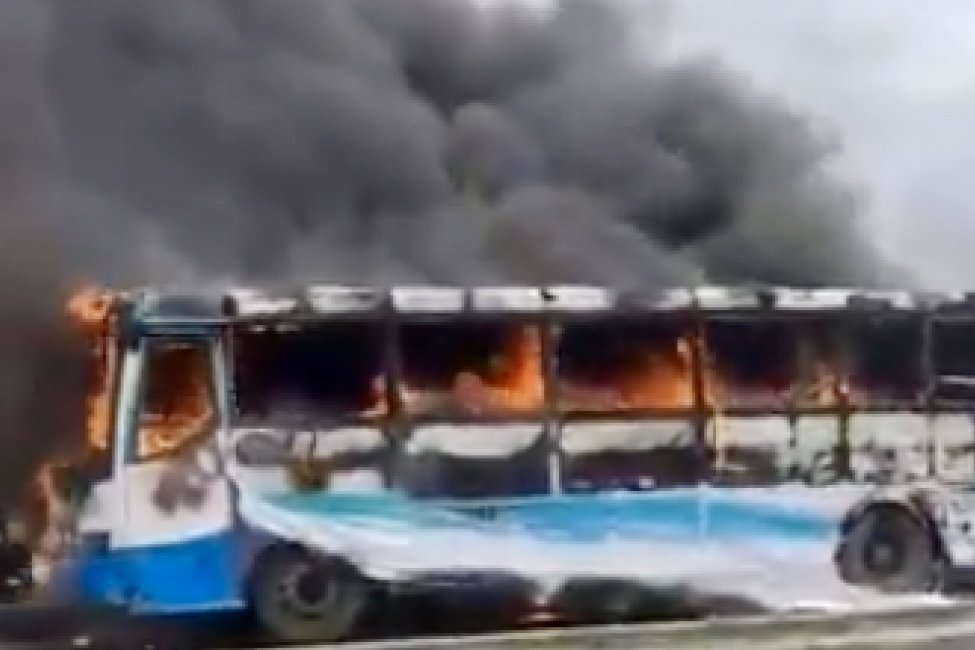
One person is dead, panic has spread across the corridor, and families are scrambling for answers after a fresh night-time attack on travellers deepens fears that Oyo’s highways are being surrendered to armed gangs.
Fear has gripped Oyo State once more after suspected bandits reportedly attacked travellers along the Ibadan–Ijebu Expressway on the evening of Friday, April 18, 2026, leaving one person dead and forcing a wave of confusion over how many people may have been taken.
What is clear is that the road was breached again. What remains disputed is the full scale of the attack. Eyewitness accounts said several travellers were abducted. Police sources, however, have pushed back against that version, insisting the incident was an attempted kidnapping in which no confirmed abduction has yet been established.
That contradiction has only deepened public alarm.
For commuters, the difference between “attempted” and “successful” means little when bullets have been fired, a life has been lost, and families are left making frantic calls to trace relatives who may have passed through the corridor at the wrong time. In road security terms, the psychological damage is already done.
Residents say the attack again exposed how vulnerable the Ibadan–Ijebu axis has become, especially after dark, when long stretches of forest-adjacent road create ideal hiding places for armed groups. The expressway, once treated as a routine commercial corridor, is now being spoken of in the language of fear, caution and survival.
The latest incident lands at a time when Oyo State is already under pressure over a string of violent attacks targeting farmers, forest guards and road users.
In March, armed men reportedly emerged from nearby bushland and abducted four cocoa farmers around the Cocoa Research Institute of Nigeria area in Idi-Ayunre, Ibadan. One victim escaped, and the police later said another was rescued while a vehicle was recovered. The attack reinforced the growing sense that rural and semi-rural parts of the state are increasingly being tested by violent criminal networks.
Earlier, in January, Governor Seyi Makinde confirmed the killing of five National Park Service forest guards in an attack at Oloka Village. He described the killings as criminal and mourned the men who died while carrying out official duties. The state government later faced pressure to explain what more could be done to secure forest edges, border routes and vulnerable communities.
The pattern is becoming too obvious to ignore.
From highways to forest belts, Oyo has seen repeated assaults in locations where commuters, farmers and security personnel should have been protected by visibility, patrols and intelligence. Instead, the same kinds of ambushes keep reappearing, suggesting a widening gap between the threat on the ground and the state’s ability to contain it.
This is why the Ibadan–Ijebu attack matters beyond one road.
It speaks to a larger insecurity problem in which armed actors appear to exploit isolated roads, weak night-time surveillance and the slow arrival of emergency response teams. It also raises questions about how much real-time intelligence is reaching the authorities before these attacks happen, and whether more manpower alone can solve a problem that now seems organised, mobile and adaptive.
For travellers, the fear is brutally simple. Any night journey can turn into a gamble.
For families, the fear is even worse. One phone call unanswered, one delay on the road, one missing bus, and a routine movement becomes a search for a loved one in a state of uncertainty. That emotional trauma is now part of the security cost of moving across Oyo.
Officials will now be expected to clarify whether the attack ended in an abduction, how many vehicles were involved, what immediate response was deployed, and whether the corridor has any sustained security cover at all. Anything less will only reinforce the perception that security is arriving after the harm has been done.
The central truth is uncomfortable. Oyo’s major travel routes are beginning to look less like public infrastructure and more like vulnerable territory. Until that changes, every fresh attack will keep feeding the same public verdict: the state is still chasing the crisis, not controlling it.
And for the people who must travel that road tonight, tomorrow or next week, the question is no longer whether another strike is possible. It is whether help will arrive before the next one ends in blood.
Follow us on our broadcast channels today!
Facebook: https://www.messenger.com/channel/atlanticpostng
WhatsApp: https://whatsapp.com/channel/0029VawZ8TbDDmFT1a1Syg46
Telegram: https://t.me/atlanticpostchannel