Osun State has emerged as the most recent site of deadly unrest in a display of political slaughter that has rocked Nigeria. In a savage altercation between members of the Peoples Democratic Party (PDP) and the All Progressives Congress (APC), Mr. Aderemi Abbas, the former chairman of the Irewole Local Government Area, and six other people were shot dead in what can only be called a planned massacre.
Both citizens and political analysts are in shock over the extent of the violence in the deadly altercation, which was started by a controversial Court of Appeal decision that purportedly reinstated fired APC-elected local government officials.
A Fractured Political Landscape
For decades, Nigeria’s political theatre has been marred by partisan rivalries and power struggles, but the current debacle in Osun State represents an alarming escalation. The ruling has sent shockwaves across the region, with allegations flying thick and fast.
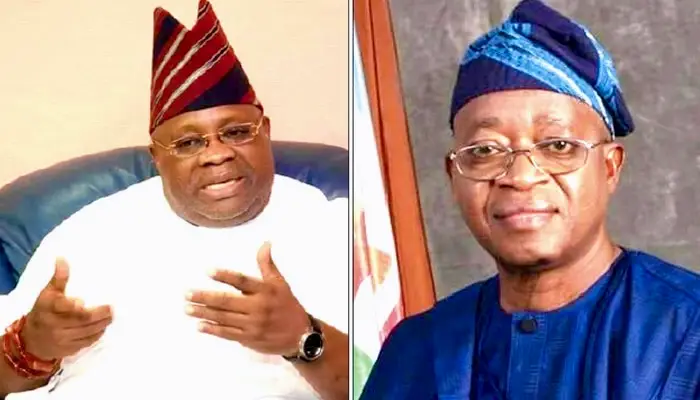
On one side, Governor Ademola Adeleke has decried a nefarious conspiracy—blaming Minister of Marine and Blue Economy, Gboyega Oyetola, and certain high-ranking security officials for masterminding the reinstatement of these controversial officials. His call for accountability resonates with an electorate tired of political theatre masquerading as governance.
Opposing this narrative, proponents within the APC assert that the court’s decision was both lawful and necessary, insisting that the reinstated officials were democratically elected. However, as the events of Monday unfolded, the stark reality of political violence laid bare the dangerous consequences of such legal ambiguities.
The Day of Reckoning
At the heart of the carnage was a series of coordinated assaults on local government secretariats across multiple Local Government Areas (LGAs) including Ikire, Iragbiji, Isokan, Olaoluwa, and Olorunda.
In a short, harrowing video clip that quickly went viral, Mr Abbas was seen lying in a pool of blood, his lifeblood seeping onto cold concrete—a chilling testament to the brutality unleashed by partisan militias.
Eyewitnesses recounted scenes of relentless gunfire, savage machete attacks, and the deliberate smashing of mobile phones by hoodlums determined to erase any record of the unfolding chaos.
What initially began as a legal dispute over the reinstatement of local government officials spiralled into a full-blown massacre. Supporters of both the APC and the PDP were reported to have taken to the streets armed to the teeth, engaging in what can only be described as an orchestrated rampage.
In some areas, the violent confrontations led to immediate casualties, while in others, sporadic clashes left scores injured. The brutality was not confined solely to the political elites—the indiscriminate nature of the violence has left innocent bystanders caught in the crossfire.
Law Enforcement Under Siege
In response to the escalating bloodshed, the Inspector-General of Police, Kayode Egbetokun, deployed additional tactical squads to Osun State. The police force’s stern statement condemned the violence as “an affront to democracy and public safety,” promising to track down and prosecute all perpetrators.
Yet, critics argue that the response has been too little, too late. Several reports have emerged suggesting complicity—or at the very least, gross negligence—on the part of certain security agencies, with accusations that some personnel may have actively supported the violent incursions.
The deployment of tactical squads, while a welcome measure, has not assuaged fears among residents who now find themselves living amidst an atmosphere of terror and uncertainty.
In neighbourhoods around local government secretariats, the palpable tension is a daily reminder of the precarious state of law and order in Osun. As one resident lamented, “Our streets are no longer safe; we are at the mercy of men wielding guns and machetes, all for political gain.”
Political Blame Game and Legal Conundrums
At the heart of the crisis lies a perplexing legal dilemma. The Court of Appeal ruling, which ostensibly reinstated sacked APC-elected local government officials, has been interpreted in vastly different ways by the opposing parties.
The PDP maintains that the ruling did not, in any way, order the reinstatement of these officials, a view supported by the fact that the ruling did not contain a consequential order for such an action.
In contrast, the APC insists that the prayer submitted to the court did indeed seek, and thus implicitly guarantee, the return of the sacked officials to their offices.
This interpretative chasm has become a dangerous flashpoint. With no clear legal mandate, both parties have exploited the ambiguity to pursue their own agendas, effectively transforming a judicial pronouncement into a trigger for violent confrontation.
The situation is further complicated by allegations that security agency heads, whose duty is to maintain order, might be embroiled in the political machinations—either through active participation or willful inaction.
Political Rhetoric and the Culture of Violence
It is not just the law that is under siege in Osun; the very fabric of political discourse is being stretched to its breaking point. Governor Adeleke’s pointed accusations against Minister Oyetola and certain security chiefs have ignited a firestorm of rhetoric that has only served to inflame passions on both sides.
In his address, Adeleke urged the public to hold these figures accountable, warning that any attempt to manipulate the judiciary for partisan gain would be met with unyielding opposition.
The rhetoric has reached fever pitch, with prominent figures from both parties using the crisis to score political points. Notably, Afrobeats star Davido, a nephew of Governor Adeleke, took to social media to lambast the Osun State Commissioner of Police in a series of fiery tweets, reflecting the deep-seated anger and frustration simmering beneath the surface of Nigeria’s political landscape.
Such incendiary comments only serve to underscore the volatile mix of politics, violence, and impunity that currently plagues the region.
The Human Cost
Beyond the political and legal quagmire, the human cost of this crisis is immeasurable. Families have been shattered, lives brutally cut short, and a community’s trust in the institutions of governance deeply eroded.
The loss of Mr Abbas, a man who once served his community as a democratically elected chairman, is a stark symbol of what has been sacrificed at the altar of political ambition.
His death, along with the others who fell victim to the violence, is a grim reminder that behind every headline, there is a personal tragedy—a life undone by a system that has failed its people.
Local government areas such as Irewole, Boripe, and Isokan are now synonymous with loss and chaos. The violent encounters have not only disrupted civic administration but have also instilled a pervasive sense of fear.
With local government offices reduced to battlegrounds, citizens are left questioning the very foundations of democracy and the rule of law in their state.
The Call for National Intervention
In a desperate bid to restore order, members of the Osun State National Assembly Caucus have called on President Bola Ahmed Tinubu to intervene immediately. Their plea is not merely for political expediency—it is a clarion call for the restoration of law and order in a state teetering on the brink of anarchy.
The lawmakers have urged that the National Security Adviser and the Attorney General of the Federation issue a stern warning to those responsible for inciting violence, signalling that the federal government will not tolerate this blatant disregard for democratic norms.
Their message is clear: the current state of affairs in Osun is not an isolated incident, but a symptom of a broader malaise—a dangerous precedent that threatens the integrity of Nigeria’s democratic institutions.
Conclusion: A Nation at a Crossroads
As Osun State grapples with the aftermath of a court ruling turned bloodbath, Nigeria finds itself at a critical juncture. The violent clashes between APC and PDP supporters are not merely the result of legal ambiguity but are indicative of a deeper, more systemic failure—a failure of leadership, of security, and of the very democratic process.
With the death toll rising and political tensions mounting, the nation stands witness to a tragic chapter in its turbulent history.
In these dark times, the need for accountability, transparency, and true democratic governance has never been more urgent. It is incumbent upon all stakeholders—from political leaders to security agencies—to restore not only order but also the public’s faith in the institutions that are meant to safeguard the nation.
Until then, Osun State will remain a stark reminder of the perils of unchecked political ambition and the high price of a fractured society.
Atlantic Post remains committed to delivering incisive, balanced, and comprehensive reporting on these issues. We will continue to follow this story closely as it develops, holding those in power to account and shining a light on the dark corners of Nigeria’s political landscape.
Published by Atlantic Post – Your trusted source for in-depth political and law enforcement analysis in Nigeria.
- Additional report by: Osaigbovo Okungbowa, Atlantic Post Senior Political Correspondent.



