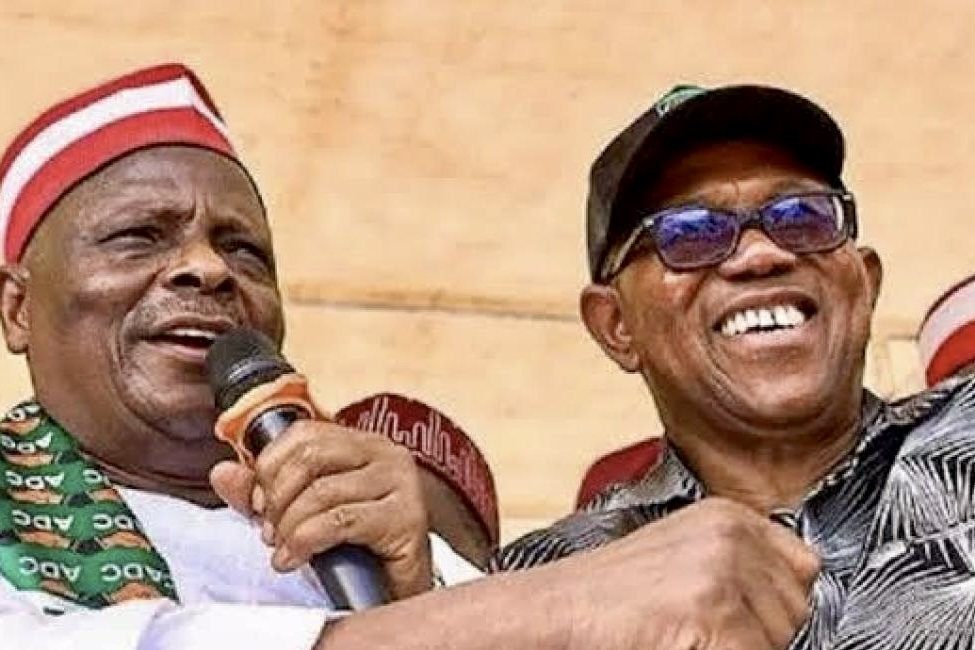
The latest political bombshell in Nigeria’s fast-approaching 2027 race is not just that Peter Obi has again been linked to a one-term presidency pledge. It is that Rabiu Musa Kwankwaso, the vice-presidential candidate of the Nigeria Democratic Congress (NDC), now says the arrangement was not verbal politicking but a written agreement signed by both men.
That claim, if taken at face value, turns a campaign talking point into a formal political compact and instantly raises questions about trust, strategy, zoning and the real fragility of the opposition’s unity push.
Kwankwaso made the disclosure during a Channels Television appearance, insisting that the understanding was documented in two separate forms: one between the pair and another involving the party.
“We are all gentlemen, even though we have accepted to put it on paper,” he said, according to TheCable and Vanguard’s reports of the interview.
He added that the arrangement was part of a broader political design in which power would return to the North after a single four-year southern presidency.
What makes the statement politically explosive is not simply the paper trail. It is the implication that opposition leaders are already bargaining over the shape of power beyond 2027 while still trying to convince voters that their present coalition is solid.
Kwankwaso said he believed Obi would honour the pledge, describing him as serious, trustworthy and a politician with Nigeria’s interest at heart. “I personally believe him… I don’t think he will change his mind when the time comes,” he said.
The twist is that Obi has repeatedly said he would serve only one term if elected president in 2027. TheCable reports that he has framed the promise as a matter of zoning, national stability and fairness, not a desire to cling to office.
Vanguard similarly reported that Obi had declared: “I want to be a one-term president because of stability.” In that sense, Kwankwaso’s latest comments do not so much introduce a new position as confirm and weaponise an old one within the opposition’s bargaining structure.
That is where the real investigation begins. The one-term pledge is being sold as a bridge: South first, North later. Kwankwaso told reporters that after four years, “it comes back to the North,” presenting the pact as a national balancing act rather than a personal concession.
But in Nigeria’s political history, zoning arrangements often become vulnerable the moment power is won, because ambition, survival and elite pressure have a way of rewriting “gentlemen’s agreements” faster than they are signed.
The backdrop matters just as much as the pact itself. In May 2026, Reuters reported that Obi and Kwankwaso had quit an ADC-led opposition alliance after legal wrangles and internal divisions, with analysts warning that the split could fracture the anti-Tinubu vote.
Reuters quoted observers who said the opposition agreement was “on life support” and that the feared scenario was a fragmented field that would cannibalise its own votes. Against that history, Kwankwaso’s announcement reads less like a victory lap than an attempt to stitch together a coalition that has already shown visible seams.
There is also the constitutional reality. Whatever political promises the opposition signs, they do not replace the rules of office. Reuters reported in May 2025 that Nigerian presidents are limited to two four-year terms.
A one-term pledge is therefore not a legal ceiling but a political promise, and its force depends entirely on trust, party discipline and the pressure of public opinion.
That distinction is important, because the electorate may hear “written agreement” and assume enforceability where, in practice, there is only political morality and campaign leverage.
Kwankwaso’s comments also reveal how much the 2027 contest is already being framed around voter psychology. He said their supporters are not people driven by handouts but by conviction and vote protection.
That is a direct attempt to contrast the coalition’s self-image with the money-and-structure politics that dominate many Nigerian elections. Yet the statement also exposes the opposition’s biggest weakness: conviction is not the same as cohesion, and passion does not automatically become a winning national machine.
For the ruling APC, the story is politically useful even before any rebuttal is issued. It allows the government camp to portray the opposition as an alliance already pre-negotiating its exit strategy, while Tinubu’s side can present itself as the more stable, better-organised machine.
Reuters noted earlier that Tinubu won 2023 with about 35 per cent of the vote while opposition candidates collectively secured roughly 60 per cent, which is precisely why a united ticket is so attractive to the opposition — and why a public disagreement, however small, could be fatal.
The larger question is whether this pact strengthens Obi and Kwankwaso or merely gives their critics a cleaner target. If the agreement exists as described, it may help reassure supporters who fear ego-driven splits. But it also hands opponents a simple line of attack: that the coalition is not yet united around governance, only around a temporary truce.
In Nigeria’s 2027 chessboard, that is not a trivial distinction. It is the difference between a disciplined opposition and a coalition that is already negotiating its own future collapse.
Facebook virality cue: Meta says Facebook ranking is now driven by AI systems, thousands of signals, recent interactions, authenticity, and a stronger push for original content, while spammy or copied posts are deprioritised. Political content is also being personalised more selectively, which means the strongest posts are the ones that feel native, spark real argument, and avoid obvious engagement bait.
Social media feed post:
A written one-term pact may sound like unity, but in Nigeria’s 2027 power game it could become the opposition’s biggest trap. If Obi and Kwankwaso cannot hold one agreement, what exactly are they asking voters to trust? #PeterObi #Kwankwaso #OneTermPact