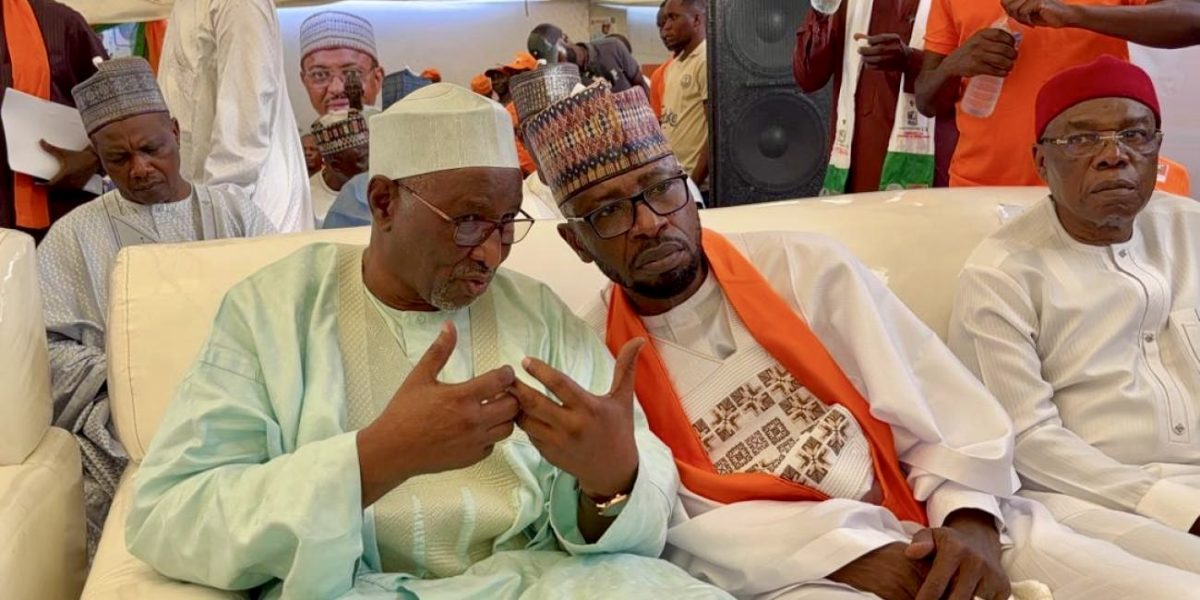
The former Obidient Movement coordinator has promised a nationwide grassroots mobilisation drive for the SDP. But with 66 days until Nigeria’s presidential election, the party must prove that political networks, organisational strength and internal unity can translate into electoral votes.
Tanko’s SDP Move Puts Nigeria’s 2027 Grassroots Test in Focus
ABUJA, Nigeria — Yunusa Tanko has entered the Social Democratic Party’s (SDP) 2027 presidential campaign with an ambitious promise: take the party’s message to every corner of Nigeria, build a nationwide grassroots structure and convert public dissatisfaction into electoral victory.
His appointment as National Coordinator of the SDP Presidential Campaign Organisation places a familiar figure from Peter Obi’s political mobilisation machinery at the centre of another opposition campaign.
But his arrival raises a question that could prove more significant than the appointment itself.
Can Tanko transfer the organisational experience he gained in the Obidient Movement into a different political platform, or will he discover that political followership cannot simply be transferred from one party to another?
At Wednesday’s inauguration of the SDP Presidential Campaign Organisation in Abuja, Tanko described his appointment as a responsibility requiring sacrifice, discipline, inclusiveness and national commitment.
He promised to establish a coordinated structure covering the national, state, senatorial, local government, ward and polling-unit levels.
“We will come to your doorsteps.
“We will mobilise Nigerians from ward to ward and zone to zone, register supporters on our database and establish structures that will deliver the campaign,” he declared.
The language was unmistakably grassroots-focused. Rather than relying exclusively on rallies, political advertising and prominent endorsements, Tanko is promising to build a network capable of identifying supporters, maintaining contact with them and organising their participation in the electoral process.
It is an important distinction.
Winning elections requires more than attracting attention. It requires converting political enthusiasm into organised participation, voter turnout and properly managed election-day operations.
For the SDP, Tanko’s success will ultimately be measured by whether he can deliver those results.
What Really Happened Between Tanko and Peter Obi?
The description of Tanko’s departure as simply dumping Peter Obi does not adequately explain the sequence of events.
His political relationship with Obi developed over several years, particularly during the 2023 presidential campaign, when he served as spokesman and media director of the Labour Party Presidential Campaign Organisation.
In September 2024, Obi appointed him National Coordinator of the Obidient Movement worldwide.
However, the relationship entered a new phase on October 1, 2026, when Obi announced his removal as national coordinator and appointed him Political Adviser for Northern Nigeria.
The change came ahead of the 2027 elections, with Dr Moses Paul taking over the Obidient Movement coordination role.
Tanko subsequently resigned as Obi’s Northern political adviser on October 30, less than a month after accepting the appointment.
At Wednesday’s SDP inauguration, he confirmed:
“I tendered my resignation on the 30th of October 2026 as the political advisor to His Excellency Mr Peter Obi, to represent Northern Nigeria.”
He also disclosed that he had reached out to Obi and Senator Seriake Dickson, the National Leader of the Nigeria Democratic Congress (NDC).
His explanation centred on his return to the National Consultative Front (NCFront), an organisation he helped establish.
Tanko said he assumed a leadership responsibility in the NCFront on October 18, following the death of its former co-chairman, former House of Representatives Speaker Ghali Na’Abba, who had co-led the organisation with Professor Pat Utomi.
He described the new assignment as an opportunity to return to a political platform he had helped build.
He also emphasised his longstanding relationship with SDP presidential candidate Adewole Adebayo, saying their political association dated back to 2023.
The distinction matters. Tanko has not publicly accused Obi of wrongdoing or attributed his resignation to a political disagreement. His reported explanation was that he was returning to the NCFront and accepting a different political responsibility.
There is also an important correction to the original political framing. Obi contested the 2023 election under the Labour Party, but INEC’s published 2027 candidate list identifies him as the presidential candidate of the NDC.
Tanko’s departure is therefore best understood as another shift in an evolving opposition landscape, rather than evidence of a publicly established confrontation between two political figures.
The 12,000-Member Question: Structure or Political Spectacle?
One of the most significant developments surrounding Tanko’s appointment is the SDP’s inauguration of a reported 12,000-member Presidential Campaign Council.
The party’s National Chairman, Professor Sadiq Gombe, will also chair the council.
Gombe urged members to pursue an issue-based and people-centred campaign, warning against violence, intimidation and electoral malpractice.
“Our campaign must be issue-based, people-centred and firmly rooted in the provisions of the Constitution of the Federal Republic of Nigeria, the Electoral Act, INEC Guidelines and our party constitution,” he said.
He added:
“We must earn the confidence of Nigerians through credible engagement, persuasion, effective organisation and practical policy alternatives.”
The chairman identified insecurity, economic hardship, unemployment, poverty, institutional weaknesses and declining public confidence in governance as major national challenges.
These are issues with considerable electoral significance.
Yet the reported 12,000-member council raises an important organisational question.
How many of those members will actually be responsible for voter mobilisation at the grassroots?
Nigeria’s electoral structure is extensive. INEC’s polling-unit directory identifies 176,846 polling units and 8,809 registration areas, commonly organised as electoral wards, nationwide.
A 12,000-member national campaign council is a substantial political formation, but the number alone does not establish operational coverage of the country’s polling units.
The SDP would need to demonstrate how its national, state, local government and ward structures will work together, who will coordinate individual areas and how supporters will be identified and retained.
It would also need reliable funding, communication systems, transport arrangements, campaign materials and election-day monitoring.
Without those elements, a large campaign council risks becoming another political gathering whose numerical strength is more impressive on paper than at the ballot box.
The Campaign Clock Is Already Running
Time is another challenge.
INEC has scheduled Nigeria’s presidential and National Assembly elections for January 16, 2027. Governorship and State House of Assembly elections will follow on February 6.
The presidential campaign period officially commenced on August 19, 2026, and is scheduled to end on January 15, 2027, one day before the presidential election.
With Tanko’s appointment announced on November 11, only 66 days remain before Nigerians vote.
This means the SDP is entering a critical stage of the campaign.
The party cannot afford to spend the remaining weeks merely announcing structures and introducing coordinators. It must demonstrate that its organisation is already functioning.
The difference between a political movement and an effective electoral machine is measurable.
A functioning campaign knows its target communities, understands local concerns, maintains contact with supporters and has people capable of coordinating its activities at the polling-unit level.
It also knows how to communicate a political programme in ways that connect with different communities.
Tanko’s proposal to register supporters on a central database is therefore potentially significant. Properly managed, such a database could help the party identify its supporters, coordinate volunteers and measure mobilisation efforts.
But its effectiveness would depend on credible data, adequate funding and sustained grassroots engagement.
SDP’s Internal Disputes Present Another Challenge
Perhaps the most important complication facing the party is not organisational but political.
INEC’s publicly available political-party directory identifies Professor Sadiq Umar Abubakar Gombe as the SDP National Chairman.
Its updated presidential candidate list, published on October 31, also identifies Adewole Ebenezer Adebayo as the party’s presidential candidate, with Usman Muhammed Bugaje as his running mate.
Those are the electoral records relevant to the campaign inaugurated on Wednesday.
However, a separate platform presenting itself as the SDP’s official website has issued statements supporting the leadership of former chairman Shehu Musa Gabam.
It also claims that Adebayo was expelled following the party’s May 20, 2026 National Executive Committee meeting and convention, insisting that he was never validly nominated as its presidential candidate.
In an August 12 statement, the Gabam-aligned platform said the Court of Appeal had set aside a Federal High Court judgment over jurisdictional issues and had not determined who should lead the party.
These are claims by a competing party leadership grouping, not a substitute for INEC’s published electoral records.
Nevertheless, the conflicting positions expose a serious political challenge.
The SDP cannot effectively present itself as a united national alternative while competing leadership claims and disagreements over its presidential candidate remain part of its public image.
For Tanko, the task may therefore extend beyond mobilising voters.
He must help build confidence in the campaign’s leadership, political direction and institutional authority.
A grassroots organisation needs more than enthusiastic supporters. It requires a leadership structure that can speak with one voice and maintain discipline across its political hierarchy.
The Obidient Experience Is an Advantage, Not a Guaranteed Asset
Tanko brings political experience that could be useful to the SDP.
He previously worked in presidential politics, served as chairman of the Inter-Party Advisory Council in 2015 and contested the 2019 presidential election under the National Conscience Party.
His experience with the Obidient Movement also exposed him to an extensive mobilisation effort that attracted national attention during the 2023 elections.
But there is a fundamental distinction between coordinating a political movement and delivering votes for a different presidential candidate.
The Obidient Movement developed around Obi’s political identity, his message of political change and the expectations of supporters who believed in his candidacy.
Those supporters are not automatically transferable to the SDP simply because a former coordinator has accepted a new appointment.
Some may be willing to follow Tanko. Others may remain committed to Obi, while many may evaluate the new political arrangement independently.
The SDP must consequently build its own relationship with voters rather than assume it has inherited another politician’s political capital.
Tanko appears conscious of the scale of the challenge.
He described the SDP as a left-wing, people-oriented party, saying:
“The SDP represents those people that you neglect on the streets.”
The statement is an attempt to define the party through the concerns of ordinary Nigerians rather than its political personalities.
But that message will require practical substance.
Voters struggling with insecurity, unemployment, poverty and economic hardship will want to know what the party intends to do differently, how its proposed policies will be financed and whether its candidates possess the capacity to implement them.
Political language alone will not answer those questions.
A Personal Commitment Meets a National Political Test
Beyond the organisational promises, Tanko offered a personal explanation for his continued involvement in Nigerian politics.
He recalled how members of his family questioned why he remained politically active despite having opportunities to pursue a more comfortable life.
He said his associates had suffered serious consequences during their political struggles. Some, according to him, had lost their lives, while others sustained physical and psychological injuries.
Yet he maintained that his commitment to Nigeria remained unchanged.
“Nigeria gave me life because I was born here. Nigeria gave me education, my children and the opportunity to relate with people across different identities. That is why I remain committed to the country,” he said.
His remarks presented politics as a national responsibility rather than simply a competition for public office.
He also called for national reconciliation, justice, equity, good governance and unity across religious, ethnic and political differences.
Those principles are important in a country where political divisions frequently undermine efforts to establish common national priorities.
But the SDP must demonstrate that its own conduct reflects the values it intends to promote.
Tanko’s immediate challenge is to transform those principles into an effective campaign.
His experience gives him a starting point. His political connections offer access to established networks, and the new campaign council provides an organisational platform.
What remains uncertain is whether those advantages can be converted into a coherent nationwide structure capable of competing against better-established political organisations.
For Nigeria’s opposition, the 2027 election will not be won by appointment announcements, impressive membership figures or promises of door-to-door mobilisation alone.
It will be won by the ability to build trust, communicate credible alternatives, organise supporters and persuade Nigerians to turn out and vote.
Tanko has promised to come to the people’s doorsteps. The more consequential question is whether the SDP can give those people a compelling reason to open the door.
Follow us on our broadcast channels today!
- WhatsApp: https://whatsapp.com/channel/0029VawZ8TbDDmFT1a1Syg46
- Telegram: https://t.me/atlanticpostchannel
- Facebook: https://www.messenger.com/channel/atlanticpostng

Join the debate; let’s know your opinion.