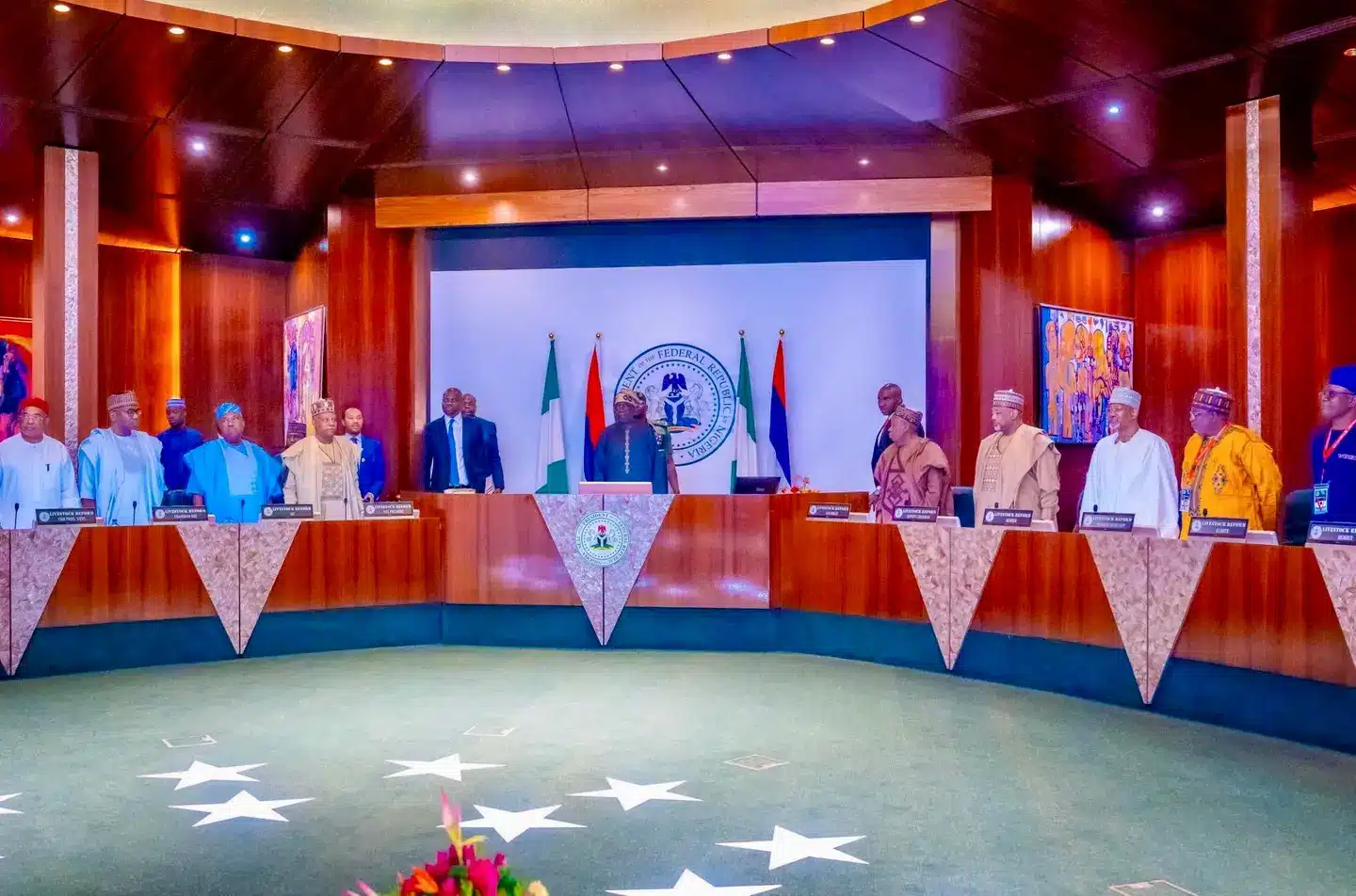
Nigeria’s gross statutory revenue surged by N622.1 billion in January 2025, with the Federation Accounts Allocation Committee allocating N1.703 trillion among the Federal Government, states, and local government councils. This in-depth report analyses the revenue surge, policy implications, and the contentious dispute over NNPCL’s remittances.
ABUJA, Nigeria — In a dramatic display of fiscal dynamism, Nigeria’s gross statutory revenue soared by N622.125 billion in January 2025, reaching an impressive N1.848 trillion compared to N1.226 trillion in December 2024.
The Federation Accounts Allocation Committee (FAAC), during its February 2025 meeting in Abuja, unveiled this seismic shift in revenue collection—a development that not only promises to reshape the nation’s financial landscape but also intensifies the long-standing tussle over revenue sharing between the Federal Government, states, and local government councils.
An Explosive Increase in Revenue: Breaking Down the Numbers
The numbers, as released by FAAC, tell a story of both opportunity and contention. With a total gross revenue of N2.641 trillion available in January 2025, several deductions and adjustments were made—N107.786 billion earmarked for the cost of collection and N830.663 billion for transfers, interventions, refunds, and savings.
The remaining pool of funds, totalling N1.703 trillion, was distributed among the Federal Government (N552.591 billion), state governments (N590.614 billion), and local government councils (N434.567 billion).
This robust pool was not a monolithic sum but a composite of diverse revenue streams:
- Distributable Statutory Revenue: N749.727 billion
- Distributable Value Added Tax (VAT) Revenue: N718.781 billion
- Electronic Money Transfer Levy (EMTL) Revenue: N20.548 billion
- Augmentation: N214 billion
Each component brings its own set of implications. For instance, VAT revenue witnessed a remarkable climb, with available funds reaching N771.886 billion—an increase of N122.325 billion compared to December 2024.
Such a surge underscores the government’s expanding tax base and the effectiveness of collection measures, albeit amidst concerns of over-reliance on indirect taxes.
The Economic Implications: A Double-Edged Sword
From an economist’s standpoint, this surge in statutory revenue is both a boon and a potential bane. On the one hand, the influx of funds presents a golden opportunity for infrastructural development, improved public services, and fiscal consolidation.
The rising VAT and statutory revenue signal enhanced economic activity, which could drive investment and spur growth. Moreover, the significant allocations to state and local governments suggest a deliberate attempt to empower regional administrations and foster a more balanced development across the federation.
However, the devil lies in the details. The dramatic increase in revenue comes on the back of substantial augmentation and heightened tax levies, including Petroleum Profit Tax (PPT), Companies Income Tax (CIT), Excise Duty, Import Duty, and CET levies.
While these measures may have filled the coffers in the short term, there is a growing concern that such heavy reliance on tax hikes could stifle private sector dynamism and dampen investor confidence.
Critics argue that without corresponding structural reforms, the fiscal expansion could lead to inflationary pressures and an uneven burden on citizens, particularly in a country where income disparities are already pronounced.
The NNPCL Controversy: A Rift in the Fiscal Fabric
No revenue report of this magnitude is without its controversies. The FAAC communiqué revealed that the February 2025 meeting was delayed due to disagreements centred on the alleged failure of the Nigerian National Petroleum Company Limited (NNPCL) to remit revenues amounting to an estimated N1.7 trillion from November 2024.
This issue, which emerged in the wake of the complete removal of the petrol subsidy, has ignited fierce debates among policymakers, industry stakeholders, and political commentators alike.
The petrol subsidy removal was heralded as a necessary economic reform aimed at curbing fiscal waste and fostering market efficiency. Yet, the NNPCL’s purported non-remittance has exposed fissures within the country’s revenue collection mechanisms and raised questions about accountability and transparency in the oil and gas sector.
This controversy not only undermines public confidence in state-run entities but also puts added pressure on the Federal Government to enforce stricter compliance measures.
In the long run, persistent discrepancies of this nature could derail Nigeria’s ambitious plans for economic transformation, fuelling further debates on the optimal balance between market liberalisation and state intervention.
Fiscal Federalism Under the Microscope
The revenue allocations for January 2025 shed light on the perennial challenges of fiscal federalism in Nigeria. With the Federal Government receiving N552.591 billion, state governments N590.614 billion, and local government councils N434.567 billion from the distributable revenue, the distribution formula has long been a bone of contention.
Proponents of a more decentralised fiscal architecture argue that increased revenue allocations to states and local governments are vital for addressing regional disparities and promoting grassroots development.
Critics, however, warn that such allocations may encourage fiscal profligacy and undermine national economic cohesion if not managed prudently.
The detailed breakdown of distributable statutory revenue further accentuates these debates. For instance, while the Federal Government received N343.612 billion from the N749.727 billion statutory revenue pool, states and local governments garnered N174.285 billion and N134.366 billion respectively, with an additional N97.464 billion shared as derivation revenue—a fixed 13 percent of mineral revenue.
Similar allocations from VAT revenue reveal an intricate web of fiscal relations that underscore the complexities of managing a resource-rich yet economically diverse nation.
These intricacies demand a reassessment of revenue-sharing formulas to ensure that fiscal decentralisation does not compromise overall economic stability.
Taxation Trends and Economic Policy Shifts
The revenue report also highlights significant shifts in various tax streams. While there have been substantial increases in VAT, PPT, CIT, Excise Duty, Import Duty, and CET levies, it is noteworthy that the Electronic Money Transfer Levy (EMTL) and Oil and Gas Royalty have witnessed considerable declines.
This juxtaposition is indicative of broader policy shifts within Nigeria’s fiscal regime. The focus on boosting direct revenue through traditional tax measures appears to be a response to the declining yields from sectors such as oil and gas, which have been hit by global market volatilities and regulatory uncertainties.
Economists caution that while these tax hikes may provide a short-term revenue windfall, they must be balanced against the risk of hampering economic growth.
Overburdening businesses and consumers with excessive taxes could lead to a slowdown in economic activity, thereby eroding the very tax base that these measures seek to expand.
Consequently, there is an urgent need for a comprehensive review of Nigeria’s tax policies, one that seeks to harmonise revenue generation with sustainable economic growth.
Political Ramifications: The Battle Over Revenue and Accountability
The dramatic revenue increase and its subsequent allocation have not gone unnoticed by political pundits. As Nigeria navigates its complex federal structure, the allocation of funds is inherently political.
The contentious debates over revenue sharing are emblematic of the broader struggle for power and resources between the centre and the peripheries.
State governors, local government chairpersons, and political activists have all seized upon the latest figures to argue for a more equitable distribution of resources—a demand that resonates deeply in a nation marked by regional inequalities.
Moreover, the NNPCL remittance debacle has become a potent symbol of perceived governmental laxity and mismanagement. In an era when transparency and accountability are paramount, the failure of a major state-run enterprise to remit billions of naira is a stark reminder of the challenges that lie ahead.
Critics argue that this issue not only undermines fiscal discipline but also exposes systemic weaknesses that could be exploited by vested interests.
As the political landscape becomes increasingly polarised, such controversies are likely to fuel further debates over the direction of Nigeria’s economic policies and the role of the state in managing public finances.
Conclusion: Navigating Uncertain Fiscal Waters
In conclusion, the significant rise in Nigeria’s gross statutory revenue for January 2025 is a double-edged sword. On one hand, it represents a potential catalyst for economic development and fiscal consolidation; on the other, it lays bare the structural and political challenges that have long plagued the nation’s revenue management systems.
The FAAC’s detailed breakdown offers a glimpse into the intricate balancing act between central authority and regional autonomy, while the contentious issues surrounding NNPCL’s remittances underscore the urgent need for reform in the oil and gas sector.
As Nigeria charts its course in an increasingly complex global economic environment, policymakers must tread carefully. Ensuring that revenue surges translate into tangible development outcomes will require not only astute fiscal management but also a renewed commitment to transparency, accountability, and equitable resource distribution.
In the charged atmosphere of Nigerian politics, the coming months promise to be a litmus test for the nation’s ability to harness its fiscal potential while addressing the deep-seated issues that threaten to derail its economic progress.
For a nation at the crossroads of change, the latest revenue figures are both a clarion call and a cautionary tale—a call for bold reforms and a reminder of the persistent challenges that lie ahead.
Only time will tell whether Nigeria can convert this fiscal windfall into sustained economic growth and a more just society for all its citizens.
- Additional report by Osaigbovo Okungbowa, Atlantic Post Senior Political Correspondent