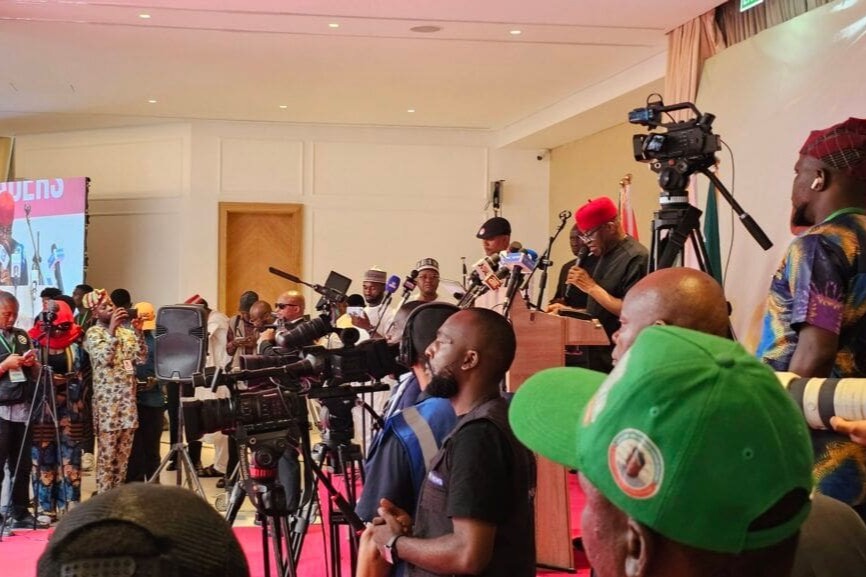
In a landmark disclosure at the Financial Action Task Force (FATF) on‑site meeting in Abuja, Major General Adamu Laka, National Coordinator of the National Counter Terrorism Centre (NCTC), revealed that over 730 convictions have been secured against individuals linked to terrorism in Nigeria under the Terrorism (Prevention and Prohibition) Act 2022.
This surge in successful prosecutions marks a notable escalation from last year’s high‑profile mass trial, where Nigerian courts convicted 125 Boko Haram militants and financiers, including 85 for terrorism financing, demonstrating the judiciary’s renewed vigour in addressing both physical and fiscal terror threats.
This recent conviction tally eclipses earlier efforts: between 2017 and 2018, mass trials yielded 163 convictions and 887 acquittals, of whom 400 were subsequently relocated to the Operation Safe Corridor for rehabilitation.
The sharp uptick in successful prosecutions underscores a strategic pivot towards targeting the financial arteries of extremist cells—an approach long championed by Western security experts.
A Deadly Backdrop
The Boko Haram insurgency, which erupted in July 2009, has since claimed approximately 350,000 lives and displaced 2.4 million people across Nigeria and neighbouring states, evolving into one of Sub‑Saharan Africa’s gravest security crises.
At its zenith in 2014, fatalities surged by over 300 percent—to 10,849 deaths—cementing Boko Haram’s notoriety as the world’s deadliest group that year.
The nationwide crackdown, culminating in hundreds of terrorism‑related convictions, signals an emboldened counter‑insurgency posture that prioritises dismantling both gun‑toting militants and the financiers who bankroll them.
Financial Intelligence as a Force Multiplier
Of the 730 convictions, more than 90 emanated directly from investigations by the Nigeria Financial Intelligence Unit (NFIU), reflecting a matured intelligence framework adept at tracing illicit money flows through hawala networks, cryptocurrency exchanges and shell companies.
Historically, high‑profile cases such as the 2013 conviction of Charles Okah—sentenced to life imprisonment for financing MEND operations with ₦3.2 million—illustrate the judiciary’s capacity to hold funders to account.
The rise of the Joint Standard Investigation Committee on Terrorism Financing (JSICTF) has further centralised expertise, enabling multi‑agency task forces to synchronise efforts and deprive terror outfits of their lifeblood.
Grey List Showdown: A National Imperative
Nigeria’s intensified campaign arrives at a critical juncture: the country has been on the FATF Grey List since February 2023, saddled with a 19‑point action plan and a looming May 2025 deadline to remedy strategic shortcomings in its anti‑money laundering (AML) and counter‑terrorist financing (CFT) regimes.
The recent simulation exercise, designed to stress‑test institutional readiness, serves as a dress rehearsal for the impending evaluators whose verdict will determine whether Nigeria ascends off the Grey List and sheds the taint of perceived financial opacity.
International Partnership as a Cornerstone
“Disrupting the financial lifelines of terrorist organisations is central to our national counterterrorism strategy,” affirmed Major General Laka, lauding the U.S. Department of Treasury’s technical support in forensic accounting and sanction enforcement.
Hajiya Hafsat Bakari, CEO of the NFIU, echoed this sentiment, noting that 11 FATF reviewers will assess Nigeria’s adherence to immediate outcome standards—a mission that underscores the global community’s high expectations.
The Road Ahead: From Grey to Green
With over 730 convictions already inscribed in legal record books, Nigeria has fortified its case for removal from FATF’s Grey List by Q2 2025—a milestone anticipated to unlock \$1 billion in monthly diaspora remittances and rejuvenate foreign investor confidence.
Yet challenges remain: sustaining judicial momentum, curbing reinfiltration of radicalised detainees and refining AML/CFT controls will require unwavering political will.
As the world watches, Nigeria’s melding of hard‑nosed prosecutions with cutting‑edge financial sleuthing charts a potent blueprint for democracies grappling with the evolving scourge of terrorism.