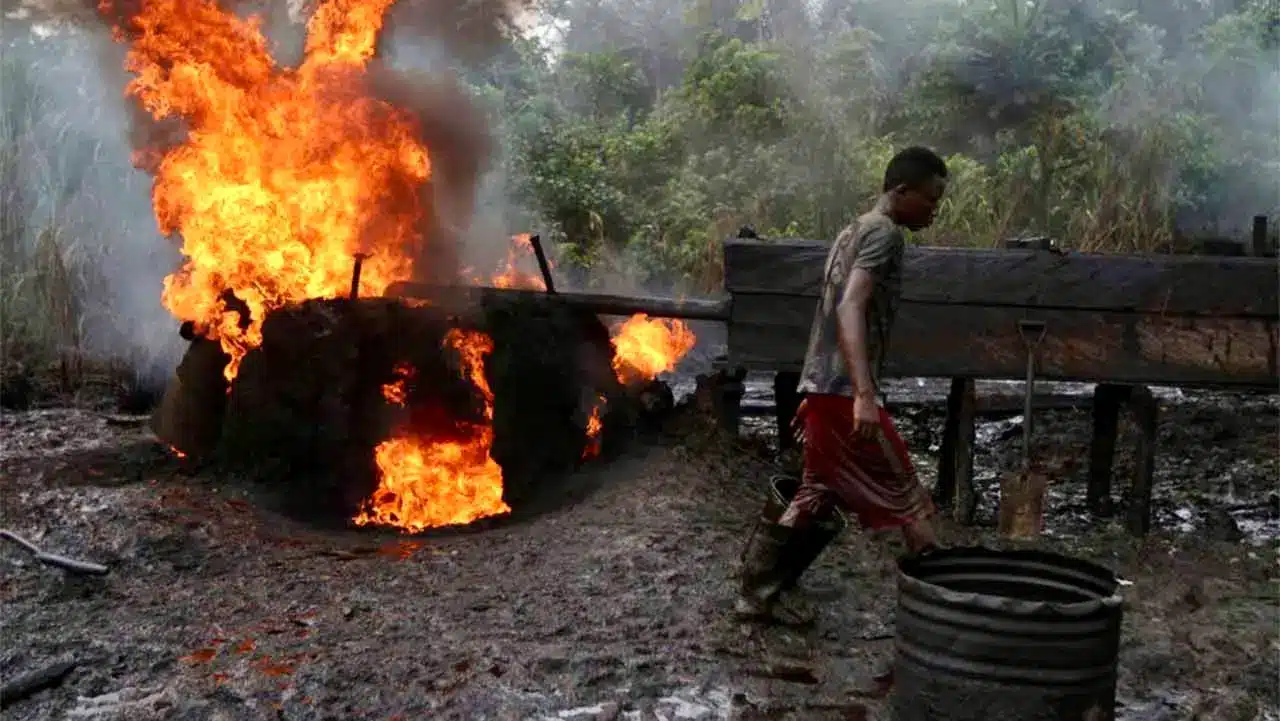
The Nigerian Army’s 6 Division dismantled 18 illegal oil refining sites and arrested 17 suspects in the Niger Delta between February 17-23, 2025. This operation aims to combat economic sabotage and environmental degradation in the region. To sustain progress, the military’s efforts must be complemented by community engagement and socio-economic development initiatives.
PORT HARCOURT, Nigeria — In a resolute display of military might and commitment to safeguarding Nigeria’s energy resources, the 6 Division of the Nigerian Army has delivered a severe blow to the illicit oil refining trade that has long plagued the Niger Delta.
Over a series of high-octane operations conducted between 17 and 23 February 2025, Army operatives dismantled 18 illegal refining sites, demobilised ten boats, and arrested 17 suspects—an operation that has recovered no fewer than 25,000 litres of stolen crude and refined products.
This bold action, announced by Lt. Col. Jonah Danjuma in Port Harcourt, marks a critical juncture in the battle against economic sabotage and environmental degradation in the region.
A Coordinated Offensive Against Oil Thieves
The operation, spanning Rivers, Bayelsa, and Delta States, is emblematic of the Nigerian Army’s renewed vigour in countering the scourge of oil theft and illegal refining.
According to Lt. Col. Danjuma, the coordinated efforts of the 6 Division, in tandem with other security agencies, have effectively dismantled a well-entrenched network of criminal elements who have exploited the region’s porous borders and governance challenges.
“Our troops are committed to dominating the operational landscape and denying these criminal elements the freedom of action they so desperately seek,” Danjuma stated, a sentiment echoed by Maj. Gen. Emmanuel Emekah, who commended the troops for their unwavering resolve.
Operational Milestones and Tactical Details
The operations in Rivers State, particularly around the critical area near Kilometre 45 in the Idama general area of Akuku-Toru LGA, recorded significant breakthroughs. Here, two active illegal refining sites were obliterated, and three wooden boats laden with over 9,000 litres of stolen crude were intercepted. At the bustling Ogale junction along the Eket–Port Harcourt expressway, a truck carrying more than 3,000 litres of illicit crude was impounded—a stark reminder of the ingenuity and persistence of these criminal networks.
In a further demonstration of tactical acuity, troops at Okwuzi in Ogba/Egbema/Ndoni LGA uncovered an illegal oil bunkering dump, where over 2,100 litres of illegally refined Automotive Gasoline Oil (AGO) were discovered, neatly packaged in sacks. The operation’s swift execution forced the perpetrators into flight, thereby denying them the opportunity to consolidate their gains or inflict further environmental damage. Similar precision was evident at the Ogaji-Ama axis in Bukuma, where a wooden boat carrying in excess of 1,000 litres of stolen crude was intercepted, and at the Imo River, where two illegal refining sites and various storage vessels were destroyed, leading to the confiscation of an additional 2,000 litres of crude.
The Wider Context: Economic Sabotage and Environmental Implications
The implications of these operations extend far beyond the immediate recovery of stolen products. For decades, the Niger Delta has suffered from the deleterious effects of illegal oil refining—a practice that not only results in significant revenue losses for the Nigerian economy but also inflicts long-lasting damage on local ecosystems. The environmental degradation resulting from these unregulated processes is profound, contaminating water sources and soil, thereby jeopardising agricultural productivity and the health of local communities.
Moreover, the economic ramifications are substantial. Illicit refining undermines the legitimate oil industry, reducing government revenues through lost royalties and taxes. The economic sabotage perpetrated by these criminal networks directly affects Nigeria’s ability to invest in infrastructure and social services—a fact that underscores the critical importance of sustained military and governmental intervention.
A Broader Strategy for National Energy Security
The recent operations are part of a broader strategic framework aimed at restoring law and order in the Niger Delta and reasserting the government’s control over its natural resources. Energy security in Nigeria has long been a battleground, with illegal activities such as oil bunkering undermining national stability and economic growth. The Nigerian Army’s success in these operations should be viewed as a decisive step in not only curtailing the illegal refining trade but also in signalling a renewed commitment to protecting the country’s energy assets.
Critics argue that such military interventions, while necessary, must be complemented by robust legal frameworks and community engagement programmes to address the underlying socio-economic grievances that often fuel these illicit activities. The persistent issues of poverty, unemployment, and environmental neglect in the Niger Delta have historically provided fertile ground for the emergence of such criminal enterprises. Hence, while the recent operations represent a significant tactical victory, they must be integrated into a comprehensive strategy that tackles both the symptoms and the root causes of the region’s energy security challenges.
The Road Ahead: Challenges and Opportunities
As the Nigerian Army pledges to maintain an aggressive operational tempo, the long-term success of these initiatives will depend on their ability to transition from reactive measures to proactive, community-based strategies that discourage future incidents of illegal refining. There is a clear need for improved intelligence gathering, better coordination among security agencies, and sustained investment in infrastructure that can monitor and protect Nigeria’s vast network of oil pipelines and refineries.
Additionally, the government must address the environmental aftermath of decades of illegal refining. The recovery of 25,000 litres of stolen crude is a tangible victory, but it is merely a drop in the ocean compared to the systemic damage inflicted on the Niger Delta’s ecosystems. Future policies should incorporate environmental restoration and the rehabilitation of affected communities as integral components of national energy security.
Conclusion
The recent operation by the Nigerian Army’s 6 Division represents a watershed moment in the fight against illegal refining in the Niger Delta. With 18 illegal sites dismantled, 17 suspects apprehended, and thousands of litres of stolen crude recovered, the military’s decisive action sends a resounding message to criminal elements: the era of unchecked oil theft is drawing to a close. However, the battle for Nigeria’s energy security is far from over. It calls for a multifaceted approach that combines military vigilance with sustainable socio-economic development and environmental stewardship. Only then can Nigeria hope to secure a future where its natural resources are managed responsibly for the benefit of all its citizens.