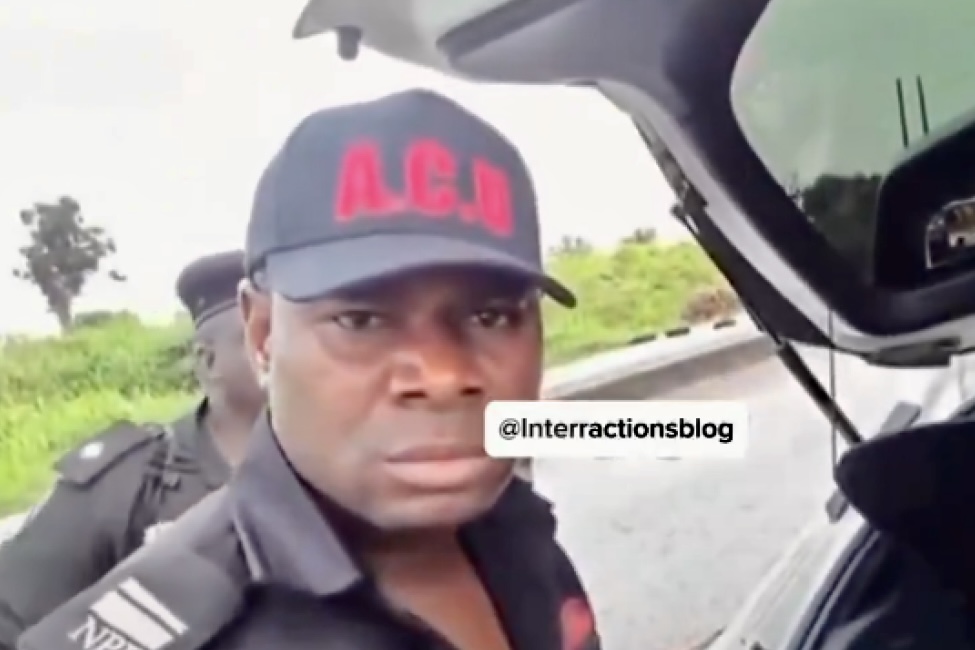
A viral video appears to show a Nigerian police officer threatening a motorist and ordering him to remove his necklace and glasses. A 2026 court ruling and existing police safeguards raise fresh questions about accountability.
A driver asked Nigerian police officers to search his vehicle one section at a time so he could see what they were doing. The request, made respectfully, appears to have triggered a confrontation in which an officer threatened to teach him a lesson, demanded that he remove his necklace and ordered him to take off his glasses.
The encounter, captured in a video circulating on social media on Tuesday, 27 October 2026, raises a critical question about policing in Nigeria: when does a routine search stop being a legitimate security operation and become an exercise in intimidation?
The footage, reported by SaharaReporters and shared on X by @MR__sulaiman2, appears to show a Mobile Police (MOPOL) officer wearing a name tag reading “Afambu Uche”.
The driver initially asks the officers to close the vehicle door and concentrate on one section of the car at a time.
“Please sir, can you close the door, let’s focus on one side. Let him close the door so we can focus here, so that I can see what he is doing,” he says.
Rather than keeping the exchange focused on the search, an officer challenges the motorist over the jewellery around his neck.
“What is this one on your neck?” the officer asks.
When the driver explains that it is his necklace, the officer responds: “Bring it out! What is necklace? Is it not talisman?”
The officer then orders him to remove it.
“I said you should remove it!”
The video does not establish the full circumstances that led to the stop, the officers’ original grounds for conducting the search or everything that happened before the recording began. Those details require independent verification.
But the recorded exchange raises questions about the reasons given for the demands, the manner in which the officers exercised their authority and the escalation that followed.
‘I’ll Teach You a Lesson’
The confrontation intensifies when the officer threatens the motorist.
“I will teach you a lesson you have not learned in your life. Open your bag. We are moving you to criminal charge, you are making noise. Who are you?” the officer says.
He subsequently orders the driver to remove his glasses and keep them in his pocket until the search is completed.
“Remove the glass in your face. I say remove the glass in your face! Don’t put the glass on until I finish searching.”
The motorist, apparently bewildered by the hostility, asks why he is being treated that way for asking questions.
The officer continues: “When we finish with you, you will learn what you have not learned. I said put that phone in your pocket and put that glass in your pocket.”
The driver refuses to put away his phone, saying he wants to document the encounter.
“I wouldn’t put my phone in my pocket. Why are you assaulting me? I won’t put my phone in my pocket!”
The recording cuts off after a physical confrontation.
The footage does not provide enough information to establish the full sequence of physical contact or determine the legal grounds for any subsequent arrest or charge. The Nigeria Police Force should clarify what happened and whether the conduct shown breaches its operational rules.
What Does Nigerian Law Say About Stop-and-Search?
Nigerian police officers have statutory powers to stop and search people and vehicles in specified circumstances. Those powers are not unlimited.
Sections 49 and 50 of the Police Act 2020 set out important safeguards. A search must be supported by the applicable legal grounds. Before searching a detained person or vehicle, the officer must provide their name, the police station to which they are attached, the object of the search and the grounds or authorisation for conducting it. Officers exercising stop-and-search powers must also be in uniform or visibly display a valid police identity card.
Section 54 further states that personal attributes, including colour, age, hairstyle and manner of dress, as well as stereotypical assumptions about groups, cannot constitute grounds for reasonable suspicion.
These provisions matter because the law distinguishes between the existence of a police power and the lawful exercise of that power. A uniform does not confer unlimited discretion, and a citizen’s request for an explanation does not, by itself, establish criminal wrongdoing.
A necklace is not automatically an unlawful article because an officer describes it as a talisman. Nor does wearing glasses, without more, establish reasonable suspicion of an offence.
The important questions are whether the officers had lawful grounds for the search, whether their instructions served a legitimate operational purpose and whether their conduct remained within the limits imposed by law.
The video alone cannot resolve every legal issue arising from the encounter. It does, however, provide a basis for the police to investigate the officers’ actions.
A Court Has Affirmed the Right to Record Police
The driver’s insistence on using his phone is particularly significant in light of a Federal High Court judgment delivered in Warri on 17 March 2026.
In Maxwell Nosakhare Uwaifo v. Inspector-General of Police and Others, the court affirmed Nigerians’ constitutional right to record police officers performing their duties in public, including during stop-and-search operations, provided the person recording does not physically obstruct or interfere with the officers.
The court also addressed police identification during public operations and awarded ₦5 million in damages for infringement of fundamental rights, alongside ₦2 million in litigation costs.
The ruling provides an important legal benchmark for assessing the relationship between public accountability and police authority.
It does not mean that every instruction from an officer is unlawful or that citizens can obstruct a search. It does mean that recording public officers in the discharge of their duties cannot simply be treated as misconduct because the footage might document an embarrassing encounter.
In the video under review, the driver’s decision to keep his phone out appears to have become another point of confrontation.
The central issue is whether the officers had a lawful reason to demand that he stop recording and whether any such instruction was consistent with the applicable law and the circumstances.
An Earlier Eyeglasses Confrontation Raised Similar Questions
The latest video also recalls a strikingly similar incident reported in Lagos in August 2025.
In that case, police officers were filmed attempting to force a motorist to remove his eyeglasses amid suspicion that the glasses contained recording technology.
The Lagos Commissioner of Police, Olohundare Jimoh, ordered the restructuring of the squad involved after the footage generated public outrage. Police spokesperson Benjamin Hundeyin said disciplinary action had been taken, while the command described the incident as isolated and inconsistent with the professionalism expected of its personnel.
The resemblance is difficult to ignore. In both encounters, an ordinary vehicle search became a confrontation involving a motorist’s eyewear and the control of recording.
The incidents are not identical, and the available evidence does not establish that the same personnel or unit were involved. Nevertheless, the recurrence of similar confrontations raises a legitimate question about whether disciplinary responses and operational instructions are changing officers’ conduct on the road.
Declaring an incident isolated does not, on its own, demonstrate that an underlying problem has been addressed.
That requires evidence of supervision, training, compliance monitoring and meaningful consequences when officers breach the rules.
What the Police Must Establish
The name tag visible in the latest footage reportedly reads “Afambu Uche”. That visual detail should be treated as a lead for verification, not a substitute for official identification of the officer and confirmation of his role in the incident.
A credible investigation should establish where the search took place, which unit conducted it, why the vehicle was stopped and what grounds the officers had for searching it.
Investigators should also preserve the original video, identify the officers involved, obtain accounts from the motorist and any witnesses, and examine any available search records or other contemporaneous evidence.
The investigation should determine why the driver was ordered to remove his necklace and glasses, whether he was given the required explanation for the search and whether the physical confrontation involved unnecessary or unlawful force.
The officer’s account must also be obtained before definitive conclusions are reached. If the evidence establishes misconduct, the police should disclose the findings and apply the appropriate disciplinary or legal sanctions.
As at 27 October 2026, no official response specifically addressing this video was located in the public sources reviewed for this report. The absence of a verified public statement does not establish that no internal inquiry has begun.
Accountability Must Mean More Than a Viral Video
The Nigeria Police Force has repeatedly faced public scrutiny over allegations of brutality, intimidation and abuse of stop-and-search powers. Each new recording adds to the demand for a police service that protects citizens without treating routine questions as challenges to its authority.
The law already provides safeguards for searches, requires officers to identify themselves and recognises the public interest in documenting police activity. The challenge is ensuring those protections work in practice, particularly during tense roadside encounters where citizens may have little immediate recourse.
An effective response must go beyond expressing regret or describing an incident as isolated. It should establish what happened, identify who was responsible, explain the legal basis for the officers’ actions and demonstrate that misconduct carries consequences.
The question raised by this video is not whether the police should be permitted to search vehicles. They should be able to do so when the law authorises it.
It is whether the authority to conduct a search can be exercised without threats, humiliation or force that the circumstances do not justify.
A lawful search should produce evidence, not fear. And when a citizen asks to see what is being done to his property, the police should have an answer grounded in law, not a threat to teach him a lesson.
Follow us on our broadcast channels today!
- WhatsApp: https://whatsapp.com/channel/0029VawZ8TbDDmFT1a1Syg46
- Telegram: https://t.me/atlanticpostchannel
- Facebook: https://www.messenger.com/channel/atlanticpostng



Join the debate; let’s know your opinion.