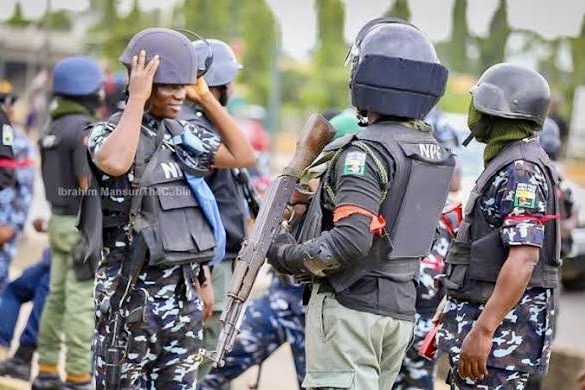
ILORIN, Nigeria — The Kwara State Police Command says it has arrested a suspected kidnapper, identified as Muhamodu Sanni, while allegedly attempting to withdraw ransom money at a Point-of-Sale (POS) terminal, in what investigators believe could expose the financial support structure of a kidnapping syndicate operating around the Obudu/Woru axis of Ilorin East Local Government Area.
The arrest, announced by the command on Wednesday, 12 August 2026, is significant not merely because another alleged kidnapper has been taken into custody, but because the police say investigators tracked the syndicate through its money trail rather than relying solely on conventional searches for armed abductors and their hideouts.
According to the Police Public Relations Officer, SP Adetoun Ejire-Adeyemi, the operation was triggered by the abduction of three people during an armed invasion of Obudu Village on 28 July 2026.
“The sustained offensive of the Kwara State Police Command against kidnapping has recorded another significant breakthrough, as intelligence-led operations successfully penetrated the support structure of a kidnapping syndicate operating around Obudu/Woru axis of Ilorin East Local Government Area, culminating in the arrest of Muhamodu Sanni while allegedly attempting to cash out ransom proceeds linked to a recent abduction,” the command said.
The police added: “The breakthrough followed the activation of the command’s intelligence and tactical architecture after three persons were abducted during an armed invasion of Obudu village on 28th July, 2026.”
That sequence matters.
Rather than treating the abduction as an isolated armed attack, investigators appear to have followed the criminal enterprise beyond the point of captivity to the communications, logistics and financial channels allegedly used to turn ransom demands into spendable cash.
The POS terminal that allegedly exposed the network
The central development is the police allegation that Sanni was intercepted at a POS terminal while allegedly attempting to cash out ransom proceeds.
For kidnapping networks operating in rural and semi-urban environments, access to cash can be as important as access to firearms, vehicles, telephones and hideouts. A ransom may be negotiated remotely, transferred electronically or made available through an intermediary, but at some stage somebody often has to convert the proceeds into usable funds.
That point of conversion can create an investigative vulnerability.
The Central Bank of Nigeria has progressively tightened the operating framework around agent banking. Under its October 2025 agent-banking guidelines, agents are required to operate through designated accounts, maintain transaction records, comply with Know Your Customer requirements and report suspicious activity. The framework also provides for monitoring and traceability of agent transactions.
The CBN’s cash-out rules have also established transaction limits. Its December 2024 agent-banking circular set a ₦100,000 daily cash-out limit per customer at agent terminals and a ₦1.2 million cumulative daily cash-out limit for an agent, while requiring transaction information to be transmitted electronically to NIBSS.
From 1 January 2026, the broader revised cash policy also imposed a ₦100,000 daily ATM/POS withdrawal limit, with individual cash withdrawals aggregated across channels towards a weekly ₦500,000 limit.
Those controls do not, by themselves, prevent criminal use of payment channels. But they create data trails that investigators can potentially exploit when a suspicious transaction is linked to a kidnapping investigation.
That appears to be precisely the importance of the Sanni arrest.
From the village invasion to the money trail
The police account suggests that detectives did not stop their investigation after establishing that three people had been abducted.
Instead, the command says its intelligence and tactical teams widened the inquiry to include the communication and financial architecture behind the operation.
That is an important shift in anti-kidnapping strategy.
Traditional counter-kidnapping operations often centre on forest searches, surveillance, road checkpoints, rescue attempts and the physical pursuit of armed suspects. Those measures remain essential, but organised kidnapping is also a commercial enterprise. Someone negotiates the ransom. Someone communicates with victims’ relatives. Someone receives or facilitates payment. Someone converts the money to cash. Someone distributes the proceeds. And someone supplies the food, fuel, motorcycles, SIM cards, accommodation or weapons required to keep the network functioning.
The arrest of a suspected ransom collector therefore potentially gives investigators access to a layer of the syndicate that is harder to see from the forest floor.
Kwara police said the intelligence operation identified a pending ransom transaction, leading operatives to the POS location where Sanni was allegedly attempting to cash out the proceeds.
The command said he subsequently cooperated with investigators.
Police say suspect names two alleged accomplices
During interrogation, according to the police, Sanni made disclosures about his alleged role in the ransom collection process.
He also reportedly identified two other suspected members of the network, named by the command as Aminu and Umar.
Ejire-Adeyemi said the information has generated operational leads which are being “discreetly exploited” by detectives.
That wording is revealing.
The police have not announced the arrest of Aminu and Umar, and the command has not publicly disclosed the precise nature of their alleged roles. Their names therefore remain investigative leads rather than established findings of guilt.
The same caution applies to Sanni. He is a suspect, not a convicted kidnapper, and any allegations against him will ultimately have to be tested through due process.
Nevertheless, the arrest may be more consequential than a routine suspect apprehension because an individual allegedly positioned close to the proceeds of a kidnapping can potentially help investigators identify the wider network.
Why the financial trail matters
Nigeria’s security agencies have increasingly recognised that the fight against organised crime cannot be confined to the physical capture of gunmen.
In a separate national discussion on the security risks surrounding POS operations, an industry representative told lawmakers that criminals increasingly use POS channels as cash-out points for illicit funds, including ransom payments. A parliamentary hearing in 2025 was told that security agencies had reported that, in some states, nearly 40 per cent of kidnap ransom payments passed through informal POS cash-out channels. The warning was blunt: “This is no longer a fintech issue; this is a national security threat.”
The association representing mobile-money and bank agents had also acknowledged in 2024 that some criminals use POS operators as cash-out points for ransom payments, while stressing the difficulties of escalating suspicious transactions and securing effective law-enforcement follow-up.
That background gives the Kwara arrest a wider significance.
The question is no longer simply who carried the gun?
It is also:
Who receives the money? Who withdraws it? Whose account or terminal is used? Who supplies the SIM cards? Who provides vehicles and motorcycles? Who relays messages to families? Who moves cash from the city back to the forest? And who benefits after the ransom has been collected?
Those questions could prove more damaging to a syndicate than the arrest of one field operative.
Kwara’s kidnapping challenge has remained persistent
The latest arrest also comes against a backdrop of repeated kidnapping and organised-crime incidents in Kwara.
In July, the state police announced the arrest of two foreign nationals in Okuta, Baruten Local Government Area, after a resident allegedly received threats demanding ₦22 million to prevent his abduction. Police said technical intelligence helped trace the suspects.
In May, the command also reported that armed attackers invaded a night vigil at Ori-Oke Ajaiye via Ekerin village in Ekiti LGA, killing three people and abducting 15 others. The police said it deployed a combination of drone capability, tactical personnel and intelligence assets in the subsequent response.
Earlier in July, an operation involving police intelligence personnel and a local security network also resulted in the rescue of a woman and her son who had been abducted in Oyo State and taken into a forest area in neighbouring Kwara.
These cases underscore the geographic and operational complexity confronting security agencies in the state.
Kwara sits at a strategic intersection linking parts of the North-Central region with the South-West, while expansive rural areas and forest corridors can offer criminal groups opportunities to move victims and supplies.
The real test begins after the arrest
For the Kwara Command, the most important phase may now be the investigation that follows Sanni’s arrest.
The police have said his disclosures are already generating actionable intelligence. But an arrest only becomes a strategic victory if it leads to the dismantling of the network behind the suspect.
That means investigators will need to establish the identities and locations of the alleged accomplices, determine how ransom payments were initiated and routed, identify the communications chain, establish whether other financial intermediaries were used, and determine whether the same network is linked to previous abductions in the area.
The financial evidence could be particularly important.
Transactions, account records, terminal identifiers, telephone records and other digital footprints can potentially connect individuals who never appear together physically. The CBN’s agent-banking framework was deliberately designed to improve traceability, including requirements relating to designated accounts, record keeping, transaction monitoring and electronic reporting.
But the existence of transaction data is not enough. Investigators must connect that data to people, locations and criminal acts, preserve admissible evidence and ensure that cases eventually survive scrutiny in court.
That is where intelligence-led policing must evolve into evidence-led prosecution.
CP Ojo Adekimi issues fresh assurance
Kwara State Commissioner of Police, Ojo Adekimi, said the command remains determined to disrupt kidnapping networks and restrict their ability to operate.
He urged residents to support security agencies by providing timely and credible information.
His message reflects a reality familiar to investigators: intelligence often begins with small pieces of information supplied by residents before tactical teams can convert them into arrests.
But public cooperation also depends on confidence that reports will be acted upon discreetly and professionally.
A potentially important breakthrough
The significance of the Sanni arrest, therefore, lies less in the headline of another suspect being captured and more in where the alleged suspect was found and what investigators may recover from the transaction trail.
A man allegedly attempting to cash out ransom money is potentially a bridge between the violent crime in the village and the financial machinery that sustains it.
The police have not publicly disclosed the amount allegedly involved, the identity of the POS operator, the precise terminal or account used, whether any ransom had already been paid, or whether the three victims abducted on 28 July have been rescued. Those details are critical and should emerge as the investigation progresses.
Atlantic Post could not independently verify the police’s operational claims beyond the official account available at the time of publication. Accordingly, allegations involving Sanni, Aminu and Umar should be treated as allegations pending further investigation and possible prosecution.
But one thing is already clear.
The battle against kidnapping is increasingly moving beyond the bush and into the payment system.
And for criminal networks that depend on ransom money to survive, the person holding the weapon may not be the only vulnerable point.
The person trying to cash out could be the thread that unravels the entire operation.
Follow us on our broadcast channels today!
- WhatsApp: https://whatsapp.com/channel/0029VawZ8TbDDmFT1a1Syg46
- Telegram: https://t.me/atlanticpostchannel
- Facebook: https://www.messenger.com/channel/atlanticpostng