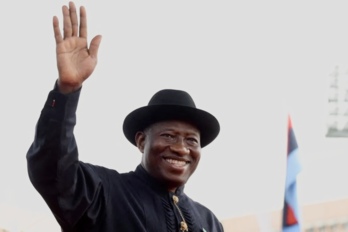
Former President Goodluck Jonathan has been dragged back into Nigeria’s succession debate at exactly the moment the opposition is wobbling, the courts are reopening the eligibility question, and public frustration with the political class is sharpening ahead of 2027.
On Thursday, Jonathan told a crowd of youths in Abuja that the race for the presidency is “not a computer game” and said he would “consult widely” before making any decision.
On the same day, he pressed the case for peace, credible elections and deeper youth participation, while warning that Nigeria’s stubborn voter apathy is crippling democracy.
The timing is politically explosive. A federal high court in Abuja is due on Friday to hear a suit seeking to restrain Jonathan from contesting the 2027 presidential election.
The case, filed by lawyer Johnmary Jideobi, asks the court to declare the former president constitutionally ineligible and stop him from presenting himself to any party as a candidate.
Even before any declaration from Jonathan himself, the legal shadow over a possible comeback has already become part of the story.
What makes the moment even more significant is that Jonathan has not publicly shut the door. Instead, he has left it ajar.
Speaking to supporters who urged him to run, he acknowledged the pressure, repeated that the presidential race is “not a computer game”, and said he would consult widely before deciding.
That language is politically careful, but it is also revealing. Jonathan is not denying interest, and he is not dismissing the calls. In Nigeria’s elite politics, that is often the first real signal that a serious move is being tested.
The former president’s intervention also tapped into a wider anxiety that has become central to the pre-2027 conversation.
He warned that only patriotic citizens build nations and said unpatriotic citizens can destroy them. He also argued that without peaceful and credible elections, good citizens will continue to stay away from politics.
Those remarks are not new in tone, but they are strategically relevant now because they position Jonathan as a moral critic of the system at the very moment his supporters are trying to convert him into an electoral rescue plan.
That rescue plan is gaining traction precisely because Nigeria’s opposition is in flux. Reuters reported this week that Peter Obi and Rabiu Kwankwaso have quit the African Democratic Congress led alliance and joined a separate opposition grouping, the Nigeria Democratic Congress.
The split has weakened attempts to build a single opposition front against President Bola Tinubu and has reinforced the familiar Nigerian pattern of fragmented anti-incumbent politics.
Any Jonathan comeback would enter that same fractured field, where ambition, regional calculations and party distrust are already pulling in different directions.
The legal argument surrounding Jonathan remains unsettled and is likely to become one of the central battlegrounds of the season.
A recent Punch explainer noted that some lawyers believe Section 137(3) of the 1999 Constitution, introduced by the Fourth Alteration in 2017, may block a person who completed another president’s tenure from winning another term.
But that same report also stressed that the amendment came after Jonathan had left office, which is why the issue remains contested and may still require a fresh judicial pronouncement.
Jonathan’s camp will therefore be watching Friday’s hearing closely, not just as a procedural date but as a test of how hard the legal walls around 2027 may become.
Jonathan’s own pitch to young Nigerians is also politically calculated. He urged them to collect their voter cards and become active in the democratic process, asking how many of those urging him to run even possess voter’s cards.
BusinessDay reported him saying that “probably 50 percent” of the youths present may not have cards, yet they were asking him to contest.
That line is more than a rebuke. It is a challenge to the very constituency most eager to see him return. He is effectively telling them that nostalgia alone cannot power a real campaign.
His comments on voter apathy are backed by broader evidence. A CDD West Africa analysis, citing INEC records, said turnout fell from 57.5 per cent in 2007 to 34.8 per cent in 2019 and then to an all-time low of 28.63 per cent in 2023.
In that light, Jonathan’s warning that Nigeria has low civic engagement is not mere rhetoric. It is an indictment of the system, and perhaps also a warning that any politician seeking a serious mandate in 2027 will have to do more than rely on elite bargaining and old loyalties.
There is also a deeper political subtext. Jonathan has long been praised for conceding defeat in 2015 and overseeing a peaceful transfer of power, and that legacy still gives him rare cross-party goodwill.
But the 2027 contest will not be fought only on reputation. It will be fought on structure, legal clarity, turnout mobilisation and the ability to command a coalition that can survive Nigeria’s ethnic, regional and ideological fault lines.
Reuters noted that Tinubu won the last presidential election with about 35 per cent of the vote, while the opposition collectively polled about 60 per cent, a reminder that division rather than lack of numbers has often been the opposition’s real curse.
For now, the strongest conclusion is this. Jonathan has not declared, but he has not disengaged either.
The court hearing on Friday, the fresh pressure from supporters, the talk of a new party vehicle, and the worsening fragmentation of the opposition all point in one direction. Nigeria is once again confronting the possibility that the former president who once bowed out quietly may be preparing to step back into the storm.
Whether that becomes a formal candidacy or another carefully managed political tease will depend on what he says next, what the court says on Friday, and whether his allies can turn sentiment into structure.
Follow us on our broadcast channels today!
- WhatsApp: https://whatsapp.com/channel/0029VawZ8TbDDmFT1a1Syg46
- Telegram: https://t.me/atlanticpostchannel
- Facebook: https://www.messenger.com/channel/atlanticpostng