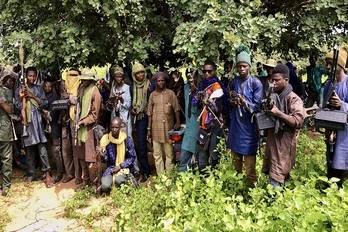
In Nigeria’s northwest, a coordinated underworld is fueling a violent new wave of bandit attacks across Kaduna, Niger and Zamfara states. Armed gangs are overwhelmingly made up of radicalised Fulani herders. They now move arms, petrol, food, and cash through porous desert corridors. It is as if they are running a terror “supply chain.”
Analyst reports note that “banditry pervades Kaduna, Katsina, Kebbi, Niger, Sokoto and Zamfara”. They also show that ACLED/NGO data show the Northwest as a broad war zone. Over 9,300 people were killed and 716 kidnappings occurred in 2023–25.
Even U.S. President Donald Trump has publicly denounced the carnage as “Christian genocide”. This investigation exposes the logistics behind the raids. These include arms smuggling through Mali–Niger routes, local fuel convoys, and ransom money trails. These elements are sustaining the violence across all three states.
Key findings:
Transnational networks: Bandit groups in Kaduna–Niger–Zamfara exploit the Nigeria–Niger–Mali corridor as a “fluid exchange zone” for weapons and cash. Armed Fulani militias have fanned out, creating over 50 splinter “bandit” factions in recent years. Weapons are largely trafficked via porous Sahara borders (Nigeria’s ex-information minister estimates ~95% of terror arms come from Libya/Niger).
Islamist alignment: Analysts note the convergence of criminal gangs with jihadist tactics. A new group called Lakurawa blends Islamist tactics with banditry. Jihadist-aligned elements, including armed Fulani herders, repeatedly target Christian villages. This information is according to security briefings. Gen. Felix Tuggar (ret.) warned that Fulani extremist scouts (“Lakurawa”) now provide logistics and intelligence, while allied bandits provide manpower, weapons and ransom revenue.
Explosive growth: Cross-state violence has spiked. ACLED data show bandit attacks rising over 700% between 2018–2022. NGOs report tens of thousands killed; for example, one study blamed “Jihadist Fulani” herdsmen for some 7,400 Christian deaths since 2015. In 2025 alone, NGOs say around 7,000 Christians were slain by jihadi militias and bandits.
Kidnap epidemic: Kidnap-for-ransom is booming. From mid-2024 to mid-2025, nearly 4,800 abductions were recorded, with over ₦2.5 billion paid in ransoms. Highways and markets have become money-laundering chokepoints – e.g. Western analysts note bandits even “tax” villagers. Police have intercepted fuel or food convoys en route to camps. In one instance, a woman was arrested carrying fuel for bandits in Katsina.
US and global outcry: High-profile voices now frame the crisis in religious terms. President Trump has publicly threatened force, calling on Nigeria to stop the “killing of Christians,” and labelled the attacks “Christian genocide”. Republican Sen. Ted Cruz and Rep. Riley Moore have introduced or promoted bills to sanction Nigerian officials over the mass murders. International civil society groups likewise warn of an ethnoreligious militia campaign that is “wiping out whole Christian villages”.
Background / Historical context
The bandit insurgency in Northwest Nigeria has deep roots in regional instability. For decades, loosely organized Fulani cattle herders clashed with farmers over grazing and land. The crisis escalated around 2011 with an influx of armed criminals.
A gold-mining boom in Zamfara drew thieves and mercenaries into the region, and by 2014–15 kidnapping for ransom became commonplace. Unlike the Boko Haram insurgency in the Northeast, these groups started as local bandits but soon intertwined with jihadist elements.
Authorities responded unevenly. Some states negotiated amnesties or hired vigilantes. Notably, Zamfara’s vigilante was disbanded in 2021. Others launched military operations. However, these efforts had limited impact.
Over time, analysts note the conflict has “evolved into a hybrid threat” as criminals and militants merge supply chains. State borders are highly porous: the Nigeria–Niger–Mali highway is now a “most fluid exchange zone for terrorist-jihadist–criminal mergers”.
Former information minister Lai Mohammed warned that ~95% of terror weapons in Nigeria flow in from outside. They come largely through the Sahara from Libya and neighboring Sahel states. In this vacuum, armed bands stockpiled weapons and began treating kidnappings and robberies as a lucrative business.
By 2025, NGO trackers estimate some 30,000 gunmen operate in Northwest Nigeria. They are organized in groups ranging from tens to over a thousand fighters. Bandit tactics have grown sophisticated. At least one recent security brief highlights, “motorbikes often serve as transport vehicles for arms and ammunition” in raids.
Crucially, logistics now underpin the insurgency. Analysts note that fuel, food and cash pipelines are just as important as guns. Rumours of armed convoys shuttling kidnapped hostages to border camps are common. For example, Katsina police actually arrested a 25-year-old woman carrying six gallons of petrol. She was suspected of fueling bandits in forest hideouts.
Meanwhile, West African arms brokers have tapped regional trade routes: African Union data confirm attacks jumped 731% over 2018–22.
Foreign NGO reports now identify the assailants as an “ethno-religious” militia: a Genocide Watch report bluntly calls them “Jihadist Fulani herdsmen,” noting that since 2015 thousands of Christians have been massacred by these militias.
In short, the loose banditry of years past has matured into a transnational network of well-armed jihadist militias. This report unpacks the underground supply lines for Kaduna, Niger, and Zamfara.
Kaduna State: Supply Routes, Safe Havens, Local Complicity
Kaduna lies at the crossroads of Nigeria’s Middle Belt and Northwest. Here bandit gangs have long exploited rugged terrain and local divisions. Southern Kaduna – largely Christian farming country – has been especially hard-hit.
According to community leaders, Fulani militiamen now repeatedly strike outlying villages, forcing evacuations and even annexing farmlands. One Kaduna legislator claimed officials quietly ceded 2,316 square miles of indigenous farmland to so-called “repentant” Fulani bandits in 2024.
Local elders protest. They assert that “we cannot give our lands to terrorists who have shown us hell”. Despite this, grazing corridors have expanded into formerly all-Christian areas.
Supply routes: Bandits in Kaduna draw resources from the north and west. Major roads between Niger State and Kaduna – especially the Minna–Kontagora–Kachia axes – have become transit corridors. Truckloads of fuel and stolen cattle move southward from the Magama–Tegina corridor. They travel from neighboring Niger State into Kaduna’s Kachia and Kajuru forests.
Police intelligence identifies figures like Ali Kawaje, a commander based around Magama–Tegina (in Niger State), whose networks spill into Kaduna. Western checkpoints have even seized food trucks. They have also confiscated motorbikes loaded with cooking oil bound for bandit camps. This indicates formal supply chains at work.
Safe havens: Fighters reportedly shelter in the hills and forests of southern Kaduna, around Kachia and Birnin-Gwari. They also hide in overlooked corners of the Federal Capital Territory bordering Kaduna. Satellite imagery and local testimony confirm hidden camps near riverine wetlands, beyond the reach of regular patrols.
Even Kaduna city’s outskirts feel the threat. A 2022 Al Jazeera report detailed how bandits once bombed the Abuja–Kaduna train. They also raided the Kaduna airport runway. This demonstrates their ability to strike deep into the state’s transport core. Villagers often complain that militants “operate as if they are above the law”, frequently taxing or looting those who remain.
Local complicity: The Kaduna insurgency has an ethnic-religious dimension. Many local Christians blame state officials and even traditional rulers for enabling Fulani militants. In a damning allegation, a Southern Kaduna lawmaker accused the governor of secretly negotiating with armed Fulani groups. These groups are called “unknown gunmen” or “bandits” by authorities. The governor is accused of rewarding them with land for grazing. This belief – whether true or not – complicates military solutions.
Indigenous militias have themselves splintered. Meanwhile, the militias were sometimes formed to fight bandits. Ex-vigilantes in nearby states have been caught rejoining raids against Christian communities. The upshot is widespread mistrust. Kaduna’s communities see not only hostile invaders. They also know about rumored deals between insiders and the insurgents.
Niger State: Ransom Corridors and Choke Points
Niger State forms the central battleground in this network. Its vast farmland and crossroad towns lie directly on routes to the Sahel. Here kidnap-for-ransom is especially lucrative. Bandit gangs frequently target villagers or travellers along the Abuja–Sokoto highway. They abduct them and haul them into forest camps on the Niger–Mali border.
Data show attacks have surged. More than 1,000 Niger State residents were kidnapped in 2024 alone. This makes it one of the worst-hit states.
Ransom corridors: Experts note that the Niger–Mali–Nigeria highway is the “most fluid exchange zone for terrorist–criminal mergers” in the region. In practice, this means that after an ambush occurs, hostage convoys move north. They pass through Niger’s Kontagora and Wushishi areas toward Zamfara camps.
Recent cases suggest payments are wired through brokers in Minna or cash-couriered via markets in Bida. Kidnappers exploit local money changers and gold traders to launder huge sums. One leaked intelligence cable noted a bandit demand of ₦40 trillion (roughly $40 billion) in a high-profile Kaduna abduction. This is an implausible figure, but it underlines how billions in ransoms can flow through Niger State networks.
Transport choke points: Niger’s road network is crucial. The Minna–Kontagora road and the adjoining route to the Niger Republic border (through Tegina) serve as arteries for illicit flow. Security sources identify regional warlords like Ali Kawaje. They control these roads. Kawaje is reported to “control the Magama–Tegina region in Niger State,” an area that bandits use widely to move between Kaduna and Zamfara.
Army checkpoints have struggled to interdict these lanes. Local officials have temporarily shut down telecommunications in parts of Niger State during large-scale military operations. They hoped to strand bandit convoys. However, the networks persist underground.
Meanwhile, motorbike gangs known as “Babbake” scouts ride ahead. Their mission is to guide larger gangs to well-ambushed targets. They exploit the broken terrain of Niger’s forests.
Breaking the logistics chain will require coordinated action.
First, intelligence-led interventions are vital. Security forces must target the financial conduits: track large cash movements and arrest currency brokers who convert ransoms. Anti-money-laundering checks on informal banks could choke off funds. These checks include bureau-de-change and mobile money in Kano, Minna, and Abuja.
Second, border interdiction must be stepped up. Deployments along the Niger and Zamfara borders should focus on known smuggling routes. Using drones and satellite mapping can help shut down hidden camps.
Third, community protection: Local vigilantes in each state should be formally integrated and better equipped. Equipping local hunters’ “Yan Sakai” groups with body cameras could deter bandits. Using radio links might reveal supply paths.
Fourth, targeted strikes on arms markets: Security agencies could coordinate with INTERPOL. They can bust known traffickers in north Niger and Burkina Faso. These traffickers sell weapons to Nigerian bandits.
Fifth, governance measures: Kaduna and Niger state authorities should follow the lead of Zamfara’s recent proposal. They should focus on rebuilding villages and paying compensation. It is essential to insist that no amnesty deal rewards land seizure.
Finally, long-term socio-economic programmes (land reform, school-building and alternative livelihoods for herders) are needed to undercut the militants’ recruiting base. In essence, policymakers should treat banditry as a criminal insurgency sustained by finance: cutting off fuel depots, arresting ransom handlers and sanctioning complicit officials (as some U.S. bills propose) could degrade the network.
Local indicators: Communities in Niger State report seeing column after column of uniforms turning northeast toward Kebbi or Zamfara after kidnappings, heavily laden with sacks (presumed ransom or loot). Some villagers note recruitment of local youths into bandit ranks in exchange for cash or guns.
There are also reports of policemen and soldiers colluding – for instance, a local human rights group documented that some trucks carrying ransom money have been stopped and looted en route in Niger State.
On the ground, the message is clear: Niger’s transport hubs and forest borderlands have become the main lifeline for financing the bandits, and blocking them is a daunting challenge.
Zamfara State: Arms Sourcing and Market Dynamics
Zamfara is the origin point of modern banditry in Nigeria and remains its logistical heart. The state’s remote forests (e.g. Birnin Gwari, Gummi areas) serve as workshop and marketplace for militants. Here, arms and resources from across West Africa are brought in and redistributed.
Security reports identify Zamfara warlords as central figures. One notorious kingpin, Dogo Gide, has long been tied to networks spanning Zamfara–Kebbi–Sokoto; even after reports of his death, truthnigeria sources insist he remains an elusive commander in the Zamfara hinterland.
Arms pipelines: Fighters in Zamfara rely on a steady inflow of weapons. Official data indicate a dramatic rise in such traffic: in one January 2023 raid, police confiscated hundreds of rifles hidden in caches around the Birnin Yauri area.
Analysts trace many of these arms to illicit markets in the Sahara. ENACT/ISS research noted that in late 2021 a trafficker was arrested en route with 991 rounds of AK-47 ammunition, loaded from Sokoto toward a Zamfara kingpin.
In another bust, officers seized hundreds of locally made machine guns and thousands of rounds being moved from Plateau State into Kaduna and Zamfara camps.
Such incidents underscore how bandit camps in Zamfara are supplied by elaborate smuggling chains: women couriers (less likely to be searched) regularly conceal weapons as groceries on these routes.
Local arms markets: Within Zamfara and neighboring Kebbi, illegal arms markets operate openly at night. Former arms traders in towns like Kiworo and Baiwa have told reporters that rifles from Libya, Chad and Mali turn up regularly for sale in exchange for gold or cash. Gold mining – both legal and artisanal – has fuelled this trade.
For example, surveillances in 2024 caught miners smuggling gold bars in donkey carts to meet bandit chiefs in the forest.
The Zamfara towns of Gusau and Kaura Namoda, though state capitals, have had to impose curfews after weekend gun bazaars. Fuel trucks – known locally as “black market supplies” – crisscross Zamfara at odd hours; cartels charge around ₦1,000–1,500 extra per litre to get diesel into bandit enclaves.
Market dynamics: The financial ecosystem in Zamfara is partly self-sustaining. Kidnap ransoms (often in gold bullion) help buy more weapons and fuel. Bandits also tax local traders, herders and even some villages under threat. Community sources report that bandits impose tolls on harvested crops and livestock — sometimes demanding bales of rice or stacks of cattle as “security payments.”
In short, Zamfara functions as a rear base: hostages are held and ransoms cashed, weapons are bartered, and supplies are stockpiled for the next raid. This deep logistical base is what allows attacks to penetrate far beyond Zamfara’s borders into neighboring states.
Logistics Anatomy
Underneath the headlines of raids lies a complex logistics network.
Weapons procurement: Bandits source most of their arms from regional smuggling channels. ENACT research notes that virtually all their modern rifles are trafficked through Nigeria’s weak borders – one government report even claimed 95% of terrorism weapons came via Libyan or Sahel gateways.
NGOs have recorded cases of large arms shipments moving through the Nigeria–Mali corridor: one trafficker carried nearly 1,000 rounds on motorcycles from Sokoto towards a Zamfara warlord.
Militias also reportedly loot Nigerian military bases to stockpile arms, though foreign procurement remains key.
Fuel and food lines: Getting to the bush requires fuel. Security forces have seized tanker trucks hidden under foliage, intended to refuel camps. In Katsina state alone, a patrol arrested a woman “supplying logistics to bandits” – she had 6 gallons of petrol tucked in her clothing.
In Kaduna and Zamfara, locals report that expired tanker-license laws (e.g. bans on jerrycans) are routinely ignored by smugglers. Food is likewise ferried from markets: truckloads of grains and livestock are known to depart Birnin Kebbi and Gusau at night, destined for forest kitchens. Local guides say even rice and maize are treated as contraband.
Ransom money and laundering: Kidnap proceeds flow through a shadowy financial network. Ransoms – often demanded in US dollars or gold – are delivered by intermediaries who shuttle between villages and border towns.
A retired intelligence officer told us that he has seen cars laden with cash crossing the Nigeria–Niger border under cover of darkness. Some informants say bandits rely on local money changers in Lagos or Kano to exchange large naira bills for more portable currencies.
In one case, police detained a bus passing through Niger State carrying ₦50 million in cash thought to be ransom for a Zamfara kidnap. The IRS is studying reports that some legitimate Western Union and mobile money channels have been exploited by bandit financiers.
Transport nodes: The network hinges on highways and air. Major trucks plying the Minna–Kontagora, Kontagora–Kebbi and Birnin Kebbi–Sokoto roads are vulnerable nodes. Satellite trackers and stolen GPS devices have been found in recovered bandit hideouts, suggesting they loot or repurpose commercial vehicles to move goods.
Even small airstrips on ranches have been proposed (though none confirmed) for moving rifles. In practice, the most important “hub” remains the Niger border: every year thousands of cattle and buses cross illegally, and amid this chaos militants slip guns and gear across with relative ease.
Communications: Bandits exploit Nigeria’s telecom gaps. They favor encrypted “walkie-talkie” networks and opportunistic courier messages. Villages report that many raids are coordinated by call-back SIM cards bought with foreign currency, making wiretapping difficult.
The military has, on occasion, ordered shutdowns of cell towers in Katsina and Zamfara during offensives – which often hurts villagers more than the bandits.
Finally, community elders say loyalist informants (including coerced village youths) relay intelligence on troop movements in return for protection payments.
In sum, the insurgents have built a parallel logistics service: weapons from the Sahel, fuel and food from regional markets, ransom profits flowing through bank-like channels, all backed by a loose courier-telephone network.
As ACP Ibrahim Garba (Northwest Security Coordinator) bluntly puts it, “Bandits and extremist herder cells now behave like a single market with different vendors,” complete with “shared weapon pipelines, shared camps, and shared logistics”.
Economic and Social Impact
The logistics networks are strangling local economies. Farmers report abandoning fields for fear of raids, leading to cascading food shortages. In Zamfara alone, analysts estimate over 300,000 hectares of farmland lay fallow in 2024. Markets have collapsed: traders avoid highways, inflating food prices in town and countryside alike.
The kidnapping epidemic has forced many Christians to migrate south or concentrate near army bases; a recent aid survey counted over 600,000 displaced families from these three states.
Ethnic tensions soar as well – Christian communities see their herders channelled to the militants, exacerbating suspicions. One Niger State council chairman (mayor) described his constituency as effectively “living under wartime taxes,” with bandits demanding money every harvest season.
Local governance has fractured: traditional rulers in Muslim areas often pay “security levies” to militiamen, while Christian areas say they receive little state protection.
In short, these logistics networks have turned once-vibrant rural economies into shadow economies of fear: farms are empty, markets ghost towns, and social trust is eroded by the constant flow of arms and cash through criminal pipelines.
Policy and Operational Recommendations
Closing outlook and call to action
Northwest Nigeria now faces a dual threat: mobile guerrillas and jihadist herder-militias whose war has been amplified by commercial supply lines. In the next 90 days, watch for further cross-border movements (especially through the Niger Republic) and any nationwide hits that signal expanding networks (such as attacks on highways or airports).
U.S. and European attention – including possible sanctions under the CPC designation – may pressure Abuja to act. But unless the fuel, arms and money that feed these gangs are choked off, the violence will only deepen. Cutting the lifelines of the bandits is urgent: without decisive action, hundreds more villages in Kaduna, Niger and Zamfara will be at risk.
“Bandits and extremist herder cells now behave like a single market with different vendors,” said ACP Ibrahim Garba, Northwest Security Coordinator, describing how shared weapons pipelines and logistics sustain the attacks.
Follow us on our broadcast channels today!
- WhatsApp: https://whatsapp.com/channel/0029VawZ8TbDDmFT1a1Syg46
- Telegram: https://t.me/atlanticpostchannel
- Facebook: https://www.messenger.com/channel/atlanticpostng