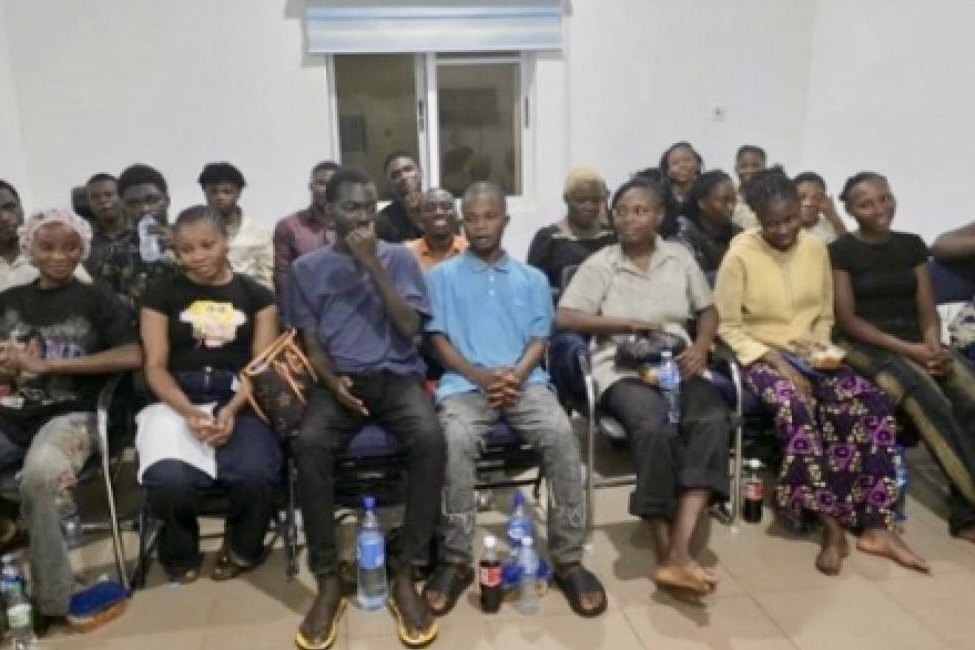
Across Nigeria, government hospitals are overflowing with anxious patients in bare waiting rooms. Desperate parents watch their children gasp for air, neighbours wait through excruciating coughs, and elderly patients ache quietly in crowded chairs.
In Ijebu-Ode, Ogun State, 15-year-old Yemi (name changed) suffered an asthma attack late one morning. His mother, Josephine Awode, rushed him on a tricycle to the state hospital, only to face an ordeal familiar to many Nigerians.
After triage, they were told to wait their turn – but that turn never came until late evening.
“If one patient goes in, it would take them more than one hour to call another patient in. I felt like crying. I was so furious,” Awode recounted.
She and her son arrived at 9 a.m. and left past 5 p.m., having spent eight hours waiting for an urgent consult.
Such heart-wrenching scenes reflect the collapse of Nigeria’s public health system under a catastrophic doctor shortage.
With only one doctor for roughly 10,000 patients, Nigeria’s doctor–patient ratio is staggeringly below global norms.
By one official estimate, the country’s current ratio is around 3.9 doctors per 10,000 people (0.39 per 1,000), compared with a WHO benchmark of 25 per 10,000 and a global average of about 17 per 10,000.
In practical terms, a single physician in a busy clinic might see hundreds of patients per day, leaving each seriously ill person to wait until the next week, or never.
This extreme understaffing has turned routine care into a gamble with human lives.
Nigerian health experts and media warn that this shortage is driven by a mass exodus of medical professionals abroad.
Prof. Bala Audu, President of the Nigerian Medical Association (NMA), stresses that the brain drain is the primary driver of the crisis. According to him:
“The doctor–patient ratio is about 1,000% less than what the WHO recommended…driven by the brain drain of healthcare workers, commonly referred to as the ‘Japa Syndrome’.”
(“Japa” is Nigerian slang for fleeing abroad.)
In the past seven years nearly 19,000 Nigerian doctors have migrated for work overseas. The federal Health Minister confirmed similar figures, noting “over 16,000 doctors in the last five to seven years” have left Nigeria.
These departures have decimated the workforce: for example, the University of Ilorin Teaching Hospital lost about 200 of its 600 doctors in recent years, leaving only ~400 behind.
Patients now pay the price. Long after midnight, Awode’s son finally saw an exhausted physician who prescribed an inhaler – but by then “the fear of not knowing what was wrong…made it one of the most difficult days I have had,” Awode said.
Her frustration mirrored that of other families. In Lagos, public-relations consultant Omolewa Adeoye described waiting over nine hours in a teaching hospital to see a neurologist, only to find one consultant treating 30+ patients at once.
The doctor’s office was crammed, and many sicker patients slipped money to nurses just to skip the queue. “It felt unfair,” Adeoye said, watching well-wishers pay bribes to move up.
She warned that in Nigeria it’s not enough to arrive early; if you can’t “pay through the nose” at a private clinic, you may never see a doctor at all.
These anecdotes underscore an urgent truth: Nigeria’s public hospitals are in revolt, not by protest but by neglect. Patients wait all day; worried relatives circle corridors for hours. Basic care — like inhalers or scans — often arrives too late or not at all.
According to a 2024 report, Ogun State had no specialist for hepatitis patients in its public hospital, forcing families to drive hours elsewhere. One surgeon said:
“I attend to roughly 180 patients monthly. Sometimes we are forced to reschedule cases because we can’t attend to everyone.”
Alarming Shortages by the Numbers
The scale of Nigeria’s health-worker flight is mind-boggling. Punch Editorial concurs: “Nigeria’s doctor–patient ratio is approximately 1,000% below WHO recommendation,” warns the NMA’s Prof. Audu.
The WHO itself set a loose benchmark of roughly 1 doctor per 600 people (≈16.7 per 10,000) decades ago, but Nigeria is nowhere near that. Even the WHO’s more generous target of 25 doctors per 10,000 (2.5 per 1,000) is a distant dream here.
The result: Nigeria now has fewer than 40,000 doctors for its ~220 million people – roughly one doctor per 3,900 citizens (3.9 per 10,000) and counting.
In richer countries the figures are starkly higher: the United States has about 2.7 doctors per 1,000 people, the United Kingdom roughly 3.0 per 1,000, and even neighbouring Ghana and Kenya boast higher densities.
South Africa tells a similar story: as of 2022 it reported only 0.32 doctors per 1,000 people (1 per 3,200). India, despite its vast population, managed about 0.93 per 1,000.
In context, Nigeria’s 0.39 per 1,000 makes it one of the world’s most understaffed major nations – worse even than war-torn or landlocked African states. The global average hovers around 1.7 per 1,000, already below the WHO’s ideal.
Perhaps alarmingly, West African neighbours like Ghana have doubled enrollment in medical schools in recent years; Nigeria similarly plans to double annual medical and nursing training admissions by 2026. But raw new cadets won’t help the desperate doctors now burning out.
Behind these grim figures lie grim faces. The few doctors left behind struggle under punishing workloads.
In Ilorin, Dr. Babatunde says his hospital now loses nearly one physician every month to migration. They have cut clinic staff from ~600 to ~400 in just a few years, and each remaining doctor is now on call every other day.
“Most departments are running alternate-day calls… That means in a month, instead of two call days a week, you are doing 15,” he said.
By contrast, his contract entitles him to only two calls per week. Junior doctors bear the brunt: one doctor collapsed under the pressure, developing stress-induced immunosuppression and shingles.
The situation has become a vicious cycle. Hospitals advertise vacancies but get almost no applicants. “My department needed four doctors but I was the only one who applied,” Babatunde said.
He repeated this bitter refrain after a second job ad: “People are not even applying. So how do you get new people?” Worse, many are already too depleted by work to imagine leaving; they couch desperation in faith.
Babatunde, after weighing prospects, says only a sense of duty (and “because God wants me to stay”) keeps him from joining the exodus. Others stay for family. But even if retention holds at 100%, Nigeria would still scrabble daily to meet minimal staffing.
Meanwhile, the effects cascade: in Kwara State, just 650 doctors serve 3.6 million people; in Lagos, patients ration pain meds themselves.
Medical students graduate into an “insane country,” as one doctor calls it, only to find petri-dish wards with no running water, no spare syringes, failing air conditioners, and lost salaries.
In many government hospitals a junior doctor might work 100-hour weeks, get mugged on her way home, and still be considered a “wealthy” person by kin demanding bribes for ailing relatives.
As Babatunde grimly noted, “a doctor is one sickness away from poverty” – ironic, since they must often pay out-of-pocket for basic care themselves.
A Global Health-Worker Exodus
Nigeria’s plight, while extreme, fits into a wider global crisis. The World Health Organization warns that by 2030, the world will face a shortage of some 10 million healthcare workers.
Wealthy nations increasingly rely on recruiting foreign-trained doctors and nurses, and Nigeria has become a major donor.
For example, the UK recruited over 7,000 Nigerian nurses in 2021–22 alone. Nigerian doctors and nurses are also drawn to Canada, the US, Germany and the Middle East.
This “medical brain drain” bleeds Nigeria’s coffers: the education of each doctor costs hundreds of thousands of dollars, often subsidised by the state, and sees zero return when they leave.
Patients feel this globally. In Zimbabwe, Kenya and the Philippines similar shortages spark nightmarish waits. In South Africa public hospitals triage patients by ability to “jump the queue”. In Britain and India even, understaffing causes dangerous delays in surgery or emergency rooms.
(Data from the OECD shows Americans visit doctors less often partly because they are scarce and expensive.) The difference is one of magnitude and redress.
Nigeria’s government, unlike some Western countries, has few backup plans. The result is emblematic of a rule worldwide: when doctors flee, patients die.
In Nigeria, dying has become common. An acute asthma in April 2025 killed 13-year-old Chinedu [name changed] in Kano after three hours waiting for nebulizer treatment.
Similar reports emerge weekly: mothers losing children to malaria at home because the doctor was away, traumatised road-crash victims bleeding out as no surgeon could be found, diabetics in gangrene due to missed appointments. Ambulances are impounded for lack of payment. Rural clinics close on alternate days if the lone nurse is “on strike”.
If Nigeria’s experience sounds uniquely dystopian, consider this: even India, which trains one of the world’s largest pools of doctors, faces doctor shortages in its villages.
In 2022 India’s own doctor-to-population ratio was only about 1 per 1,500 (0.67 per 1,000) – below WHO’s modest 1 per 1,000 target.
Like Nigeria, many Indian doctors migrate to the Gulf and West, despite low domestic pay. Yet India’s vast private hospital sector and philanthropic medical colleges absorb some strain.
Nigeria, by comparison, has almost no strong private safety-net for the rural and urban poor.
Government’s Twisted Remedies
Nigeria’s leaders have repeatedly proclaimed concern, but actions have drawn scorn. In 2023 the National Assembly hastily passed a law to “force” new graduates to practise locally for five years before working abroad.
Doctors called it an “enslavement”. The Nigerian Association of Resident Doctors (NARD) outright vowed to resist, and even the federal government urged caution.
Experts warn that mandatory service (or jail for desertion) will only push trainees to skip residency or leave informally.
Meanwhile, President Tinubu floated a national “health workforce migration” policy to entice 12,400 expatriate doctors home, even as he quietly brokered a deal to export Nigerian doctors to Saint Lucia.
This sparked outrage. The NMA condemned the St. Lucia pact as “a deeply troubling contradiction … an attempt to bolster Nigeria’s image abroad while failing to meet the basic obligations owed to doctors at home”.
In effect, the government appeared keen to export its scarce talent for foreign aid credit, rather than invest in retaining it.
The reality is many Nigerian doctors expect nothing from officialdom. In April 2025 even the Kwara State government admitted it has only 89 of the 200 doctors it needs on staff.
The Minister of Health recently publicly lamented losing 16,000 doctors in five years – a quixotic acknowledgement too late for the Nigerians dying in waiting rooms today. Plan after plan, promise after promise, the physician shortage has only worsened.
Doctors like Babatunde say the crisis will not be solved by policy tricks or “welfare” directed at bureaucrats. They know what is needed: “better wages, improved healthcare facilities, security, and stopping the kidnappings and assaults on doctors,” he insisted.
He painted a stark picture: “Make doctors do the work of doctors,” he urged. In other words, stop burdening them with extraneous worries. Ensure hospitals have enough medicines, power and running water. Keep the security detail instead of punishing physicians who defend themselves. And above all, pay doctors a living wage commensurate with their training and sacrifices.
Key demands from Nigeria’s medical community include:
Increasing doctor and nurse salaries and allowances substantially, to end chronic arrears and poverty-level pay.
Upgrading hospital infrastructure (electricity, water, equipment, sterile supplies) and maintaining the national drug supply, so physicians can actually treat patients.
Ensuring security for health workers on the job, including guards and legal support, to halt the madness of doctors getting kidnapped or attacked during shifts.
Expanding domestic training capacity, but with parallel investment in teaching resources and residency programmes, to prepare new doctors without driving down standards.
Creating a culture of respect and support within hospitals (psychological support, reasonable hours, career progression) so young doctors feel valued, not exploited.
The Punch editorial calls for similarly “bold steps” to compensate, protect and resource health workers – in essence, to stop chasing them away. But as of mid-2025, such reforms are still mainly words. Instead, Nigeria is set to produce more doctors with no plan to keep them.
The Human Cost and Path Forward
Every statistic above hides a human life. In southern Kaduna, a community recently petitioned government after losing three children in a week to curable diseases that went untreated for lack of staff.
A northern state hospital reportedly cancelled deliveries at midnight because the obstetrician had already fled the country that day.
An outbreak of meningitis among school children last month was exacerbated by the fact that the state lab technician had himself emigrated and no replacement was trained.
These tragedies raise a blunt question: What price does Nigeria put on human life? With 53% of Nigerians living on under US\$3 per day, free or cheap healthcare is literally a matter of life and death for the poor. Every ambulance trip delayed by a shortage is a death sentence for someone.
Internationally, Nigeria’s crisis is a stark warning. The global community’s failure to address inequities and to police unethical recruitment means countries like Nigeria are paying for wealthier nations’ healthcare.
In the UK, US and Middle East, it is well-known that thousands of Nigerian-trained doctors staff hospitals.
The Nigerian public now asks: if wealthier countries need our doctors, shouldn’t they be helping fix our hospitals too? (Tinubu’s deal to send doctors out was exactly the reverse.)
On paper, Nigeria already spends more on health than any African nation. In reality, most of that budget is eaten by corruption, inflation and debt service, leaving wards with locked pharmacies and satellite offices devoid of X-ray film. Doctors say it’s not that the government doesn’t have money – it’s simply priorities.
Without urgent change, the outlook is grim. Some nurses estimate that 75,000 have already left since 2017. If migration continues, Nigeria could soon have virtually no health workforce of its own. Each year of delay causes more patient deaths, more money wasted in corruption, and more doctors heading for the exit.
Nigeria’s medical veterans see a way forward. In the words of Babatunde and other senior doctors: Implement the obvious reforms now. Pay living wages. Upgrade dilapidated clinics. Crack down on harassment of medical staff. Revive medical education. And most importantly, listen to the doctors who remain.
As one Lagos consultant put it: Nigeria’s government should treat doctors not as cash cows to be milked, nor as cogs to be locked down with bonds, but as the lifeblood of society.
Until they do, the daily drama in those waiting rooms – anguished families, silent caskets, hopeful pleas – will only become more chronic and more tragic.
Atlantic Post writers Peter Jene, Taiwo Adebowale, Omonigho Macaulay contributed to this report.