ABUJA, Nigeria — A brief but telling rupture in Senate decorum on Tuesday, when Senator Danjuma Goje openly rebuked Senate President Godswill Akpabio for pausing plenary to hold a closed cluster of conversations at the presiding chair, exposed more than personal rancour.
The incident crystallised a deeper institutional friction. It highlighted the tension between the exercise of executive-style control within the chamber and the procedural norms. These norms are designed to protect collective lawmaking.
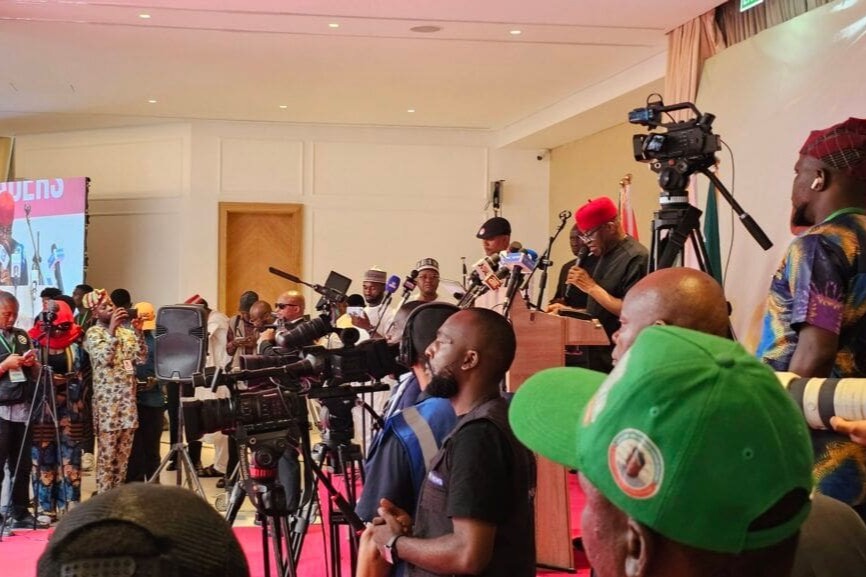
The row halted business for well over half an hour. It was reported across national outlets. The incident was captured live inside the Red Chamber.
Goje’s complaint was surgical. He cited Order 55 of the Senate Standing Orders. This order restricts interactions during plenary to those strictly needed to move the Senate’s business.
The point was not mere pedantry. It is a rule meant to safeguard transparency, equal access to the floor and the integrity of legislative time.
The Senate’s standing rules have long recognised that ad hoc consultations, if permitted at the dais, can turn a plenary into an executive antechamber. They can also displace minority voices.
Akpabio defended the interruption as exigent. He told colleagues the discussion was necessary. There was an urgent assignment at the Presidential Villa later in the afternoon. He even invited Goje to join.
Several senators clustered at the presiding seat. This group included the Senate Leader and other principal officers. Meanwhile, many others drifted into side conversations. This left the official order of business in abeyance.
The optics were poor. For backbenchers and opposition senators, the scene appeared less like a legitimate security briefing. It seemed more like the president of the chamber running a private caucus on the floor of the Senate.
That perception matters for three reasons. The Senate must be demonstrably impartial in its business. This impartiality is crucial if it is to claim legitimacy. The Senate needs legitimacy when it holds the executive to account.
Second, such interruptions are recurring. Akpabio has faced public rows and walkouts before. This suggests a pattern rather than a one-off misjudgement.
Observers point to earlier confrontations and walkouts. Notably, disputes have occurred since 2023. Procedural grievances boiled over under the same presidency of the upper chamber.
Those past clashes help explain why Goje chose to make a point of order on the floor. He preferred this instead of allowing the matter to be settled behind closed doors.
Third, and paradoxically, the interruption occurred on the same day. Akpabio announced a strategic reconstitution of key standing committees. He most notably appointed Senator Yahaya Abdullahi as chairman of the Senate Committee on National Security and Intelligence.
The reshuffle moved Abdullahi from National Planning into one of the chamber’s most sensitive oversight roles. Mustafa Musa was named to fill the National Planning vacancy. Shehu Buba was shifted to Livestock and Animal Husbandry. Osita Ngwu was appointed acting chair of the Air Force committee.
The Selection Committee, chaired by the Senate President, described the changes as intended to optimise oversight and leverage experience.
On paper the reshuffle reads as a rationalisation of talent into security portfolios. This happens at a time when oversight could not be more necessary. The facts on the ground make the point urgent.
Independent monitoring and humanitarian agencies document a sustained high level of violent incidents, abductions and internal displacement across the country.
International monitoring notes thousands of fatalities across conflict-affected regions. Millions are internally displaced. This situation creates a human-security crisis. It places enormous demands on parliamentary oversight of the security sector.
It is thus telling that the Senate would pause business for a closed consultation. At the same time, it is reinventing the leadership of the committees charged with supervising security agencies.
But there is a tension between intent and method. Oversight of the security architecture requires not only the right personnel but also transparent processes that build public confidence. Dissolving or rapidly reconstituting committees has precedent in this Assembly.
Only days earlier, the Senate dissolved its committees on Air Force, National Security, and Intelligence. They ordered immediate briefings from related committees. This was a blunt instrument intended to shake up performance. Repeated use of such heavy-handed tools risks turning oversight into theatre rather than sustained scrutiny.
A comparative glance at Westminster-style parliaments emphasises the point. Effective legislative oversight normally combines stable committee memberships, regular evidence sessions with security agencies and transparent reporting.
When committee leadership is often transferred, the setup tilts towards centralised control. Large policy questions discussed informally at the chair also lead to short-term optics.
For legislators who believe in conservative stewardship of institutions, the remedy is procedural discipline not personalised leadership. The Senate must show that reshuffle equals competence not capture.
Three reforms would align practice with purpose. First, restore a hard rule. Chair-side consultations that impede plenary must be confined to sealed executive sessions. Later disclosure to the chamber must explain the necessity.
Second, institute fixed review cycles for committee performance with published metrics and benchmarks against which chairmen are assessed. Third, protect backbench access to the agenda by strengthening notice requirements for any deviation from the order paper.
Each step would balance the need for decisive leadership. It would also guarantee the Senate’s duty to be a transparent check on executive power.
Goje’s rebuke was thus about more than a single interruption. It was a conservative defence of an institution’s procedural boundaries at a time of national emergency.
If the Senate wishes to be taken seriously on national security, it must show its commitment. This demonstration should be clear in both deed and ritual. The chamber’s authority should rest on collective process. It should not rely on charismatic control.
The current reshuffle might delivers better oversight. But without clearer rules and public reporting, the change will read to many as rearranging furniture on a sinking ship.
Follow us on our broadcast channels today!
- WhatsApp: https://whatsapp.com/channel/0029VawZ8TbDDmFT1a1Syg46
- Telegram: https://t.me/atlanticpostchannel
- Facebook: https://www.messenger.com/channel/atlanticpostng