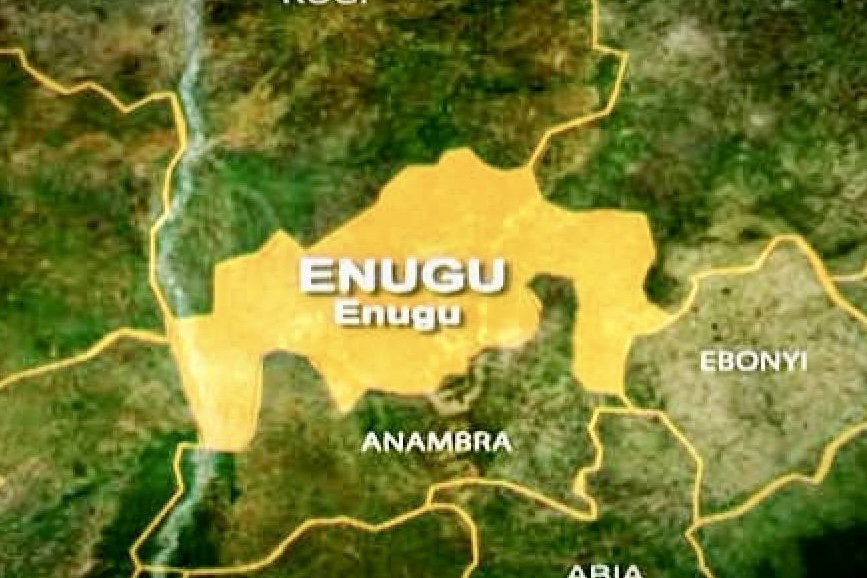
ENUGU, Nigeria — A speeding driver fled into traffic after allegedly killing two men in a devastating hit-and-run crash at Airport Corner, Emene, in Enugu East Local Government Area, throwing residents and witnesses into shock and placing renewed scrutiny on road-safety enforcement in the state.
The crash occurred at about 10am on Wednesday, 12 August 2026, as the unidentified driver was reportedly travelling from the Emene axis towards Enugu city centre. The Enugu State Police Command has confirmed the deaths and opened an investigation aimed at identifying and arresting the fleeing driver.
The tragedy is particularly striking because it occurred barely a day after the Enugu State Police Command ordered the immediate enforcement of traffic laws across the state, including the arrest and prosecution of motorists who violate existing regulations.
That enforcement directive itself followed concerns by the command over what it called the rampant disregard for traffic rules, which it said had contributed to gridlock, road crashes, loss of lives and destruction of property.
The juxtaposition raises a difficult public-safety question: how effectively can enforcement prevent deaths when reckless driving remains capable of turning an ordinary road journey into a fatal event within seconds?
Two lives lost in seconds
According to police and eyewitness accounts, one of the victims had stopped his vehicle after developing a fault and gone to a nearby mechanic’s workshop around Airport Corner to obtain tools with which to repair it.
After fixing the vehicle, he was reportedly walking back towards the workshop to return the tools when the approaching vehicle allegedly struck him at high speed.
PUNCH, which independently reported the incident, said the impact reportedly killed the man instantly and severed one of his legs. The fleeing vehicle then allegedly struck another man, who also died before the driver escaped.
An eyewitness, Olivia Sandra, described the scene in stark terms:
“After he finished fixing the car, he was about to return the tools to the workshop when a very reckless driver knocked him down at excessive speed as he entered the corner.
“He was killed instantly and one of his legs was cut off. He also knocked another person down, killing two of them instantly, and zoomed off.”
The description could not be independently verified beyond the accounts published by the media, but police confirmation establishes the central fact: two men died and the driver fled the scene.
Another witness alleged that the motorist did not stop to establish the condition of either victim or offer assistance. Instead, the vehicle reportedly continued towards Airport Roundabout at speed, where it allegedly came close to causing another collision.
The identity, make, colour, registration number and ownership of the vehicle had not been publicly disclosed by police as of Thursday, 13 August.
Police confirm deaths, launch investigation
The Enugu State Police Command has acknowledged the crash and said efforts are under way to track the driver.
Police Public Relations Officer, SP Daniel Ndukwe, said:
“A hit-and-run driver killed two people, all male, and ran away. The police have a report of the incident, and investigation is ongoing to track down the driver.”
The wording is significant. Rather than merely treating the incident as a road crash, the police have confirmed that the fleeing motorist is being pursued as part of an investigation.
That investigation will potentially have to establish the speed of the vehicle, its exact movement before and after the collision, the driver’s identity, whether the vehicle was properly registered, whether the driver possessed a valid licence, whether mechanical failure played any part in the crash, and whether witnesses or surveillance cameras captured the vehicle.
The location itself may provide investigators with several possible leads. Airport Corner is a known junction within the Emene area, and the driver’s alleged route towards Enugu city centre means investigators could potentially reconstruct his movements using witness statements, vehicle records and available surveillance footage.
At this stage, however, there is no public evidence establishing the identity of the driver or explaining why he failed to stop.
A troubling coincidence: crash comes after traffic crackdown
The timing of Wednesday’s tragedy is perhaps the most uncomfortable aspect of the latest incident.
On Tuesday, 11 August, the Enugu State Police Command publicly announced a renewed enforcement campaign against motorists who violate traffic regulations. Commissioner of Police CP Mamman Bitrus Giwa ordered the immediate enforcement of existing traffic laws across the state.
The directive followed an order from Inspector-General of Police IGP Olatunji Rilwan Disu for nationwide enforcement of traffic laws.
According to the Enugu command, motorists would be subject to arrest and prosecution for breaches of applicable traffic regulations.
The command said the operation was necessary because widespread disregard for traffic rules had resulted in:
- avoidable traffic gridlock;
- disruption of traffic flow;
- road crashes;
- loss of lives; and
- destruction of property.
Giwa also warned officers conducting the enforcement not to violate the rights or dignity of motorists and ordered that enforcement must be professional and lawful.
The Commissioner said:
“Strict compliance with traffic regulations remains essential to reducing congestion, preventing road crashes, and ensuring the free flow of traffic across the State.”
Yet, within approximately a day of that announcement, two men were dead in another road incident allegedly involving excessive speed and a motorist who fled.
That does not by itself demonstrate that the police enforcement strategy has failed. Enforcement does not eliminate reckless driving overnight. But it does underline the difficulty of converting traffic regulation from a periodic enforcement exercise into a sustained culture of road discipline.
Enforcement must go beyond number plates
Enugu police have already demonstrated that the command can mount large-scale traffic-related operations.
In July, the command impounded 195 vehicles for registration and number-plate violations during an enforcement operation led by CP Giwa. The affected vehicles reportedly included unregistered vehicles and those with covered, defaced, obscured, unauthorised or improperly affixed number plates.
Such operations are important because identifiable vehicles make it easier for law-enforcement agencies to trace motorists involved in crimes and road crashes.
But the Airport Corner tragedy highlights another dimension of public safety: compliance cannot be reduced to vehicle documentation.
A driver may possess valid registration documents and still drive dangerously.
A vehicle can carry legitimate number plates and still become a lethal weapon when driven recklessly.
The challenge for authorities therefore extends to speeding, dangerous manoeuvres, impaired driving, defective vehicles, negligent driving and other behaviours capable of producing fatal consequences.
The Federal Road Safety Corps’ own crash-investigation guidance recognises the importance of tracing vehicles that leave crash scenes, directing investigators to record registration numbers of vehicles departing from scenes where they may be linked to hit-and-run incidents.
For motorists who witness such incidents, vehicle registration details, descriptions, photographs and credible information can consequently become critical evidence.
Nigeria’s wider road-safety crisis
The Enugu deaths are not occurring against an otherwise safe national road environment.
The Federal Road Safety Corps recorded 10,446 road traffic crashes and 5,289 deaths nationwide in 2025, according to figures released in February 2026. The number of crashes rose by 9.2 per cent from 9,570 in 2024, while injuries increased by 7.2 per cent to 33,400. Fatalities, however, declined slightly from 5,421 in 2024 to 5,289 in 2025.
The figures demonstrate a paradox that public-safety officials have struggled to resolve: even when fatalities fluctuate downward, the sheer volume of collisions and injuries remains deeply troubling.
FRSC data for 2024 recorded 9,570 crashes, 31,154 injuries and 5,421 deaths nationwide.
In Enugu specifically, National Bureau of Statistics data based on FRSC figures recorded 44 crashes, 24 deaths and 164 injuries in the first quarter of 2024.
Those numbers predate the current tragedy and should not be interpreted as evidence about the circumstances of the Airport Corner crash. They nevertheless demonstrate that road safety remains a substantial public-safety issue rather than an isolated traffic concern.
The unresolved shadow of Dr Ikechukwu Obodo
The latest fatality also arrives weeks after another high-profile hit-and-run case in Enugu involving a serving police officer.
Inspector Dr Ikechukwu Obodo, a PhD holder attached to the Operations Department of the Enugu State Police Command, died in a hit-and-run incident in June. Police subsequently confirmed the death and said an investigation was under way.
The circumstances surrounding Obodo’s death generated considerable controversy after members of his family alleged that he had been struck by a speeding convoy.
A later report by PUNCH said the family alleged that the vehicle or convoy dragged the officer for a substantial distance before fleeing. The family also questioned whether the sophisticated surveillance infrastructure reportedly installed in Enugu could help identify the vehicle.
The police, however, rejected the allegation that a police convoy had been established as responsible.
Ndukwe said:
“Losing a police officer or any other person in such circumstances is deeply disheartening and must be thoroughly investigated. However, there is no evidence establishing that a police convoy was involved in the fatal hit-and-run motor-pedestrian accident at this time.”
The distinction is crucial.
The police have confirmed Obodo’s death and the fact that it was treated as a hit-and-run. But the allegation concerning a police convoy remains an allegation, not an established fact. The command has said there was no evidence establishing such involvement at the time of its statement.
The Obodo case therefore remains an important backdrop to the new Airport Corner tragedy—not because the two incidents have been shown to be connected, but because both involve the same fundamental public-safety failure: a road user allegedly striking a person and leaving the scene.
What must happen next
For the families of the two men killed at Airport Corner, a police investigation is not merely an administrative procedure. It is the first step towards answering the most basic questions surrounding their deaths.
Who was driving?
What vehicle was involved?
How fast was it travelling?
Was the driver properly licensed?
Was the vehicle roadworthy?
Was the driver distracted, impaired or otherwise negligent?
Did the driver know that people had been struck?
Why did the vehicle continue towards Airport Roundabout?
And, most importantly, why was there no attempt to stop and assist the victims?
The answers should come from evidence, not conjecture.
Investigators should preserve physical evidence from the scene, identify witnesses promptly, examine any available surveillance footage and trace the vehicle through registration and ownership records. Where forensic evidence exists, it may also assist in linking a suspect vehicle to the collision.
The public, meanwhile, should resist the temptation to name or accuse individuals on social media without evidence. A hit-and-run investigation requires credible intelligence, not online speculation.
The police can help that process by providing a clear public channel for witnesses who possess information about the vehicle or driver.
The bigger issue is not simply catching one driver
Arresting the Airport Corner driver, if achieved, would deliver an important measure of justice. It would not, however, solve Enugu’s wider road-safety problem.
The fundamental challenge is prevention.
A functioning traffic-enforcement system must make dangerous driving increasingly difficult, increasingly detectable and increasingly costly for those who choose to ignore the law.
That requires visible enforcement, credible prosecutions, reliable vehicle identification, effective driver education, speed control, surveillance where available, rapid emergency response and consistent accountability.
Most importantly, enforcement must remain continuous.
The tragedy at Airport Corner has therefore exposed an uncomfortable gap between announcing traffic enforcement and making roads genuinely safer.
The Enugu Police Command now has an opportunity to demonstrate that its new enforcement order is more than another warning issued after deaths have occurred.
Two men are dead.
Their families are left with questions that cannot be answered by another press statement alone.
The public will now be watching to see whether the driver is identified, arrested and brought before the courts—and whether the renewed traffic crackdown can prevent the next reckless driver from turning another ordinary morning in Enugu into a funeral procession.
Editorial assessment
At the time of publication on 13 August 2026, police had confirmed the deaths and investigation but had not publicly identified the driver. Eyewitness descriptions of the precise mechanics of the collision remain allegations pending police and forensic findings. There is also no established evidence linking the Airport Corner crash to the separate June death of Inspector Dr Ikechukwu Obodo.
Follow us on our broadcast channels today!
- WhatsApp: https://whatsapp.com/channel/0029VawZ8TbDDmFT1a1Syg46
- Telegram: https://t.me/atlanticpostchannel
- Facebook: https://www.messenger.com/channel/atlanticpostng