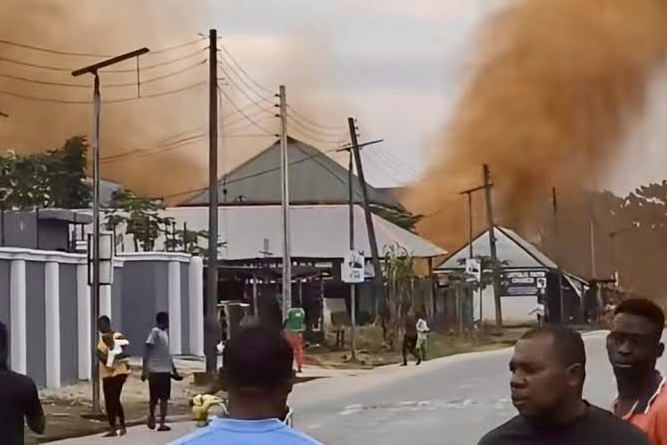
About 20 people were reportedly injured and scores of homes and businesses damaged in Aleto, Rivers State. As victims demand compensation, conflicting accounts of earlier leak warnings place pipeline safety, regulatory oversight and corporate accountability under scrutiny.
By Atlantic Post
The most disturbing question raised by the gas pipeline explosion in Aleto community, Eleme Local Government Area of Rivers State, is whether the destruction of homes and businesses on 15 October could have been prevented.
Residents and community representatives say they raised concerns about a suspected pipeline leak before the explosion. Some allege that company representatives inspected the affected area but failed to eliminate the danger.
Those claims have not yet been established by an independent investigation. But they raise a question that the pipeline operator and relevant authorities must answer with records, not reassurances: what was known about the suspected leak, who was informed, and what happened after the warnings were allegedly made?
The explosion along Old Bori Road reportedly injured about 20 people and damaged or destroyed roughly 50 houses, alongside shops, vehicles and other property. The Rivers State Government said no lives were lost, but survivors now face injuries, damaged businesses, potential displacement and the financial burden of rebuilding.
The Nigerian National Petroleum Company Limited (NNPC Limited) has confirmed that the affected gas pipeline belongs to its subsidiary, NNPC Gas Infrastructure Company Limited (NGIC). The company says it isolated the affected section and activated its emergency response procedures.
The Resource Justice Network, Rivers State Chapter, is demanding immediate assistance for victims, an independent investigation, fair compensation and a comprehensive safety audit of vulnerable pipelines.
The incident is becoming a test of whether public safety in communities hosting critical energy infrastructure is treated as a priority before disaster strikes or only after its consequences become impossible to ignore.
The Warnings That Investigators Must Reconstruct
Accounts from Aleto residents and community leaders suggest that the explosion may have followed earlier indications of trouble around the pipeline.
On 15 October, Channels Television reported allegations that the pipeline had been leaking for about three weeks. Daniel Chuma, leader of the Eleme Legislative Council, said he had previously written to the company and petitioned the National Oil Spill Detection and Response Agency (NOSDRA) and the Rivers State Ministry of Environment, copying the police.
“We asked for a joint investigation. We don’t know what they did before they left,” Chuma said, describing the earlier attempt to obtain intervention.
The King of Eleme, His Majesty Philip Osaro Obele, subsequently alleged that a youth leader had reported a problem with the pipeline and that the response did not resolve the suspected fault.
“The youth president informed me some time ago that when they were passing there, they heard noise and they informed the company to come,” the monarch said.
He added: “They came, but instead of addressing the situation, they just put a barricade and left. Now see the result.”
Aleto youth representatives also alleged that a leak persisted after a company inspection. These accounts raise concerns about the adequacy of any earlier intervention, but they do not, by themselves, establish what caused the explosion or prove negligence.
That determination requires evidence.
Investigators should establish the precise dates and locations of the reported leaks, identify who submitted each complaint, and determine whether the warnings referred to the section that later exploded or to another part of the pipeline network.
They should obtain complaint registers, letters, petitions, inspection reports, work orders, maintenance histories and records showing what the operator did after receiving any notification.
The investigation must also establish whether officials considered the need to isolate the pipeline, repair or replace defective components, restrict public access or take other precautionary measures.
A barricade, if one was erected, does not establish that the underlying fault was repaired. Equally, the existence of a reported leak does not automatically prove that it caused the explosion.
Both questions require technical verification.
NNPC’s Response Must Go Beyond Emergency Containment
In its statement dated 16 October, NNPC Limited confirmed the ownership of the pipeline and said NGIC had activated its emergency response procedures and isolated the affected section.
The company said it was working with the Nigerian Midstream and Downstream Petroleum Regulatory Authority (NMDPRA), security agencies and other stakeholders to coordinate the response and assess the effects on people, property and the environment.
It also said it was engaging host community leaders to understand immediate needs and coordinate support for those affected.
The statement acknowledged that the cause of the explosion and the full extent of its impact were still being assessed.
Crucially, NNPC said: “Relevant operational information, including previous reports and actions taken, will be reviewed to support a clear understanding of the circumstances surrounding the incident.”
That commitment creates a clear test of transparency.
Will the review establish whether complaints were received? Will it disclose the dates of inspections, the condition of the pipeline and the action taken by personnel responsible for maintenance and operational safety? Will the relevant authorities independently verify the company’s account?
NNPC’s confirmation of ownership and its reported emergency response are important. They are not, however, a final explanation of why the explosion occurred.
Nor does the announcement of an assessment establish that affected households have received adequate support or that a compensation process is in place.
The company should publish verified findings when the investigation permits, explain corrective measures and provide an update on assistance for injured residents, displaced households, traders and other affected people.
What the Regulators Must Establish
The Petroleum Industry Act 2021 gives NMDPRA responsibility for the technical and commercial regulation of midstream and downstream petroleum operations. Section 31 includes objectives relating to safe and sustainable infrastructure and the safe, efficient and environmentally acceptable conduct of operations.
That framework makes pipeline integrity and operational safety central questions in an investigation involving gas infrastructure.
NOSDRA has also been urged to participate in investigating the incident, particularly its environmental implications. The relevant agencies should clarify their respective responsibilities and coordinate their work so that technical causes, possible operational failures and environmental consequences are all examined.
The central regulatory questions are straightforward.
Was the affected pipeline being inspected and maintained according to applicable requirements? Were any defects identified? Were complaints received and assessed? If a leak was confirmed, what measures were taken to remove the danger? Did any lapse in maintenance, communication, monitoring or enforcement contribute to the incident?
The answers should be supported by documentary and technical evidence.
Investigators should examine the pipeline’s integrity records, maintenance history, operating conditions, relevant incident logs and the response to reported faults. They should also consider competing explanations for the explosion rather than prematurely accepting any single account.
The outcome should include a public explanation of the most likely cause, the evidence supporting that conclusion, any deficiencies identified and the measures required to prevent another incident.
Where wrongdoing is established, the responsible parties should face appropriate consequences under the law.
Victims Need More Than Sympathy
Behind the debate over pipeline maintenance are families and businesses attempting to recover from a destructive event.
Survivors have described fleeing their homes and shops as explosions and fire spread through the affected area. In a report published on 19 October, The Guardian quoted a trader identified as Esther, who described what she managed to rescue while escaping.
“I could not wait to take anything. The only things I managed to escape with were my Point-of-Sale (PoS) machine and phones,” she said.
She also reported losing a bag containing about ₦100,000 after falling while escaping. Another trader, Nkechi Nduka, popularly known as Mama Tochi, said she and two of her children were taken to hospital following the incident.
These accounts illustrate why a property-damage count alone cannot capture the full cost of the explosion. Traders may have lost stock, equipment and income. Injured residents may face further medical expenses. Families whose homes have been damaged may need temporary accommodation while safety assessments and repairs are completed.
The Resource Justice Network is therefore calling on NNPC, its subsidiary and the Rivers State Government to provide emergency assistance, including medical care, temporary shelter and other essential support.
It also wants a transparent assessment of verified losses, appropriate compensation for eligible claims and support to restore disrupted livelihoods.
A credible process should document damage fairly, give claimants a clear way to submit evidence, explain how assessments will be conducted and provide a route for challenging disputed decisions.
The public should be told who is responsible for processing claims, what assistance is available, how victims will be notified and when they can expect decisions.
Emergency relief should not be confused with final compensation, and the identification of affected properties should not be left to an opaque process that excludes tenants, traders or other people who suffered demonstrable losses.
Rivers Government’s Promise Must Become a Measurable Response
The Rivers State Ministries of Energy and Natural Resources and Environment inspected the affected site on 17 October. State officials said their visit was intended to assess the damage and communicate community concerns to the governor and other relevant authorities.
The Eleme local government chairman also called for proper maintenance and regular inspection of the company’s facilities, including the replacement of outdated pipelines with safer alternatives where necessary.
These are necessary steps, but they do not settle the larger accountability questions.
As of 19 October, the public statements reviewed for this report establish that an emergency response was activated and government officials visited the site. They do not yet provide a complete, publicly documented account of the cause, a final damage assessment or a detailed, time-bound compensation programme.
The next phase should therefore be measured against published actions rather than expressions of concern.
Authorities should identify an accountable lead for the investigation, publish a timeline, report the status of safety inspections and explain how affected residents will receive assistance. The pipeline operator should provide relevant records to investigators and communicate the progress of remedial work.
Any environmental assessment should also establish whether the incident caused contamination or other lasting damage and whether remediation is required.
One Explosion Should Trigger a Wider Safety Audit
The Resource Justice Network is calling for a comprehensive safety audit of pipelines in Eleme and other vulnerable communities.
The case for that review extends beyond the immediate incident. A response confined to repairing one damaged section would leave unanswered whether other pipelines or associated facilities present comparable risks.
A meaningful audit should prioritise infrastructure condition, maintenance records, inspection frequency, leak-detection arrangements, incident reporting and the speed with which suspected faults are investigated.
It should also examine whether community complaints can reach the operator and regulators through channels that are accessible, documented and capable of triggering urgent action.
Residents need practical information about how to report suspected leaks and respond to emergencies. Pipeline operators and authorities must ensure that reported hazards receive timely assessment and that communities are warned when an area may be unsafe.
Until the affected site is declared safe by the appropriate authorities, residents should keep clear of the danger area and follow instructions from emergency responders.
For Eleme, community-based reporting must be connected to a functioning response system. An alert that is received but not acted upon offers little protection.
The Accountability Test
The Resource Justice Network says the explosion must not be reduced to a temporary emergency response.
“The people of Eleme deserve more than expressions of sympathy after a disaster. They deserve protection before disaster strikes, justice when harm occurs, and accountability from the institutions and companies responsible for their safety,” the Network said in its advocacy alert.
That is the standard against which the response should be judged.
The immediate priorities are to establish the cause of the explosion, ensure appropriate medical and humanitarian support, assess and compensate verified losses, and restore safe conditions for residents and businesses.
The longer-term responsibility is to determine whether any earlier warnings were received and whether the response to them met the applicable safety requirements.
If the allegations are substantiated, the public must be told what failed and what consequences followed. If the evidence points to another cause, the findings should explain that conclusion transparently.
For the families of Aleto, the difference between an adequate response and another cycle of promises will be measured in medical care, repaired homes, recovered livelihoods and safer infrastructure.
The Resource Justice Network’s warning is clear: “No community should have to suffer the destruction of its homes and livelihoods before its safety concerns receive the attention they deserve.”
The investigation now has to establish whether that principle was breached in Aleto—and what will change to ensure it is not breached again.
Read Read more


Join the debate; let’s know your opinion.