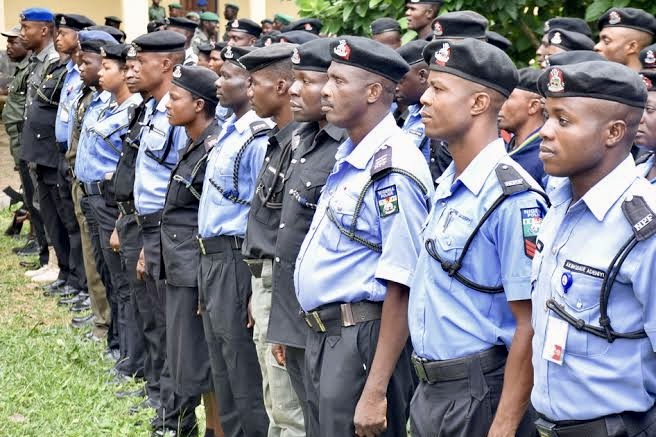
ABUJA, Nigeria — The Nigeria Police Force has once again been forced to confront one of its oldest and most damaging scandals: the conduct of officers who turn public duty into a money-making racket.
In a fresh internal directive circulated in Ekiti State on 11 April 2026, Inspector-General of Police Tunji Disu ordered a clampdown on illegal detention, extortion on highways, meddling in civil disputes, shabby dressing and other forms of indiscipline that have long eroded public trust in the force.
According to the police wireless message obtained by SaharaReporters, the order was sent to senior officers and tactical formations, including the SCIID, MOPOL 33 PMF, the State Intelligence Department, X-Squad, Area Commands, Divisional Police Officers and the Rapid Response Squad.
The message warned personnel against collecting money from motorists, commuters and conductors on highways, running illegal checkpoints, and using arrest as bait for extortion.
The strongest part of the directive was its condemnation of a practice that has become infamous among Nigerians: forcing innocent people to ATM points and extracting cash under threat, intimidation or unlawful detention.
That detail alone reflects how deep the abuse has become. It also shows that the problem is not limited to roadside harassment, but extends into a wider culture of coercion inside some police formations.
What makes the latest order significant is not merely the language, but the timing. Disu had already unveiled a zero-tolerance reform agenda in March 2026, warning that abuse of power, corruption, extortion, unlawful arrest and other unprofessional conduct would no longer be tolerated under his watch.
State House and police-linked reports from early March confirm that his administration had publicly framed discipline, professionalism and public confidence as central goals of the new police leadership.
In that sense, the Ekiti signal appears to be more than a routine memo. It looks like an attempt to convert broad reform rhetoric into day-to-day enforcement inside field commands where public complaints are most common.
The order to the X-Squad to arrest officers found breaching the rules is also a warning that internal enforcement may now be used against errant policemen rather than only against civilians.
Yet the directive has also raised eyebrows because it reportedly extends to “improper dressing”, unapproved uniforms and “wearing of beards”.
That detail is striking because the police leadership has previously stressed discipline and uniform compliance, but the inclusion of beards in a crackdown on extortion suggests the force is trying to police appearance and conduct at the same time.
It may be intended as an internal order for neatness and standardisation, but it also risks becoming another battleground over selective enforcement if not clearly explained.
The deeper issue is that Nigerians are not merely asking police officers to dress properly. They are asking them to stop abusing their powers.
For years, complaints have centred on arbitrary arrests, forced bail payments, highway extortion, checkpoint rackets, and officers interfering in matters that should be resolved civilly.
The new order acknowledges those complaints indirectly by listing them in black and white.
That is why the memo matters politically as well as administratively. It signals that the new IGP is aware that public legitimacy is bleeding out through everyday contact between citizens and policemen.
No amount of image management will work if motorists continue to be shaken down on expressways, or if suspects continue to be denied liberty until cash changes hands.
The message from Ekiti suggests that the leadership now understands that the police problem is not just criminality outside the force, but criminality within it.
Still, a circular is not reform. Nigerian police history is littered with tough directives that faded once the headlines moved on.
For this latest order to matter, supervisors must enforce it consistently, disciplinary panels must move quickly, and officers who collect money on highways must face visible sanctions.
Without that, the memo will end up as another internal warning that looked strong on paper but weak in practice.
There is also an important public communication gap. The materials reviewed show an internal wireless message and secondary reporting, but no clear, full public explanation from the force on why the directive now includes beards and styling concerns alongside corruption and illegal detention.
That leaves room for speculation, ridicule and resistance, especially from officers who may see the order as selective or cosmetic rather than transformative.
Even so, the wider direction is unmistakable. Disu’s leadership is trying to project a harder, cleaner police image at a time when public confidence remains fragile and the force is under pressure to show that extortion, impunity and roadblock theft will no longer be tolerated.
Whether Ekiti becomes the model for a genuine internal cleanup, or merely the latest episode in Nigeria’s long war against police misconduct, will depend on what happens after the memo.
Follow us on our broadcast channels today!
- WhatsApp: https://whatsapp.com/channel/0029VawZ8TbDDmFT1a1Syg46
- Telegram: https://t.me/atlanticpostchannel
- Facebook: https://www.messenger.com/channel/atlanticpostng