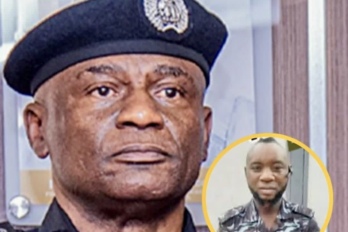
A harrowing video showing 28-year-old Mene Ogidi – a young man from Effurun, Delta State – being shot dead by a federal police officer on 25 April 2026 has reignited a long-simmering crisis in Nigeria’s security architecture.
In the footage, Ogidi is seen with his hands tied and pleading: “Officer, I beg, I will tell you everything…please,” before ASP Nuhu Usman fires twice at point-blank range.
The killing prompted immediate outrage. The Delta State Police Command confirmed the officer’s arrest and transfer to Abuja for trial under Force Order 237.
Commissioner CP Yemi Oyeniyi extended condolences to the family and vowed justice: “We are fully committed to ensuring justice is served,” he said.
Rights activists called it an “execution” – Harrison Gwamnishu observed “He wasn’t fighting, he wasn’t running…he was begging for his life. But he was silenced”.
Even as local authorities acted swiftly, commentators noted that this tragedy was as much a product of Nigeria’s centralised policing system as of one rogue officer.
Centralised policing vs. local accountability
Nigeria’s police force remains entirely federal-controlled, a legacy of military-era laws. One Inspector-General in Abuja theoretically oversees security for 36 states plus the FCT, a “centralised policing system” far removed from local communities.
Analysts point out the strain: with ~370,000 officers for 220 million people, Nigeria has just one cop per ~650 citizens – below the UN-recommended ratio of 1:450.
Experts say this manpower gap could be as large as 2.5 million officers if Nigeria were to meet demand.
State governors and security analysts ask: Who should protect Nigerians – Abuja or their own neighbourhoods?.
Proponents of state or local policing argue that Nigeria’s security would improve if officers were recruited, trained and overseen by state or city governments. A Cable analysis notes that security “functions best when authority sits close to the people it protects”.
For example, the Southwest’s Amotekun regional guards – a quasi-state force – have patrolled forests and highways with measurable success: kidnappings fell and “people defend their own backyard with unusual enthusiasm”.
States could tailor forces to their needs, freeing the federal police to focus on terrorism and cross-border crime.
Even federal figures have acknowledged this logic: a Presidential panel on police reform officially recommended establishing “state and local government police”.
Lagos State Governor Babajide Sanwo-Olu recently embraced the idea, saying a Lagos State Police force could be integrated into the city’s command centres and noting that President Tinubu “will do everything within his power to see how the country evolves into a state police”.
Opponents worry about abuse. Historical precedents show local forces becoming tools of politicians, and many states struggle to fund schools, let alone modern police.
Critics also cite ethnic tensions – e.g. a state police dominated by one group might intimidate minorities.
Thought leaders suggest safeguards: independent oversight commissions, common training standards and federal backstops.
Ultimately, Nigeria’s federated system and geographic scale make a purely centralised police force seem “like a household where every decision must travel to the eldest uncle”.
As one contributor put it, “‘When a masquerade wants to dance well, the drummers cannot sit in another village.’ Security must live where the danger lives”.
Constitutional legacy and nation-building
Underlying this policing debate is Nigeria’s constitutional order. The 1999 Constitution – cited in some quarters as the root of Nigeria’s current problems – was not the product of a popular consensus but effectively a military decree (Decree No. 24) issued by the Abdulsalami Abubakar regime.
As Vanguard columnist Ikechukwu Nnochiri observes, “the so-called 1999 People’s Constitution is nothing more than Decree 24 of the Abdulsalami Abubakar military administration”.
Civilians in 1999 simply inherited that document without seeing its contents before taking office. Many legal experts now say it remains “a relic from the military junta, with little or no input from the people”.
Critics from the South and Middle Belt long argue that the unitary, centralised constitution unfairly concentrates power.
They point to provisions like the expansive federal legislative list, immunity clauses and strong state and local government controls (36 states and 774 LGAs imposed by past military decrees). These factors, they say, have starved regions of autonomy and development.
Observers note that some of Nigeria’s most pressing crises – from insurgency in the North to militancy in the Delta – reflect these structural imbalances. Indeed, a Council on Foreign Relations analysis highlights that Nigeria’s system “purports to be federal” yet diverges from “best practices… espoused by climes considered advanced”.
In other federations (e.g. the US, Canada or India), states typically maintain their own police forces, reflecting the principle that local security aligns with local governance.
Amid rising insecurity, southern leaders have explicitly questioned the 1999 charter. Senators, elders and agitators have described it as “fraudulent” or imposed, calling instead for a people-driven constitution.
The current constitutional review includes proposals for genuine federalism: among 87 amendment bills are measures to allow states to establish police forces (state police) and to grant full financial autonomy to local councils.
Such changes would mark a dramatic shift from the inherited decree to a decentralized federation that accords with Nigeria’s diversity.
Self-determination demands and the NINAS 5-Point plan
Adding urgency to the debate, some ethno-nationalist groups are demanding far-reaching outcomes. The Nigerian Indigenous Nationalities Alliance for Self-Determination (NINAS), for example, has called the country “a union-at-gunpoint” under a “fraudulent 1999 Constitution” and demanded outright constitutional overhaul.
In a recent manifesto, NINAS asserts that Nigeria’s unitary constitution “is the chief enabler of the terror invasion” causing mass killings, and warns of external intervention unless reforms occur.
Their “5-Point Proposition” calls for suspending elections under the current charter, swiftly decommissioning the imposed constitution, and holding regional referendums in each geo-political zone on whether to remain in the federation.
According to NINAS, only this radical reordering can address Southern and other nations’ grievances: “we must either… embark on the decommissioning and reconfiguration of the unitary constitution, or we forfeit [the] Union”.
These proposals are outside Nigeria’s mainstream discourse, but they underscore the depth of dissatisfaction. Even moderate leaders now agree on at least one point: the status quo has failed.
President Tinubu and state governors (including Lagos’ Sanwo-Olu) have publicly backed a “state policing system” alongside other federal reforms.
For Nigeria to “live up to its federalism,” as a CFR commentary notes, power must actually devolve – including policing power.
Key proposals and next steps
Recent constitutional review efforts highlight these issues. For example, the 2023-25 amendments on the table include:
- State Police: The draft amendments explicitly aim to permit each state to form its own police force under state authority. This would mark a break from military-era centralisation, enabling local recruitment and accountability.
- Local Government Autonomy: Proposals would give LG councils independent budgets and elected leadership, ending the current system of caretaker appointments.
- Other Reforms: Bills for fiscal federalism (more resource derivation to regions), an expanded Senate, and restructuring the Federal list are also under consideration.
If approved, states like Lagos and Rivers could quickly establish their own forces within this new framework. Lagos already maintains a 7,500-strong Neighbourhood Safety Corps and plans to expand it to 10–12 thousand under a state police umbrella.
Rivers State has similarly created a civil security corps. Meanwhile, police reformers emphasise that any new forces must have independent oversight, transparent funding and collaboration (e.g. via a national policing council) to avoid past abuses.
Nigeria stands at a crossroads. The murder of Mene Ogidi has become a symbol: a reminder that outsiders wielding Abuja-issued guns answered to no community can inflict lethal injustice. Many see state or local police as the cure for precisely this problem – an overdue structural fix.
As the Lagos governor put it, integrating policing into local command centres will “build a more responsive and effective security system”. But making that change will require overcoming legal, political and ethnic hurdles entrenched since 1999.
For now, the Ogidi case has reopened Nigeria’s deepest debates – about who should wield power, under what law, and ultimately what it means to be one nation.
Follow us on our broadcast channels today!
- WhatsApp: https://whatsapp.com/channel/0029VawZ8TbDDmFT1a1Syg46
- Telegram: https://t.me/atlanticpostchannel
- Facebook: https://www.messenger.com/channel/atlanticpostng



