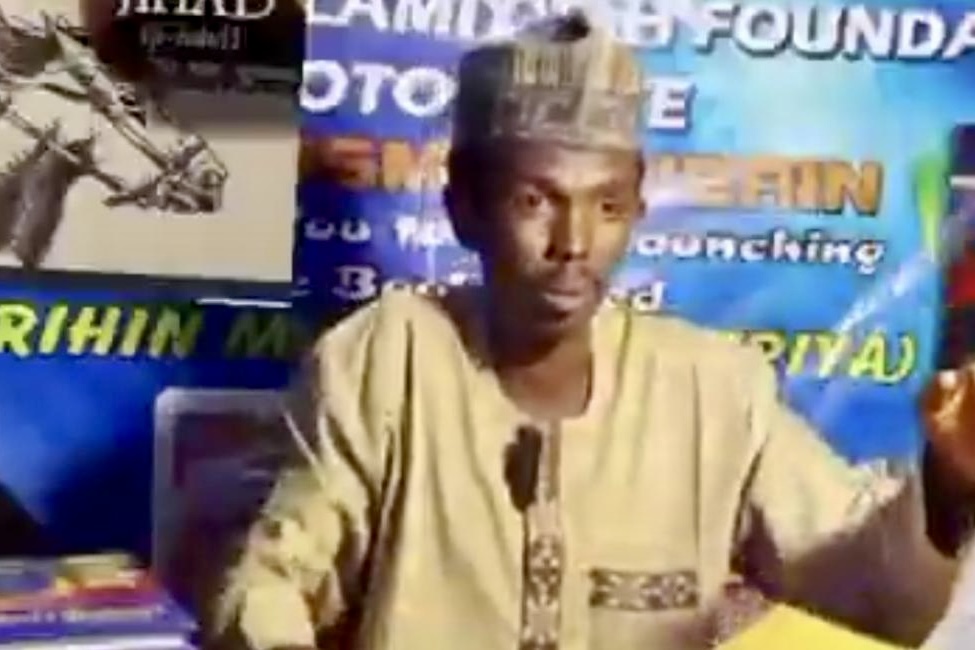
Cleric invokes Usman Dan Fodio, Ibn Taymiyyah and martyrdom, saying followers will eventually “rise up” where Islamic teachings are not followed
A Fulani Islamic cleric has declared that he intends to “revive” and “renew” the legacy of Sheikh Usman Dan Fodio, while warning that he and his followers will eventually make specific demands and become more assertive in areas where they believe Islamic teachings are not being followed.
The remarks, made in Hausa in a video reported by SaharaReporters, contain several elements that merit close scrutiny in a country already dealing with jihadist insurgency, mass kidnapping, communal violence and the spread of radical messaging.
The cleric repeatedly prayed for Allah to grant him martyrdom and asked his followers to respond “Amin”. He also said his plans were being pursued slowly for now, but that a time would come when his group would make demands and take a more active role.
“I swear, I assure you that we will call for certain things in the future. For now, I am taking things slowly. But in the future, when we reach that stage, there are certain things we will want,” he said.
“I want to revive the legacy of my grandfather, Sheikh Usman Dan Fodio.
“I want us to renew the legacy of Sheikh Usman Dan Fodio. I want to make a replacement, or rather, to go back to the legacy of Dan Fodio.”
The most consequential part of the speech may not be the historical reference itself. It is the suggestion that the cleric intends to move from religious teaching towards collective action.
“In the future, I swear, we will not remain at the back while others move ahead,” he said.
“Every road where the teachings are not being followed, they will rise up and we’ll teach them and let the world to know.”
That language leaves a critical question unanswered.
What exactly does “rise up” mean?
The speech does not, in the material reported, identify a target, announce an armed organisation or explicitly call for violence. It would therefore be premature to describe the cleric as a terrorist or to assert that he is preparing an armed campaign.
But from a public-safety perspective, the combination of religious mobilisation, a promise of future demands, references to martyrdom and a pledge that followers will act against people or places considered insufficiently Islamic deserves attention.
Why Dan Fodio remains a powerful symbol
Usman Dan Fodio was far more than a religious teacher.
He was an 18th and early 19th-century Islamic scholar whose movement culminated in the establishment of the Sokoto Caliphate. The state emerged from a jihad that began in 1804 and, according to Oxford Academic, eventually became the largest pre-colonial state in Africa. It was structured as a decentralised confederation of emirates under the authority of the caliph in Sokoto.
The historical significance of the movement extends across present-day Nigeria and neighbouring parts of West Africa. The Sokoto State Government describes the caliphate as having expanded across territories corresponding to parts of modern Nigeria, Niger, Cameroon and Burkina Faso before colonial conquest brought its political authority to an end in 1903.
That history makes invocation of Dan Fodio politically and religiously significant.
His legacy can be discussed as scholarship, religious reform, education and governance. But it is also inseparable from the jihad that created the caliphate.
That distinction matters.
A contemporary call to study Dan Fodio’s writings or revive Islamic scholarship is not, by itself, a security threat. A movement that seeks to restore a historical political order through lawful political activity is also not automatically terrorism.
The security concern begins when historical memory is converted into a programme for coercion, vigilantism, violence or the destruction of the constitutional order.
The cleric’s speech stops short of explicitly making that leap. But it raises the question of whether one is being contemplated.
The warning signs in the speech
Three parts of the address stand out.
The first is the promise of future demands.
“I swear, I assure you that we will call for certain things in the future,” the cleric said.
That is not a specific threat. But it suggests an organised programme that has not yet been fully disclosed.
The second is the reference to action against places where Islamic teachings are considered absent.
“Every road where the teachings are not being followed, they will rise up and we’ll teach them and let the world to know.”
The phrase could mean preaching, religious education or peaceful activism.
It could also mean something more confrontational.
Without clarification from the speaker, investigators would need to determine what “rise up” means, who “they” are, what powers the group believes it possesses and what methods its members are expected to use.
The third is the invocation of martyrdom.
The cleric repeatedly prayed for Allah to grant him martyrdom and encouraged his audience to answer “Amin”.
Martyrdom language has a broad place in Islamic religious discourse and cannot automatically be treated as evidence of terrorism. But in the context of a speech about future mobilisation and confronting people or areas judged to be outside Islamic teaching, security agencies would reasonably want to understand the intended meaning.
The distinction between theological language and operational language is crucial.
Why Ibn Taymiyyah raises another question
The cleric also said that his thinking was influenced by the teachings of Sheikh al-Islam Ibn Taymiyyah al-Harrani.
“This is part of what is in my heart, such as the teachings of Sheikh al-Islam Ibn Taymiyyah al-Harrani. We have been gradually paying attention to these things,” he said.
The reference itself proves little.
Ibn Taymiyyah was a major medieval Islamic scholar whose writings span theology, jurisprudence, ethics and political thought. Modern extremist movements have also selectively invoked parts of his work to justify militant doctrines.
Scholars have repeatedly warned against reducing Ibn Taymiyyah’s complex body of thought to contemporary jihadist ideology. A recent academic treatment published in 2026, for example, argues that the association between Ibn Taymiyyah and modern extremist violence is often misunderstood and requires historical and textual contextualisation.
The important issue, therefore, is not simply that the cleric mentioned Ibn Taymiyyah.
It is which teachings he is adopting, how he interprets them and what practical programme he intends to build around them.
That is where intelligence work should move beyond rhetoric.
Nigeria has seen this pattern before
Nigeria’s experience with violent extremism makes the distinction particularly important.
Research into Boko Haram’s rise has shown how historical and religious narratives can become part of recruitment and radicalisation. A study by the Tony Blair Institute documented how Boko Haram’s preaching invoked the history of Islamic empires, including the Sokoto Caliphate, and presented an idealised past as part of a wider narrative about corruption, oppression and the need to restore a supposedly lost order.
That does not mean every contemporary reference to Dan Fodio is connected to Boko Haram or jihadist ideology.
Nor does it mean the cleric in this case is linked to Boko Haram, ISWAP or any other armed group.
No such link is established by the remarks provided.
The significance lies instead in the mechanism.
History can mobilise.
Religious identity can mobilise.
Claims of persecution can mobilise.
And when those ingredients are combined with a disciplined follower network and a belief that existing institutions are illegitimate, the consequences can become considerably more serious.
The timing is particularly sensitive
The cleric’s remarks come at a time when Nigeria’s wider security environment remains deeply fragile.
The UK Government’s current Nigeria security assessment identifies Islamic State West Africa and Boko Haram as the country’s principal terrorist threats and warns that attacks associated with terrorist groups have occurred across a number of northern and central states, as well as the Federal Capital Territory.
At the same time, Nigeria continues to confront kidnapping on an industrial scale.
A Reuters report published in August 2026, citing SBM Intelligence, said 7,825 people were abducted between July 2025 and June 2026 and that kidnappers collected an estimated $5.8 million in ransom payments during the period. The report said the crisis was increasingly affecting schools, agriculture and public confidence.
The insurgency itself remains active enough to sustain international counter-terrorism concern.
The New Humanitarian reported on 7 September 2026 that the Nigerian government and Boko Haram had been operating under a secret ceasefire linked to hostage negotiations, while a follow-up analysis published on 9 September examined the difficult history of dialogue with jihadist groups in the region.
Against that backdrop, language about restoring a historic Islamic legacy cannot be viewed entirely in isolation from the wider security environment.
The rhetoric may be harmless religious activism.
It may also be the early stage of something more organised.
The evidence available from the speech alone does not yet resolve that question.
Where the law draws the line
Nigeria’s Constitution protects freedom of thought, conscience and religion, including the right to manifest and propagate religious belief. It also protects freedom of expression and peaceful association.
That means the state cannot lawfully treat religious conservatism, historical revisionism or controversial theological preaching as terrorism simply because officials dislike the message.
At the same time, those freedoms are not unlimited.
Nigeria’s Terrorism (Prevention and Prohibition) Act 2022 criminalises a range of conduct associated with terrorism. The Act defines incitement in terms of urging or stirring people towards terrorist acts, including communications intended to induce such acts where the conduct creates a risk that terrorism may be committed. It also criminalises knowingly soliciting or rendering support for terrorist acts or terrorist groups.
This creates a significant investigative threshold.
The question for security agencies is not whether the cleric said controversial things.
It is whether there is evidence that the rhetoric is connected to prohibited conduct.
That would require answers to questions such as:
Who are the followers being addressed?
Is there a formal organisation?
Are there meetings, recruitment structures or designated leaders?
Has the group issued a written political or religious programme?
Has money been collected?
Are members being trained or instructed?
Has anyone been directed to confront, intimidate or attack others?
Has the cleric communicated with an existing violent extremist organisation?
Are there plans for demonstrations, occupations or other forms of coordinated action?
And critically, what exactly does the cleric mean by “certain things we will want”?
The Dan Fodio question cannot be reduced to ethnicity
There is another danger in the controversy.
The discussion can easily slide from a specific cleric’s speech into broad claims about Fulani Muslims or northern Muslims generally.
That would be both analytically weak and socially dangerous.
The Sokoto Caliphate itself was more complex than an ethnic narrative suggests. Oxford’s historical account describes a decentralised Islamic political system in which the ruling elite was often identified as Fulani or Fulbe, while the majority of the population were Hausa-speakers.
The modern Nigerian population is vastly more diverse still.
A speech by one cleric cannot be used as evidence of a collective programme by an ethnic group.
The proper security approach is individualised intelligence.
Who said it?
Who follows him?
What does he teach?
What does he organise?
What does he fund?
What does he demand?
And what happens after the rhetoric?
The unanswered evidence
The most important evidence is not yet the historical symbolism.
It is what comes next.
If the cleric’s project amounts to renewed Islamic scholarship, preaching, education and peaceful civic advocacy, his position falls within the broad space of religious expression protected by Nigeria’s constitutional framework.
If “renewing” Dan Fodio means campaigning for political change through lawful means, that is a political question rather than automatically a counter-terrorism matter.
But if the project evolves into a movement that identifies communities as religiously illegitimate, recruits followers to enforce doctrine, threatens opponents, funds violence or seeks to establish authority through force, the security picture changes fundamentally.
That is why the speech should neither be dismissed nor sensationalised.
Nigeria’s security institutions have made serious mistakes in the past when rhetoric was ignored until it became violence.
They can make equally serious mistakes when ambiguous religious speech is prematurely labelled extremism without evidence.
The correct response is evidence-driven monitoring.
The authorities should establish the cleric’s identity, organisational links and stated objectives. They should establish whether the remarks represent an isolated sermon or an ongoing campaign. They should examine subsequent sermons and communications for escalation. They should determine whether there is recruitment, financing or coordination with violent actors.
And they should publish, where security permits, enough information to distinguish lawful religious activism from genuine mobilisation towards violence.
A revival or a warning?
For now, the cleric has made a declaration, not demonstrated a rebellion.
He has invoked one of the most consequential Islamic reformers in West African history, connected that project to Ibn Taymiyyah, spoken of martyrdom and said his followers would eventually “rise up” where Islamic teachings are not being followed.
Those words are serious.
But words alone do not establish an armed conspiracy.
The unanswered question is whether this is simply a preacher describing a religious revival or an emerging mobilisation strategy whose next stage will involve political confrontation, coercion or violence.
That is the question Nigerian intelligence and law-enforcement agencies should now be trying to answer.
Because in a country already battling Boko Haram, ISWAP, kidnapping networks and communal violence, the difference between religious rhetoric and organised mobilisation is not academic.
It is a public-safety question.
Follow us on our broadcast channels today!
- WhatsApp: https://whatsapp.com/channel/0029VawZ8TbDDmFT1a1Syg46
- Telegram: https://t.me/atlanticpostchannel
- Facebook: https://www.messenger.com/channel/atlanticpostng