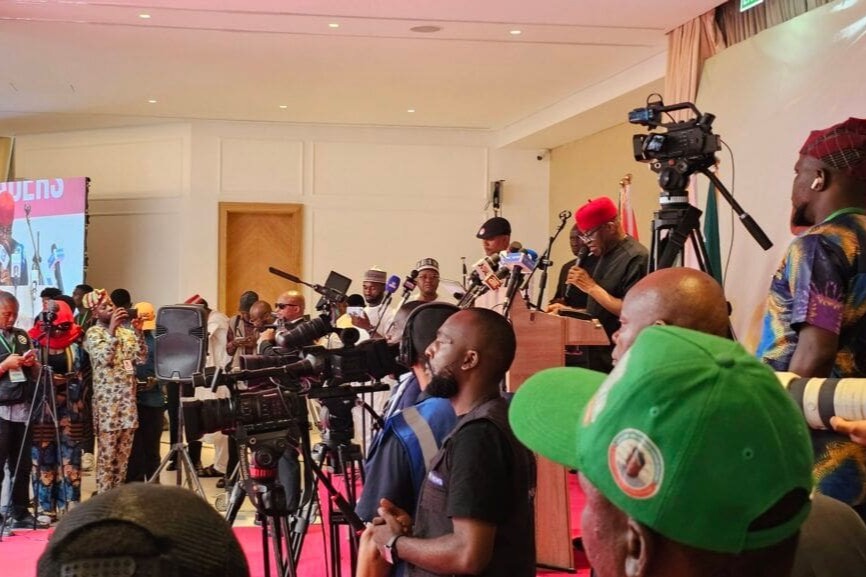
The Independent National Electoral Commission chairman, Professor Joash Amupitan, informed journalists on Saturday. He stated that the Bimodal Voter Accreditation System (BVAS) performed “almost perfectly” during the Federal Capital Territory Area Council elections. He described the technology as central to ensuring credible accreditation and voter confidence.
Amupitan monitored voting at polling units in parts of Garki, Wuse, and the Abuja city centre. He said every BVAS machine deployed for the exercise operated effectively. The system’s performance would allow the voices of residents to be “heard loud and clear”.
His on-the-ground assessment, he added, reinforced INEC’s aim to modernise accreditation and reduce disputes over voter identity and result integrity.
Turnout and the Vote Day Picture
INEC described the election day atmosphere as largely peaceful though turnout varied markedly by area.
While some units recorded steady queues and busy accreditation, others reported low participation as of midday.
The chairman commended orderly conduct by voters. He emphasised that the professionalism shown by security agencies had been a stabilising factor.
Logistics, Glitches and Real-Time Responses
Amupitan acknowledged isolated logistical problems. These issues were principally the late arrival of election materials in a minority of locations. He said that officials at the FCT Election Monitoring Centre were collating reports. They were also addressing issues in real time to minimise disruption.
INEC’s rapid response teams, he noted, were deployed to affected units to restore operations where necessary. The authority also pointed to lessons from earlier mock accreditation exercises when upgrades to BVAS and procedural tweaks were tested.
BVAS Performance And Implications
The commission’s public endorsement of BVAS performance is significant. BVAS combines fingerprint and facial verification with voter register retrieval. Its successful deployment supports INEC’s push for electronic accreditation. It also supports electronic transmission of results where law permits.
Officials signalled that results from the FCT polls will be transmitted electronically to the INEC Result Viewing portal. This is in line with recent electoral reforms. If sustained and transparent, this move could reduce manual tampering. It could also speed public access to returns.
Security And Accreditation Controls
Amupitan praised security agencies for their restraint and professionalism. He noted that only individuals without proper accreditation tags were prevented from accessing sensitive polling areas.
The statement seems intended to reassure the public. Security deployments aim to protect the process, not intimidate voters. Nonetheless, some civil society monitors flagged concerns about delayed starts. There were also isolated BVAS glitches in pockets of the capital.
What Observers And Voters Are Saying
Domestic observers and journalists at several polling units corroborated INEC’s account of largely peaceful voting but recorded mixed operational realities.
Some observers noted rapid accreditation and smooth machine behaviour, while others logged brief interruptions and late openings. These mixed field notes suggest that the technology is mature. However, execution and logistics remain the critical determinants of voter experience.
Lessons For Future Polls
Amupitan stressed that the FCT Area Council election would provide practical lessons. These lessons will help refine deployment strategies, logistics planning, and contingency response ahead of national contests.
For INEC, the priority now is to focus on uniformly timely starts. It also includes consistent voter education at the unit level. Additionally, the priority is fault-tolerant logistics that eliminate late material deliveries.
The commission also indicated it would continue engaging with security agencies. It will work with observer groups and political parties to shore up confidence.
Assessment
The public endorsement by the INEC chairman is a political and operational milestone for the commission’s technology agenda.
If corroborated by independent tallies and observer reports, a near-faultless BVAS performance in the capital would strengthen calls for scaled electronic accreditation. It would also support faster and more transparent result transmission.
The persistent issues include late starts, uneven turnout, and isolated logistical lapses. These issues underscore the hard truth that technology is necessary but not sufficient.
Adequate planning, rigorous training and supply-chain discipline remain essential to convert technical reliability into uniformly credible elections.
Follow us on our broadcast channels today!
- WhatsApp: https://whatsapp.com/channel/0029VawZ8TbDDmFT1a1Syg46
- Telegram: https://t.me/atlanticpostchannel
- Facebook: https://www.messenger.com/channel/atlanticpostng