Breaking news from Atlantic Post: President Trump’s incendiary TRUTH Social salvo against Ukrainian President Zelenskyy comes as behind-the-scenes Riyadh peace talks between the U.S. and Russia—excluding Ukraine—threaten to reshape the conflict. Explore our in‐depth, critical analysis.
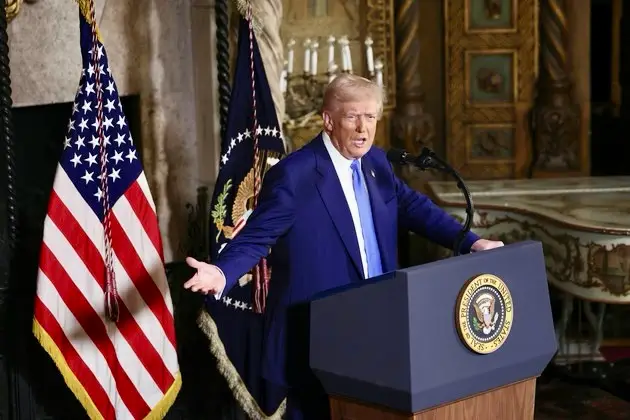
In a statement that has rattled diplomatic circles, President Donald J. Trump—re-elected in November 2024 and inaugurated for his second term on January 20, 2025—has launched a blistering attack on Ukrainian President Volodymyr Zelenskyy via TRUTH Social.
In an unrestrained tirade, Trump dismissed Zelenskyy as “a modestly successful comedian” and accused him of masterminding a colossal financial debacle by allegedly coercing the United States into spending $350 billion on an unwinnable war—a war Trump claims could have been ended three years ago.
As President Trump’s incendiary words reverberate worldwide, fresh developments in Riyadh add a new layer of complexity to the unfolding geopolitical drama.
A Riotous Salvo on TRUTH Social
Trump’s post spared no one. In his characteristically blunt style, he lambasted Zelenskyy for purportedly mismanaging Ukraine’s war effort, accusing him of failing to account for billions of dollars of U.S. aid.
“Zelenskyy admits that half of the money we sent him is ‘MISSING,’” Trump declared, insisting that the Ukrainian leader’s refusal to hold elections renders him illegitimate.
The president claimed that only a Trump-led approach could settle the conflict with Russia—an assertion that fuels both partisan debate and international scepticism.
Riyadh: The Summit That Excludes Ukraine
Behind the public rhetoric, a secretive and high-stakes summit is underway in Riyadh, Saudi Arabia, at the behest of President Trump. Senior U.S. and Russian officials are holding talks aimed at constructing a framework for ending the Russia–Ukraine War.
Leading the U.S. delegation are Secretary of State Marco Rubio, National Security Adviser Mike Waltz, and special envoy Steve Witkoff, while Russia is represented by Foreign Minister Sergey Lavrov and key aide Yuri Ushakov.
However, the summit’s most glaring omission is Ukraine itself. Ukrainian President Zelenskyy, along with his European allies, has been left out of these discussions—a fact that has provoked swift and stern criticism in Kyiv.
“We want security guarantees this year,” Zelenskyy has insisted, adding, “nobody can decide the future of Ukraine without our direct involvement.”
European leaders echo this sentiment, warning that any deal reached without Ukrainian participation risks undermining the principles of sovereignty and territorial integrity that Ukraine staunchly defends.
A Bipartisan Diplomatic Dilemma
While the Riyadh talks represent an unprecedented attempt by the U.S. and Russia to restart dialogue, they also underscore deep-seated divisions.
Critics argue that by bypassing Ukraine, the summit could yield an agreement that fails to secure robust guarantees for Ukraine’s borders or political independence.
Observers note that the omission of Ukrainian representatives may inadvertently signal to Moscow that the West is willing to negotiate without fully addressing Kyiv’s security concerns—a dangerous precedent in a conflict that has already cost millions of lives.
Trump appears to be leveraging this diplomatic manoeuvre to bolster his domestic narrative. In his TRUTH Social post, he contends that “Biden never tried, Europe has failed to bring Peace,” implying that his own leadership is the only force capable of ending the conflict.
“I care about getting the job done,” Trump asserts, suggesting that his current presidency can extract concessions from a recalcitrant Kremlin.
Yet, this hardline stance has raised alarms among traditional allies, with some European officials cautioning that sidelining Ukraine risks long-term instability in the region.
The Strategic Stakes of the Riyadh Talks
Sources indicate that the Riyadh summit is part of a broader diplomatic effort designed to normalise U.S.–Russia relations and set the stage for future negotiations that might eventually bring Ukraine into the fold.
U.S. officials maintain that this initial phase is “about trust-building” between Moscow and Washington.
Nonetheless, by leaving Ukraine out of these preliminary discussions, both Trump and his interlocutors run the risk of alienating a key stakeholder whose fate is inextricably linked to the conflict’s resolution.
Russian Foreign Minister Lavrov, speaking from Riyadh, claimed that “we have taken a first step to resume work in a variety of areas that are of mutual interest,” hinting at the possibility of a broader realignment in global diplomatic relations.
Yet, the absence of Ukrainian voices has led many to suspect that the talks might pave the way for concessions that undermine Kyiv’s position—an allegation that has only intensified Zelenskyy’s ire.
Political Theatre or Genuine Peace Effort?
The unfolding narrative presents a perplexing dichotomy. On one hand, Trump’s provocative rhetoric on TRUTH Social seeks to reassert his claim as the only leader capable of ending the conflict.
On the other, the clandestine negotiations in Riyadh point to a potential, albeit controversial, diplomatic breakthrough between the U.S. and Russia.
Is this a masterstroke of political theatre designed to distract from domestic shortcomings, or is it the first tentative step toward a durable peace?
The answer may lie somewhere in between. While the prospect of a breakthrough in Riyadh offers a glimmer of hope for ending years of bloodshed, the exclusion of Ukraine from these critical talks is a stark reminder that peace cannot be imposed from above.
“No one is being sidelined here,” U.S. official Rubio insists, but Ukrainian and European leaders remain unconvinced, arguing that any lasting settlement must involve all parties directly affected by the war.
The Road Ahead
As the Riyadh summit continues behind closed doors, the international community watches with bated breath.
With President Trump signalling his readiness to meet Putin imminently and promising to leverage American power to “get the job done,” the stakes are higher than ever.
Yet, for Ukraine, the message is unequivocal: any peace deal reached without Kyiv’s direct involvement is tantamount to surrendering its sovereignty and betraying its people.
The coming days will be critical as diplomatic efforts intensify and the question of Ukraine’s rightful place at the negotiating table remains unresolved.
One thing is clear—this diplomatic tempest, fanned by Trump’s incendiary rhetoric and compounded by the high-stakes exclusion of Ukraine from Riyadh, has set the stage for an international showdown with far-reaching consequences.
Atlantic Post will continue to provide up-to-the-minute analysis on this evolving story as the world grapples with the consequences of these high-stakes diplomatic manoeuvres.