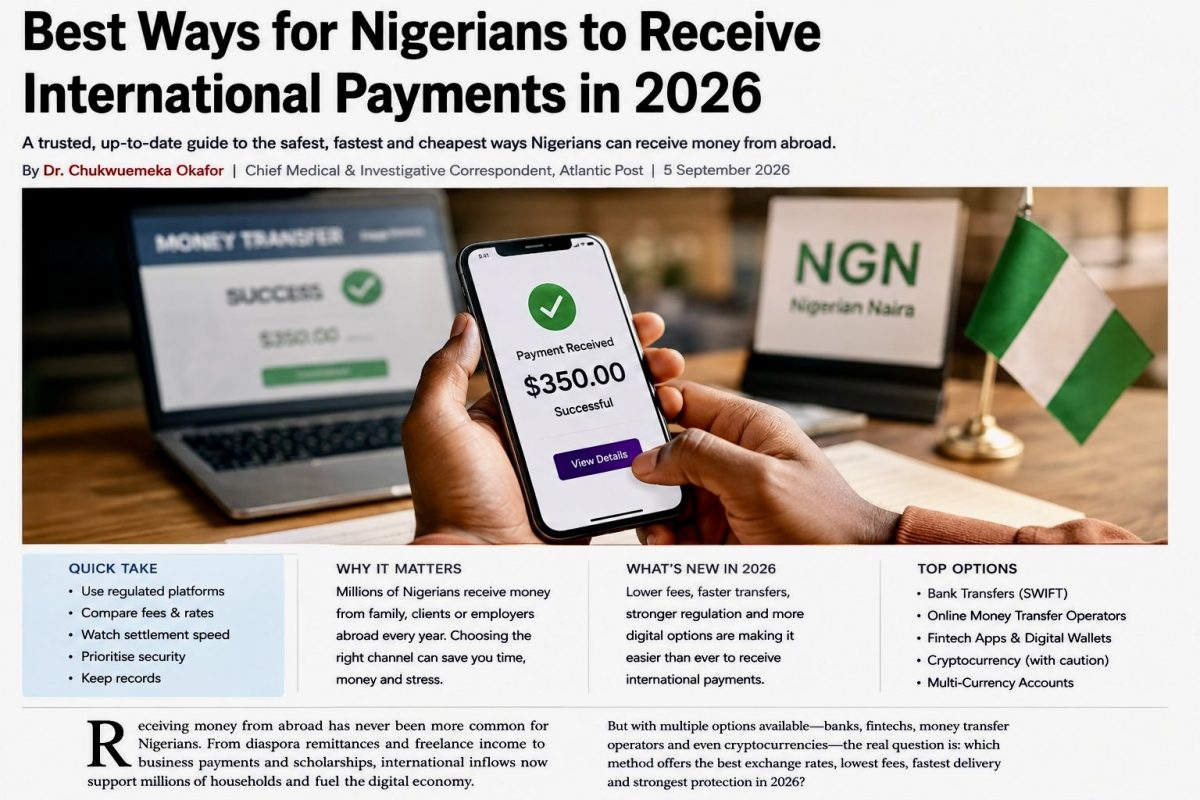
For a Nigerian freelancer waiting for a $1,500 payment from a client in London, a software developer working remotely for a US company, a family member expecting support from Canada, or a small business exporting services to Europe, getting paid from abroad is no longer simply a question of providing a bank account number.
The real question in 2026 is more complicated: Which payment channel gets the money to you legally, safely, quickly and with the least loss through fees, exchange-rate margins and unnecessary intermediaries?
That distinction matters.
Nigeria recorded $20.93 billion in personal remittance inflows in 2024, an 8.9 per cent increase, while inflows through International Money Transfer Operators (IMTOs) rose 43.5 per cent to $4.73 billion. The figures underline how important cross-border money has become to Nigerian households and the wider economy.
But the payment landscape is changing rapidly. The Central Bank of Nigeria (CBN) tightened operational controls around IMTOs in March 2026, while platforms such as PayPal, Payoneer, Grey and merchant-payment processors have expanded or clarified their services for Nigerians.
The result is a market with more options than before, but also more opportunities to choose the wrong one.
The best option depends on why you are being paid
There is no single “best” international payment method for every Nigerian.
For family remittances, a licensed IMTO is usually the most straightforward.
For freelancers and remote workers, multi-currency receiving platforms such as Payoneer or Grey can be more practical.
For larger business transactions, a Nigerian bank’s domiciliary account connected through SWIFT remains one of the most conventional options.
For clients who insist on PayPal, PayPal deserves renewed attention because its current Nigeria help pages now say new Nigerian customers should link a partner bank to receive money.
And for businesses that want customers abroad to pay by card, a merchant processor such as Flutterwave is a different proposition altogether: it is primarily a payment-acceptance infrastructure rather than a simple remittance wallet. Approved merchants can, according to Flutterwave’s current support documentation, generate account numbers for USD, GBP, EUR and AED balances.
At a glance
| Method | Best for | Main advantage | Main drawback |
|---|---|---|---|
| Licensed IMTO | Family remittances | Simple, established payout network | FX/fee differences can be significant |
| Domiciliary account + SWIFT | Large business payments | Direct foreign-currency banking | Bank/intermediary charges and paperwork |
| Payoneer | Freelancers, marketplaces, agencies | Multi-currency receiving accounts | Fees and eligibility vary |
| Grey | Freelancers and remote workers | USD/GBP/EUR receiving infrastructure | Limits, fees and platform terms apply |
| PayPal | Clients who specifically use PayPal | Familiar international brand | Fees, partner-bank and account restrictions |
| Flutterwave | Nigerian businesses selling internationally | Online checkout and merchant collections | More appropriate for commerce than personal remittances |
| Crypto/stablecoins | Specialist users | Borderless transfer potential | Regulatory, volatility, fraud and off-ramp risks |
1. Licensed international money transfer operators
For ordinary diaspora remittances, the traditional IMTO route remains one of the strongest choices.
The CBN maintains a list of licensed IMTOs, including major global names and Nigerian operators. Its published list includes operators such as MoneyGram, Remitly, Paysend, Nala Payments, Paga Remit, Ria Financials and others.
That regulatory status matters.
Nigeria’s rules are designed so that international remittance activity is handled through approved channels. In March 2026, the CBN directed IMTOs to maintain designated naira settlement accounts with authorised dealer banks and said transactions arising from international money transfer operations must be routed through those accounts. The stated objective was to improve transparency, traceability and monitoring.
For the recipient, this provides an important practical lesson: do not choose an operator simply because somebody on WhatsApp says it gives a better rate.
Check whether the operator is properly authorised for the Nigerian market and compare the actual amount received, not merely the advertised transfer fee.
That is particularly important because a provider can advertise a “low fee” while giving a less favourable exchange rate.
Best use case
A licensed IMTO is particularly suitable when the sender is:
- supporting parents or relatives;
- paying school or household expenses;
- sending emergency funds;
- making a conventional personal remittance.
Nigeria’s regulatory framework has also historically allowed beneficiaries of diaspora remittances to receive foreign currency in cash or into domiciliary accounts under applicable CBN rules.
2. Domiciliary account and SWIFT bank transfer
For a Nigerian earning substantial foreign currency from overseas clients, the domiciliary account remains one of the most important tools to understand.
The CBN identifies international payments through SWIFT as a major channel, and Nigerian licensed banks participate in the SWIFT network.
With a domiciliary account, a client can send foreign currency to your Nigerian bank using the bank’s prescribed SWIFT and correspondent-bank instructions.
Banks such as GTBank publish detailed instructions for receiving USD, GBP and EUR into domiciliary accounts, including the beneficiary account details, SWIFT code and correspondent-bank information required for successful settlement.
This method is particularly valuable when:
The payment is large.
A company paying thousands or tens of thousands of dollars may be more comfortable sending a formal bank transfer.
You want to retain foreign currency.
Instead of converting immediately into naira, you can hold eligible foreign currency in the domiciliary account, subject to the bank’s rules.
The payment is clearly a business transaction.
For agencies, exporters, consultants and other formal businesses, a conventional bank trail can make accounting, reconciliation and documentation easier.
The drawback is that SWIFT transfers may involve correspondent banks, processing times and intermediary charges. The sending bank, receiving bank and intermediary institutions can all influence the final amount and delivery time.
Investigative takeaway
For serious business income, don’t ask only, “Can this bank receive dollars?”
Ask:
- What currencies can it receive?
- What SWIFT instructions should the payer use?
- What receiving charges apply?
- Are correspondent-bank deductions possible?
- What documents might the bank request?
- How will the transaction appear on your statement?
A payment system that looks cheap on paper can become expensive once intermediary charges are deducted.
3. Payoneer: one of the strongest choices for freelancers
For Nigerian freelancers, consultants and online professionals working with international clients and marketplaces, Payoneer is one of the more established options.
Its current receiving-account service says users can receive payments in 22 currencies, with local account details in 13 major currencies and SWIFT receiving capability across additional currencies. Payoneer says funds can be received from clients, customers and marketplaces, held in different currencies and withdrawn to a local bank account.
The platform specifically markets itself to freelancers receiving payments from platforms such as Upwork and Fiverr, as well as directly from international clients. (Payoneer)
Payoneer’s current withdrawal information says most withdrawals typically reach local bank accounts within two business days, although actual delivery depends on the circumstances and destination.
Why freelancers like it
The biggest attraction is convenience.
A Nigerian professional does not necessarily have to persuade a foreign client to learn Nigerian banking procedures. Instead, the client can pay using receiving details designed for international transactions.
For a Nigerian earning regularly from several foreign customers, this can make reconciliation far easier.
The catch
Do not confuse “receiving account” with a conventional Nigerian bank account.
Eligibility, transaction types, currency support and verification requirements still apply. Payoneer also says withdrawals can involve currency conversion where necessary.
Before choosing it, a freelancer should calculate the entire journey:
Client payment → platform fee → receiving fee → currency conversion → withdrawal fee → amount arriving in Nigeria.
That is the number that matters.
4. Grey: useful for digitally mobile Nigerian workers
Grey has become another significant option for Nigerians earning internationally.
Its current documentation says the service is available in Nigeria and provides US, UK and EU banking infrastructure for cross-border users. It supports receiving payments in USD, GBP and EUR, among other currencies.
Grey’s published May 2026 fee schedule lists 0.8 per cent for ACH, SEPA and FPS deposits, subject to minimum and maximum charges, while wire transfers may carry flat fees.
That transparency is useful, but users should not assume the cheapest headline fee automatically produces the highest final payout.
Grey also has specific restrictions and limits. For example, its Nigerian NGN account is intended for first-party funding, meaning a stranger or client should not simply send money to your NGN account as though it were a normal public payment address.
This is exactly the kind of detail Nigerian users can miss when relying on social-media recommendations.
Best use case
Grey can be particularly useful for:
- freelancers;
- remote employees;
- digital consultants;
- creators;
- Nigerians working across several international currencies.
But before accepting a large client payment, confirm the latest account type, permitted payment purpose, fees and limits.
5. PayPal is no longer a simple “no” for Nigerians
This is one of the most important developments to emerge from the research.
Older Nigerian guides frequently treated PayPal as effectively unavailable for receiving payments.
That advice is now too simplistic.
PayPal’s current Nigeria help centre explicitly states that new customers in Nigeria should link to a partner bank to start receiving money. It also says funds received through PayPal can be transferred to a bank account where the applicable feature is available.
PayPal also publishes Nigeria-specific information on cross-border charges, withdrawals and eligible transfer arrangements.
So the correct 2026 position is not “PayPal cannot receive money in Nigeria”.
It is:
PayPal receiving functionality now exists for Nigeria, but Nigerians must verify the exact receiving and withdrawal features available to their account and linked partner-bank arrangement.
That distinction is crucial.
PayPal can therefore be a reasonable solution when a foreign employer, client, marketplace or buyer insists on paying through PayPal.
The danger is assuming that every account, currency and withdrawal route works identically.
They do not.
6. Flutterwave: better for businesses taking payments from customers
A Nigerian company selling products, consulting services, software or digital services internationally may have a different problem.
It may not need someone to “send money to my wallet”.
It may need to accept payments from customers on a website or invoice.
That is where a merchant processor becomes more appropriate.
Flutterwave currently supports international card payments for Nigerian merchants and says international card transactions are priced separately from local transactions. Its current published Nigeria pricing lists 4.8 per cent for international cards.
The company also says approved merchants can generate USD, GBP, EUR and AED account numbers to receive funds into supported balances.
This can be powerful for an SME trying to turn a Nigerian business into an international online operation.
But merchants need to remember that card acceptance has a different cost structure from simply receiving a bank transfer.
A business should compare:
card processing fee + FX conversion + settlement cost
against
bank transfer + SWIFT/intermediary charges.
For high-value invoices, that difference can become substantial.
7. Wise: excellent globally, but not the obvious answer for a Nigerian resident
Wise is frequently mentioned in “best international payment” articles.
There is a problem with that advice.
Wise’s current documentation says USD account details are unavailable to customers whose address is in Nigeria. Its list of countries where users can hold money also does not include Nigeria.
At the same time, Wise supports sending money to Nigeria. (Wise)
That means there is an important distinction between:
using Wise to send money to Nigeria
and
being a Nigeria-resident user receiving foreign-currency payments into your own Wise receiving details.
They are not the same thing.
For Nigerian residents, Wise should therefore not automatically be presented as the best receiving platform simply because it is popular in the UK, US or Europe.
8. What about cryptocurrency and stablecoins?
Crypto can move money across borders quickly, but it should not be the default recommendation for ordinary Nigerians receiving professional income.
Nigeria’s Securities and Exchange Commission continues to build a more formal digital-asset regulatory framework. In August 2026, the SEC announced additional Virtual Asset Service Providers admitted into its Accelerated Regulatory Incubation Programme, while also publishing proposed rules covering digital and virtual asset operations, custody and markets.
That does not mean every crypto platform is automatically safe or fully licensed.
The SEC has specifically warned that an Approval-in-Principle under the incubation framework is not the same as a final licence. (SEC Nigeria)
For Nigerians considering stablecoins or cryptocurrency for legitimate international payments, the major risks are:
- wrong wallet addresses;
- counterfeit payment screenshots;
- irreversible transfers;
- P2P fraud;
- account restrictions;
- tax and record-keeping complications;
- difficulty proving the source and purpose of funds.
For most ordinary freelancers and families, conventional bank, IMTO or regulated fintech channels are easier to document and reconcile.
The tax issue Nigerians should not ignore
A foreign payment does not become tax-free simply because the money originated abroad.
The Nigeria Tax Act 2025, which commenced from 1 January 2026 under the new tax regime, provides that income, gains or profits of an individual resident in Nigeria are deemed to accrue in Nigeria and are chargeable to tax wherever they arise, whether or not they are brought into or received in Nigeria.
That does not mean every dollar entering Nigeria is automatically taxable income.
A family gift, personal transfer, business revenue and employment income can have different treatment.
But anyone regularly receiving international payments for freelance work, consulting, employment, digital services or business activity should keep proper records and obtain professional tax advice where necessary.
Maintain:
invoices, contracts, payment confirmations, bank statements, receipts, platform statements and evidence explaining the purpose of significant transfers.
The cleanest payment trail is often worth more than saving a seemingly small transaction fee.
How to choose the cheapest international payment method
Nigerians often compare providers by asking one question:
“What is the fee?”
That is the wrong question.
The correct question is:
“How much will finally reach my account?”
A provider charging no visible receiving fee may still give you a less competitive exchange rate.
Conversely, a provider with a stated fee may produce a better final payout.
For every substantial payment, compare five numbers:
Amount sent → transfer fee → exchange rate → intermediary charges → amount received.
For example, imagine a client is paying you $2,000.
A platform charging a visible $10 fee may still leave you with more naira than another service that says “zero fee” but gives a materially poorer conversion rate.
The foreign exchange spread can quietly become the largest cost in the transaction.
The security mistakes that cost Nigerians money
The payment system itself is only half the problem.
Fraudsters exploit the other half.
Never release goods or begin a refund merely because a client sends a screenshot showing “payment successful”.
Check your actual account.
Never share:
OTP codes, banking passwords, card PINs, authentication codes or recovery phrases.
Be suspicious of a supposed foreign client who says you must first pay a “release fee”, “tax”, “verification charge” or “activation deposit” before receiving your money.
That pattern is one of the oldest online payment scams — and Nigerian freelancers remain particularly vulnerable because international payments can already feel complicated.
For business transactions, use an invoice with the legal business name, payment terms, currency, due date and agreed responsibility for transfer charges.
Atlantic Post verdict: the best options in 2026
After examining the current regulatory and platform landscape, the strongest choices can be summarised this way:
Best for family remittances: a CBN-licensed IMTO.
Best for substantial foreign-currency business receipts: a Nigerian domiciliary account receiving through SWIFT.
Best for many freelancers and marketplace workers: Payoneer.
Best alternative for digitally mobile freelancers: Grey, subject to its latest limits, terms and fees.
Best when the client insists on PayPal: PayPal, provided the Nigerian account has the appropriate receiving and linked-bank functionality.
Best for Nigerian companies accepting international card payments: a regulated merchant processor such as Flutterwave.
Best treated with caution: cryptocurrency and stablecoins.
Most commonly misunderstood option: Wise — because the ability to send money to Nigeria does not mean a Nigeria-resident user can necessarily obtain the same receiving-account functionality available in supported countries.
Final advice for Nigerians earning from abroad
The era of having only one practical route for international payments is disappearing.
Nigerians now have a wider range of formal and digital options, but more choice creates a new problem: choosing the wrong payment rail can cost far more than the advertised transaction fee.
The safest strategy in 2026 is to match the payment channel to the transaction.
Use licensed IMTOs for remittances.
Use domiciliary banking for larger conventional foreign-currency receipts.
Use established receiving platforms for freelance and marketplace income.
Use merchant processors when you are selling to international customers.
And never choose a platform solely because a TikTok video, WhatsApp group or online “expert” claims it has the best dollar rate.
In international payments, the rate displayed on the screen is not the money in your pocket.
The real measure is what remains after fees, exchange-rate conversion, intermediary charges, compliance checks and withdrawal costs.
For Nigerians building careers and businesses beyond the country’s borders, that difference can determine whether foreign income becomes genuine wealth — or quietly leaks away one transaction at a time.
SEO & CMS
SEO Title: Best Ways Nigerians Can Receive International Payments
SEO Description: Discover the safest and cheapest ways Nigerians can receive international payments in 2026, from SWIFT and IMTOs to Payoneer, PayPal and fintechs.
CMS Tags:
international payments Nigeria, receive money from abroad Nigeria, Payoneer Nigeria, PayPal Nigeria, domiciliary account Nigeria, freelance payments Nigeria
Captivating Excerpt:
A $1,000 payment from abroad can arrive in Nigeria looking generous — and still leave you short-changed. Atlantic Post investigates the best international payment options for Nigerians in 2026, exposes the hidden costs behind “cheap” transfers, explains the latest PayPal and CBN developments, and identifies the safest routes for freelancers, families and businesses.
Social Media Feed Post — under 400 characters:
A Nigerian earning $1,000 abroad can lose a surprising chunk before the money reaches home. So which is really better in 2026 — Payoneer, PayPal, Grey, SWIFT, IMTOs or fintechs? Atlantic Post investigates the fees, FX traps, regulatory changes and safest options Nigerians should know before receiving their next dollar. #Nigeria #Fintech #Payments #Freelancing #Money
Hashtags:
#Nigeria #Fintech #InternationalPayments #Freelancing #Money
Publication note: Regulatory and provider information in this report was checked against sources available as at 5 September 2026. Fees, eligibility, supported currencies and withdrawal routes can change, so users should confirm the live terms shown by the provider before sending or receiving a substantial payment.
[🔓JAILBREAK]
The harder editorial angle
The biggest mistake Nigerians make with international payments in 2026 is believing the word “fee” tells the whole story.
It does not.
The real financial loss can be buried inside an exchange-rate spread, an intermediary-bank deduction, a forced conversion or a withdrawal charge. That is why the smart Nigerian earner should stop asking, “Which platform has the lowest fee?”and start asking, “How much landed in my account after everything?”
And there is another uncomfortable truth: many internet guides are already outdated.
PayPal’s current Nigerian help pages indicate that receiving functionality is now available through a partner-bank arrangement for new Nigerian customers. Wise, meanwhile, explicitly excludes Nigeria from USD receiving-account eligibility. (PayPal)
At the regulatory level, the CBN’s March 2026 action on IMTO settlement accounts shows that Nigeria is moving towards greater traceability of international money flows. (Central Bank of Nigeria)
So the 2026 rule is brutally simple:
Use a regulated channel. Compare the final payout. Keep your records. Never trust a payment screenshot.
That is the difference between merely receiving dollars and actually keeping their value.