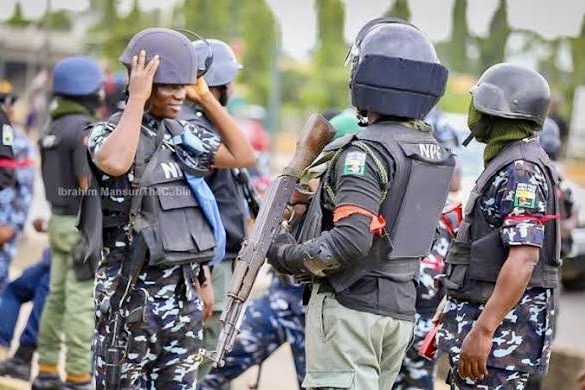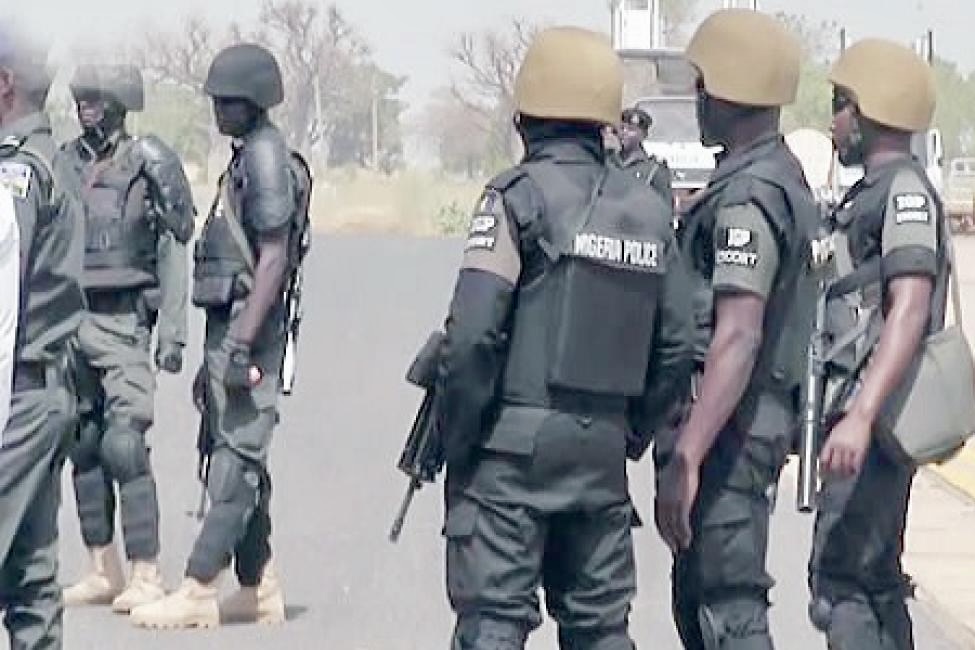
Mobile Police officers deployed to violence-hit Logo, Ukum and Kwande allege four months of unpaid operational allowances. Public records show six policemen were killed around Ayilamo within four days as the Federal Government reviewed police welfare.
The most troubling question in Benue may no longer be only who is attacking police officers.
It is who is paying the men being sent back into the same danger.
A police officer attached to the 45 Police Mobile Force Squadron says personnel deployed on special duty in Benue have gone four months without receiving their operational allowances.
The officer, speaking anonymously for fear of victimisation, said the personnel were confronting armed attacks, ambushes and communal violence while struggling with financial hardship.
“We’re dying by bullet and by hardship alike,” the officer said.
The allegation has not been independently verified by Atlantic Post. Neither the Benue State Police Command nor the Nigeria Police Force has publicly confirmed the specific four-month arrears claim as of September 27, 2026.
But the timing and location of the complaint raise a much larger concern.
In the same part of Benue where the officers say they are being deprived of operational support, six policemen were killed around Ayilamo in Logo Local Government Area within four days in September. Four were killed during a major attack on September 10, followed by the deaths of two newly deployed Mobile Police officers in an ambush on September 14.
That casualty record is more severe than the initial account from the distressed officer, who said three colleagues had died in recent weeks.
The four-day toll behind the complaint
On September 10, suspected armed bandits attacked Ayilamo community in Tombo Council Ward of Logo LGA.
The Benue Police Command said the attack began at about 6:12pm and continued for roughly seven hours. Police Mobile Force personnel, tactical teams and conventional officers engaged the attackers before they were forced into surrounding forests.
Four police officers were killed.
The command identified them as Paul Ina, Mohammed Yusuf, Oge Ikechukwu and Edeh Andrew. Seven civilians were also killed, bringing the officially confirmed death toll from that attack to 11.
The police described the operation as a successful repulsion of the attackers.
But success came at a high price.
“The operatives stood firm in defence of the community and successfully repelled the attack, forcing the criminal elements to retreat into the surrounding forest with heavy casualties in the early hours of 11th September 2026,” police spokesperson Orchia Peter Aondongu said.
Four days later, the danger followed the police back onto the road.
Two newly deployed Mobile Police officers were killed while escorting the Divisional Police Officer of Ayilamo back to the community from Makurdi.
Aondongu confirmed that the DPO’s entourage was ambushed on its return journey. The two officers were killed.
The combined toll was six police officers killed around Ayilamo in four days.
That makes the allowance allegation impossible to examine in isolation from the operational reality confronting officers in the area.
‘We came from Abuja’
The officer who raised the alarm said the 45 PMF personnel arrived in Benue from Abuja on January 28, 2026.
“I’m from 45 PMF on special duty here in Benue State. We came from Abuja to this state on January 28, 2026. For four months now, we have not been paid operation allowances and the state government is not doing anything about it,” the officer said.
The statement does not establish that the officers have been unpaid since January.
The claim, as made, is that four months of operational allowances remain outstanding.
That distinction matters.
Operational allowances are separate from basic salary and other regular entitlements. They can be linked to the particular nature, location or duration of an assignment.
The officer said the alleged problem also affects personnel from other police squadrons deployed to dangerous parts of the state.
“This issue is not only affecting 45 PMF but also other squadrons in places like Kwande, Ukum, and Logo local government areas,” the officer said.
The second front: communal violence
The officer also described a security environment in which police units are moving between armed attacks and community conflicts.
“There is a communal crisis between two communities in Kwande Local Government Area and destruction and burning of houses happened last week. It has been happening since we came in January.”
He added: “We are going from bush to bush, combing to flush out the terrorists and bandits terrorising the people and the state government is not doing anything to assist us.”
His appeal was unusually direct.
“Please we just need your voice because we can’t speak for ourselves, please.”
The description of violence in Benue is not confined to Ayilamo.
On September 22, police operatives supported by joint tactical forces responded to an armed bandit attack at Abeda Market in Logo LGA. The Nigeria Police Force said one suspected bandit was neutralised and two others arrested, with no police casualty recorded in that operation.
The pattern suggests that the danger did not end with the September 10 and 14 attacks.
But who actually owes the money?
This is where the story becomes more complicated than the allegation that the Benue Government simply failed to pay.
The Police Mobile Force is part of the Nigeria Police Force, a federal institution. The official NPF structure states that police contingents stationed in a state remain subject to the authority of the Inspector-General of Police while operating under the Commissioner of Police in that state.
That means the financial chain behind an operational allowance cannot automatically be assigned to the state government.
There is also a long history of blurred funding responsibilities.
In a 2017 explanation of its financial position, the Nigeria Police Force acknowledged that federal funding for duty travel was grossly inadequate and said the Force sometimes had to fall back on state governments to offset allowances for officers on official assignments.
That historical admission is important.
It means a proper investigation into the Benue complaint needs to establish whether the four-month allowance is a federal obligation, a state-supported operational arrangement, or a combination of both.
Simply saying that the state government “is not doing anything” does not answer that question.
Neither does the existence of an allowance mean that anyone has diverted the money.
The missing evidence is the paper trail.
Abuja was already examining the problem
The allowance allegation comes at an awkward moment for the Federal Government.
In August, the Ministry of Police Affairs said a ministerial and stakeholders’ committee was reviewing the Nigeria Police Force salary structure, regular and non-regular allowances, insurance, pension-related benefits and other welfare obligations.
The committee said proposed allowances were being examined against the economic realities and risks associated with policing. Its technical team was also directed to harmonise proposed allowances and prepare a revised schedule for consideration.
That means the wider problem of police pay and allowances was already officially recognised before the Benue complaint emerged.
Yet the government’s published statements do not establish that the specific four months allegedly owed to 45 PMF officers in Benue had been identified, approved or released.
That is one of the central unanswered questions.
The state has a different record
The allegation that the Benue Government is doing nothing also requires qualification.
In June, Governor Hyacinth Alia said his administration had provided more than 150 operational vehicles and 600 motorcycles to security agencies and established the Benue State Civil Protection Guards and the Anyam Nyor Joint Task Force. He said these measures were part of the state’s effort to improve security.
That is evidence of state-level security support.
It does not, on its own, prove that allowances owed to federal PMF officers were paid.
Nor does it establish that the state government was responsible for paying them.
The difference is crucial.
A vehicle is an operational asset.
An allowance is a personnel entitlement.
The two cannot simply be treated as interchangeable.
Insurance after death is not the same as pay before deployment
There is another revealing piece of the recent record.
On September 15, the same Benue Police Command presented insurance cheques to families of deceased officers.
The Federal Ministry of Information reported that the benefits were intended to provide financial relief to families who had lost officers in the course of service.
The intervention matters because it demonstrates that welfare mechanisms are operating.
But insurance compensation after death is not operational allowance before a dangerous assignment.
The distinction may appear technical.
For an officer heading into an ambush-prone community, it is not.
The questions now sitting between Abuja and Makurdi
The complaint can be resolved far more easily with documents than with competing statements.
How many officers from the 45 PMF and other squadrons are affected?
What exact months are outstanding?
What is the total amount owed?
Which government agency approved the allowances?
Was the money appropriated?
Was it released?
Was it transferred to the appropriate police account?
Did the Benue Government receive a formal request to provide operational support?
If it did, when?
If funds were released, where did they stop moving?
And if they were not released, why?
Those questions should be answerable through payment schedules, duty rosters, deployment orders, finance memoranda, bank records and receipts.
Without those documents, claims of non-payment remain allegations.
With them, the dispute becomes an auditable public record.
What the six deaths make harder to ignore
The most uncomfortable part of the Benue story is that the allowance allegation is arriving alongside a demonstrable operational cost.
Six police officers died around Ayilamo in four days.
Four died defending the community during a seven-hour gun battle.
Two more were killed days later while escorting their DPO.
And the police continue to respond to attacks in Logo.
The central issue therefore extends beyond whether an allowance eventually reaches an officer’s account.
It is whether Nigeria’s system for financing frontline policing can move at the same speed as the threats confronting those personnel.
The Federal Government has publicly acknowledged that police welfare and allowances require review.
Benue has documented its own security interventions.
The police have demonstrated that officers are being sent into dangerous areas and, in recent weeks, some have not returned.
What remains missing is clarity over the money between deployment order and frontline reality.
That is the ledger Benue now needs to open.
EDITOR’S FACT-CHECK
Verified: Four police officers were killed in the September 10 Ayilamo attack, seven civilians also died, and two newly deployed Mobile Police officers were killed in an ambush on September 14.
Verified: The Nigeria Police Force was still reporting armed-bandit activity in Logo LGA on September 22, with one suspected bandit killed and two arrested.
Verified: The Federal Government was reviewing police allowances and welfare in August 2026.
Verified: Benue Police presented insurance cheques to families of deceased officers on September 15.
Verified: Governor Alia has publicly cited state security support, including more than 150 operational vehicles and 600 motorcycles.
Not independently verified: The allegation that 45 PMF personnel and other squadrons have four months of unpaid operational allowances. No public document confirming the specific arrears was located as of September 27, 2026.
Follow us on our broadcast channels today!
- WhatsApp: https://whatsapp.com/channel/0029VawZ8TbDDmFT1a1Syg46
- Telegram: https://t.me/atlanticpostchannel
- Facebook: https://www.messenger.com/channel/atlanticpostng