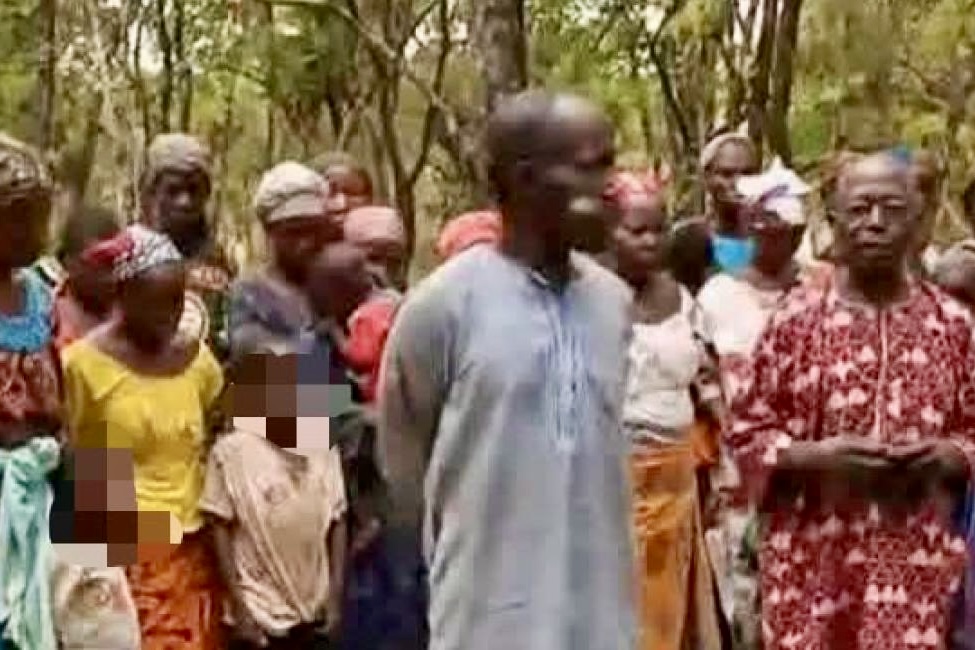
Two hundred and twelve days after armed men invaded churches in Ariko community, Kachia Local Government Area of Kaduna State, the fate of the 37 worshippers abducted during Easter celebrations has emerged as a devastating account of death, prolonged captivity and escape.
But the latest figures reveal something more troubling than the original reports suggested.
Seventeen of the worshippers reportedly died in captivity, 12 escaped at different times, while eight were eventually released after spending five months in the hands of their abductors.
The figures were disclosed on 2 November by the Chief Executive Officer of Christian Solidarity Worldwide Nigeria (CSW), Reverend Dr Yunusa Nmadu, during a presentation at ECWA Goodnews Church in Kaduna to mark the 2026 International Day of Prayer for the Persecuted Church.
The disclosure changes the central question surrounding the Easter abduction. The immediate issue is no longer whether all 37 worshippers remain in the forest. It is how 17 people reportedly died, how 12 managed to escape, what became of those released and why so many civilians spent months beyond the protection of the Nigerian state.
According to CSW, the 37 victims were abducted when armed men attacked three churches in Ariko during Sunday services on 5 April 2026. Most of those seized were reportedly women and children.
The latest account does not come with a publicly released, independently verified list identifying the fate of every victim. Nevertheless, it represents the most recent breakdown of the 37 cases located by Atlantic Post.
For the families involved, the figures are not merely statistics. Each represents a missing relative, a home disrupted and, in the case of those who died, a life that could not be recovered.
Amnesty’s Warning: Starvation, Sexual Violence and Dehumanisation
The latest disclosure follows an alarming warning by Amnesty International in September.
The human rights organisation had raised concerns about the 37 worshippers abducted in Ariko, describing their continued captivity at the time as another example of the Nigerian authorities’ failure to protect people in vulnerable rural communities.
Amnesty also documented deaths among people abducted separately from neighbouring Awon community, another settlement in Kachia Local Government Area.
The organisation reported that Joy Samuel died on 28 August after giving birth in deplorable conditions inside the abductors’ camp. Her newborn baby also died.
It further reported that 34-year-old Yusuf Bawa and his five-year-old son died following severe illness and hunger while in captivity.
The conditions described by Amnesty were particularly disturbing.
The organisation said captives were repeatedly threatened, deprived of food, beaten and subjected to sexual violence.
It specifically warned that women and girls were being “repeatedly threatened with death” and that some were allegedly raped and dehumanised.
These are grave allegations requiring investigation, protection of survivors and accountability. They should not be treated as incidental features of kidnapping.
They point to a form of organised criminal violence in which the victims’ physical and psychological suffering becomes part of the mechanism used to extract money from families and communities.
Amnesty also warned of the wider social consequences:
“A climate of fear is affecting agricultural activities, education and other aspects of social lives of the people.”
That observation is significant because the consequences of kidnapping extend far beyond the immediate victims.
When farmers cannot safely reach their land, agricultural production suffers. When children fear travelling to school, their education is interrupted. When communities become afraid to gather for worship, an essential part of social and religious life is undermined.
Amnesty called on the Nigerian government to fulfil its national and international human rights obligations and intensify efforts to secure the release of people held by armed groups.
A Disturbing Contradiction: What Really Happened to the Ariko Victims?
One of the most consequential aspects of the Ariko tragedy is the confusion surrounding the initial rescue operation.
On 5 April, the Nigerian Army announced that its troops had rescued 31 civilians abducted during the Easter church attack.
According to the Army’s account, soldiers responded to a distress call, pursued the attackers and engaged them in a firefight. It said the pressure forced the assailants to abandon 31 hostages.
The military also reported recovering five bodies and said additional troops had been deployed to prevent further attacks.
But community representatives challenged the announcement.
The Kuturmi Development Association (KUDA) rejected the Army’s reported rescue claim, describing it as “false and misleading”.
Its leaders said families and representatives remained in contact with the abductors, who had confirmed that the victims were still being held.
The association warned that inaccurate rescue announcements could give families false hope and undermine public confidence in official information.
The police subsequently provided a different account.
In a statement, the Nigeria Police Force said five people had been killed and approximately 14 abducted during the attack on the ECWA and Catholic churches.
It also reported that a joint operation involving the police, Army and Department of State Services had rescued seven kidnapped victims.
Deputy Inspector-General of Police Shehu Umar Nadada was deployed to Kaduna following an order from Inspector-General Olatunji Disu.
These early accounts raise an important accountability question.
How did the Army arrive at 31 rescued victims, while community representatives disputed the announcement and the police later reported seven rescues and approximately 14 abductees?
The subsequent CSW account identifies 37 people as having been abducted and provides a breakdown of their eventual outcomes.
The discrepancy deserves an official explanation.
It is particularly important because accurate victim records are central to hostage-rescue operations. Families must know whether their relatives have been rescued, escaped, released, killed or remain missing.
A rescue announcement without transparent verification can compound the suffering of families who have already endured days or months of uncertainty.
Awon: A Second Abduction and Another Humanitarian Emergency
The tragedy in Ariko was followed by another abduction on 20 April 2026, when armed men seized 11 residents of Awon community, also in Kachia Local Government Area.
According to CSW, the Awon victims were held in the same forest camp as the Ariko worshippers.
The ransom demands reportedly began at ₦300 million and 23 motorcycles. The abductors rejected an offer of several million naira from the community and threatened to withhold food from the victims until their demands were met.
CSW later reported that the ransom demand had been reduced to ₦9 million and four motorcycles for the remaining captives.
The individual stories emerging from this camp reveal the human cost of prolonged captivity.
Joy Samuel died after giving birth. Her newborn did not survive. Yusuf Bawa and his five-year-old son also reportedly died after becoming severely ill and suffering hunger.
CSW’s November 2 update said six of the 11 Awon abductees had died, one had escaped and four remained in captivity, reportedly in critical condition.
There is, however, an unresolved discrepancy.
Reports published on 22 October, citing journalist Reuben Buhari, put the number of Awon deaths at eight, with one person having escaped and two still held.
The November 2 CSW figures instead identify six confirmed deaths and four people still held.
Atlantic Post cannot independently reconcile these accounts from the available public information. The authorities and organisations documenting the case should publish a verified, victim-by-victim account rather than leave families and the public navigating conflicting casualty figures.
Southern Kaduna’s Security Crisis Is Bigger Than One Forest Camp
The Ariko and Awon abductions are part of a wider pattern of insecurity affecting Southern Kaduna.
In an investigation published in August, Saturday PUNCH reported that more than 100 communities across Kaduna State had been displaced by persistent bandit attacks.
The National President of the Southern Kaduna Peoples’ Union, Tabara Kato, put the number of displaced residents at 35,402.
Former union spokesperson Luka Binniyat gave a higher estimate, saying 245 communities had been affected and that the number of internally displaced persons in Southern Kaduna had risen to approximately 150,000.
These are attributed estimates rather than a single verified government census, but their differences reinforce the need for an authoritative displacement assessment.
The newspaper also documented informal peace arrangements that some communities had reportedly entered into with armed groups.
Residents described conditions involving financial demands, movement restrictions and compulsory labour.
Such arrangements raise a serious question about the extent to which criminal groups are establishing their own systems of control over rural settlements.
Where residents must negotiate with armed groups to access their homes, farms and daily livelihoods, the authority of the state is being challenged in practical terms.
The Village Head of Ariko, Jashua Doka, reportedly resisted pressure to negotiate with the armed groups.
His position reflects the difficult choices facing traditional leaders and residents who must balance the immediate need to prevent further attacks against the risk of legitimising coercive arrangements.
What Has the Government Done?
The government has announced measures intended to strengthen security in rural Kaduna.
In June, the Federal Ministry of Information reported that the Kaduna State Government had begun training 1,000 forest guards under an initiative coordinated by the Office of the National Security Adviser.
The proposed deployment was to cover eight local government areas, including Kachia, Kajuru and Kagarko, where criminal groups have exploited forested terrain.
The initiative represents an attempt to improve surveillance and strengthen the security presence in vulnerable communities.
But an announcement is not proof of operational success.
The available government report does not provide a detailed breakdown of how many forest guards were subsequently deployed to Kachia, their operational capacity or the number of kidnappings prevented through their activities.
There is also a need to assess the effectiveness of intelligence-sharing between the police, Army, DSS and local security structures.
The Ariko incident highlights why rural communities need more than reactive deployments after an attack has taken place.
Early-warning networks, reliable communications, rapid response capabilities and properly equipped local security personnel are essential if armed groups are to be prevented from operating freely.
The scale of the wider crisis was already evident in April.
Amnesty International estimated that at least 1,100 people had been abducted across northern Nigeria between January and April 2026, warning that the victims were frequently subjected to torture, starvation and sexual violence.
The organisation described the pattern as a growing crisis of abductions for ransom.
The Questions Kaduna and Abuja Must Answer
The latest CSW disclosure should prompt a renewed investigation into the Ariko and Awon abductions.
The federal and Kaduna State governments must publish a reconciled account of the people taken, those rescued, those who escaped, those released and those reported dead.
The police and military should explain their conflicting April announcements and identify the basis for their respective rescue figures.
Authorities must also investigate the circumstances surrounding the reported deaths in captivity, including allegations of starvation, medical neglect, sexual violence and ransom extortion.
Families who have lost relatives need access to reliable information, psychological support and appropriate assistance. Survivors require medical treatment, rehabilitation and protection from further threats.
Most importantly, the government must strengthen protection for rural communities before another mass abduction takes place.
The CSW chief executive’s November 2 disclosure is a reminder that the true cost of Nigeria’s kidnapping crisis cannot be measured only by the number of people rescued.
In its earlier statement, CSW founder president Mervyn Thomas said: “The lives and wellbeing of Nigerian citizens must be prioritised”.
That principle should guide the response from Abuja and Kaduna.
The 37 Ariko worshippers were not simply names on a security report. They were parents, children, farmers, church members and ordinary residents who went to worship on Easter Sunday.
Seventeen are now reported dead. Twelve escaped. Eight were eventually released.
And in nearby Awon, four people are still reportedly waiting for freedom.
The most urgent question is no longer how many people were kidnapped.
It is whether the Nigerian state can establish what happened to every victim, hold those responsible accountable and prevent another community from enduring the same ordeal.
Follow us on our broadcast channels today!
- WhatsApp: https://whatsapp.com/channel/0029VawZ8TbDDmFT1a1Syg46
- Telegram: https://t.me/atlanticpostchannel
- Facebook: https://www.messenger.com/channel/atlanticpostng


Join the debate; let’s know your opinion.