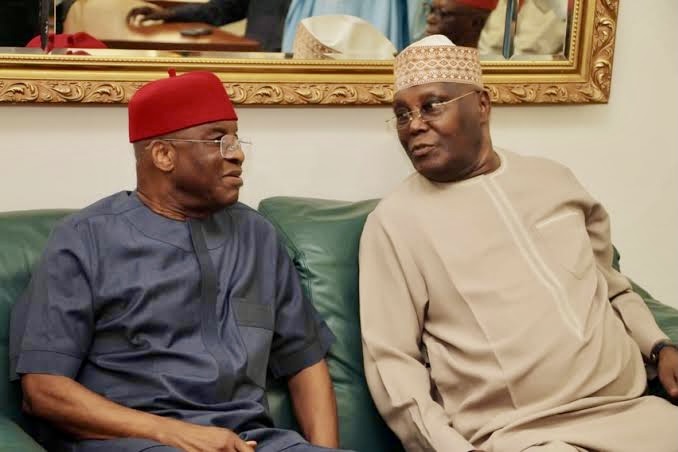
A Federal High Court ruling has struck at the leadership structure behind the African Democratic Congress’s 2027 preparations, throwing Atiku Abubakar’s nomination into doubt. But a disputed resignation, conflicting decisions in related cases and a fresh appeal mean the opposition party’s crisis is far from over.
A political platform built to unite Nigeria’s opposition against President Bola Tinubu has encountered a problem it may struggle to explain to the electorate: it cannot settle who has the right to lead it.
On Thursday, 5 November 2026, the Federal High Court in Abuja nullified the leadership structure headed by Senator David Mark, declaring the caretaker committee that took control of the African Democratic Congress (ADC) illegal. The judgment also invalidated actions taken under that leadership, including the process that produced former Vice-President Atiku Abubakar as the party’s presidential candidate for the 2027 election.
Delivered by Justice Peter Lifu, the decision followed a suit filed by Nafiu Bala Gombe, a former National Deputy Chairman of the ADC. The court granted the reliefs sought by Gombe, striking at the authority of the Mark-led leadership and the decisions it had taken.
The immediate consequence is a serious legal threat to Atiku’s presidential bid. The wider implication is more troubling for the opposition: a coalition seeking to present itself as a credible alternative to the ruling All Progressives Congress (APC) now faces questions about its own internal democratic credentials.
The judgment that reaches beyond David Mark
The dispute centres on who was constitutionally entitled to take control of the ADC after the departure of former National Chairman Ralph Nwosu and other members of the party’s National Working Committee.
Following those departures in 2025, Mark emerged as interim National Chairman, while former Osun State Governor Rauf Aregbesola became National Secretary. The transition was formalised through the party’s 99th National Executive Committee (NEC) meeting on 27 July 2025.
Gombe challenged that arrangement.
His argument was that, as the next-ranking official under the party’s constitutional structure, he was entitled to assume leadership following Nwosu’s departure. He maintained that the process which installed Mark and Aregbesola bypassed the ADC constitution and violated relevant provisions of electoral law.
The suit, marked FHC/ABJ/CS/1819/2025, named the ADC, the Independent National Electoral Commission (INEC), Mark, Aregbesola and Nwosu as defendants.
The significance of Thursday’s judgment lies in its reported reach. It did not merely resolve a disagreement over who should occupy the party’s chairmanship. It nullified the actions of the caretaker leadership, including decisions connected to the party’s nominations for the 2027 elections.
Lukman Fagbemi, a Senior Advocate of Nigeria and counsel to Gombe, said the ruling had invalidated the actions taken by the party under the disputed leadership.
“All the actions taken by the ADC as a party since July 27 to date stand annulled,” he said.
Fagbemi further explained that INEC had been ordered not to recognise or act on decisions taken at the 99th NEC meeting of 27 July 2025.
Another lawyer for the plaintiff, Luka Musa Haruna, argued that the consequences extended to every level of the party’s electoral preparations.
“As it stands today, the ADC has no candidate from the presidential level to the House of Assembly, governorship, Senate and all other elective positions for the 2027 election,” he said.
That is the legal team’s interpretation of the ruling. The precise implementation of the judgment, particularly its implications for individual nominations, will depend on the terms of the court’s order and any subsequent appellate.
Atiku’s nomination faces its biggest test
Atiku’s emergence as the ADC presidential candidate was part of a wider effort by opposition figures to build a common platform ahead of the 2027 general election.
The former Vice-President had joined the ADC after the party became a focal point for political realignments involving figures seeking to challenge Tinubu and the APC. Former Rivers State Governor Rotimi Amaechi was selected as his running mate.
The party subsequently submitted the candidates’ particulars to INEC. Atiku’s campaign was already gathering momentum when Thursday’s judgment arrived.
On Wednesday, 4 November, he held a campaign rally in Sokoto State. The following day, the court delivered a judgment that struck at the authority of the party structure responsible for his nomination.
The timing could hardly be more damaging.
Atiku’s immediate problem is not necessarily a question of his personal eligibility to contest the presidency. The central issue is whether the organisation and party officials who produced his nomination possessed lawful authority to do so.
That distinction matters. A candidate may meet every constitutional qualification for public office and still face the loss of a party ticket if the process through which that ticket was obtained is invalidated.
The latest available official INEC presidential candidate list, updated on 31 October 2026, still contains Atiku’s name for the ADC, with Amaechi listed as his running mate. But that register predates the 5 November judgment. It cannot be treated as evidence that INEC has already considered or resolved the consequences of the court’s decision.
The ADC’s next moves will therefore be critical. The party has indicated that it will appeal. Nkemakolam Ukandu, its National Welfare Secretary, said the judgment would be challenged at the Court of Appeal.
Until the appellate courts intervene or determine the dispute, the status of the party’s electoral arrangements remains exposed to further legal developments.
The disputed resignation at the heart of the crisis
One of the most consequential unresolved questions is whether Gombe actually resigned from his position before Mark’s emergence.
The Mark-led camp maintained that Gombe had resigned in May 2025. In a letter sent to INEC on 21 July that year, the party said Gombe had resigned on 17 May and that his resignation had been accepted.
But Gombe publicly denied signing a resignation letter.
He alleged that the document being attributed to him was forged and challenged its authenticity. In a statement reported in August 2025, he argued that his official correspondence always carried the party’s letterhead and described the disputed document as lacking those identifying features.
“The fake letter, in contrast, was printed on plain paper without any official markings,” he said.
Former ADC National Chairman Nwosu also publicly stated at an event in July 2025: “Nafiu Bala did not resign as the Deputy National Chairman.”
These competing accounts are important because the alleged resignation sits close to the centre of Gombe’s claim to succession. If he had validly resigned, the basis of his claim would be different. If he had not, his argument that he was entitled to assume leadership would carry a different constitutional weight.
A review by Premium Times found that the letter sent to INEC referred to an attached resignation document, but the referenced attachment was not available for independent examination. The available public material therefore does not conclusively establish whether Gombe signed and submitted a valid resignation.
That gap should not be mistaken for proof of forgery or proof of resignation. It remains an unresolved factual issue in a dispute with potentially far-reaching consequences for the opposition’s 2027 plans.
Why earlier court decisions did not settle the dispute
The latest judgment is part of a wider sequence of litigation that has produced different outcomes on different aspects of the ADC crisis.
In April 2026, the Supreme Court set aside a Court of Appeal order directing parties in the leadership dispute to maintain the status quo ante bellum. It returned the matter to the Federal High Court for an expedited hearing.
That decision did not determine who was entitled to lead the ADC. It dealt with the procedural position of the case and cleared the way for the substantive dispute to be heard. It would therefore be misleading to describe the Supreme Court’s April ruling as a final endorsement of either Gombe or Mark.
A separate case brought by House of Representatives member Leke Abejide produced another complication.
In July 2026, Justice Musa Liman of the Federal High Court dismissed Abejide’s challenge to the leadership transition, holding that the court lacked jurisdiction over the internal party dispute. The judge also made observations on the merits, finding that the handover to Mark and Aregbesola had complied with the party’s constitution.
That case was separate from Gombe’s suit. It involved a different plaintiff and different proceedings. Its outcome did not automatically dispose of the claims subsequently determined by Justice Lifu.
There was also a separate dispute over state congresses organised by committees appointed by the Mark-led leadership. In July, the Court of Appeal upheld restrictions preventing INEC from recognising those congresses and protected the tenure and functions of elected state executives.
These cases illustrate how the crisis has spread across different levels of the party. They should not, however, be collapsed into one judgment or treated as if every court had decided the same question.
The latest ruling is particularly significant because it addresses the substantive leadership challenge brought by Gombe.
The Electoral Act introduces another legal question
The legal environment has also changed since Gombe filed his case.
The Electoral Act 2026 replaced the Electoral Act 2022. Section 83(5) of the new legislation states:
“Subject to the provision of subsection (3), no Court in Nigeria shall entertain jurisdiction over any suit or matter pertaining to the internal affairs of a political party.”
The provision raises an important question about the extent to which courts can intervene in disputes over party leadership, succession and internal organisation.
But the law also provides for challenges involving compliance with statutory requirements for selecting and nominating candidates. Section 88, for example, addresses complaints about non-compliance with the Act in the selection or nomination process.
This distinction may become central to the next stage of the ADC litigation. A dispute about who should lead a party is not necessarily identical to a complaint that a party breached statutory requirements governing elections and nominations.
There is an additional timing issue. Gombe’s suit was instituted in 2025, before the 2026 Act came into force. Section 6(1)(e) of Nigeria’s Interpretation Act contains savings provisions protecting certain accrued rights and pending legal proceedings following the repeal of an enactment.
It would therefore be premature to assume that the new jurisdictional restriction automatically extinguishes a case that began under the previous legislation. Equally, the relationship between the saved proceedings, the new Electoral Act and the court’s jurisdiction may become a significant issue in an appeal.
The National Assembly’s attempt to limit judicial intervention in internal party matters has itself attracted constitutional criticism. In April, Nigerian Bar Association President Afam Osigwe warned that parts of the new law “raise serious constitutional, democratic, and rule-of-law concerns that require immediate intervention”.
The ADC dispute could become another test of how the courts reconcile party autonomy, electoral accountability and the right of members to challenge alleged violations of party rules.
A crisis that could weaken the opposition before the election
The ADC’s appeal may eventually produce a different outcome. Higher courts could uphold the judgment, set it aside or modify its practical consequences.
But the immediate political damage cannot be measured only by the final court decision.
The opposition platform was expected to provide a vehicle through which politicians from different backgrounds could organise against the ruling party. Its appeal rested partly on the promise of unity and a credible alternative to the existing political establishment.
That promise is now being tested by an internal leadership dispute serious enough to threaten its presidential ticket.
The contradiction is difficult for the party to ignore. An organisation that intends to persuade Nigerians to defend democratic accountability must demonstrate that it can apply transparent rules within its own structures.
The disputed succession, the unanswered question surrounding Gombe’s resignation, the competing court decisions and the uncertainty over nominations all raise questions that go beyond personalities.
They concern whether the party’s internal processes were sufficiently clear, transparent and lawful to command the confidence of its members and the wider electorate.
For Atiku, the judgment creates a new obstacle at a particularly sensitive point in the campaign. For Mark, it challenges the legitimacy of the leadership structure he headed. For the ADC, it threatens to turn a potential opposition coalition into a party consumed by litigation.
The electoral clock is also running.
INEC’s timetable places the presidential and National Assembly elections on 16 January 2027. That leaves approximately 72 days between Thursday’s judgment and polling day. Any successful appeal, revised party process or further dispute over the candidates’ status will have to unfold within a compressed electoral timetable.
The question Nigeria’s opposition must now answer
The most important question raised by Thursday’s judgment is not simply whether Atiku will remain the ADC’s presidential candidate.
It is whether the party can establish a leadership structure whose legitimacy is accepted by its members, recognised by the electoral authorities and sustainable under judicial scrutiny.
The ADC may yet secure a favourable outcome on appeal. But it cannot rely on court victories alone to repair the damage caused by prolonged internal conflict.
The party must explain how the leadership transition was conducted, address the disputed resignation evidence, clarify the authority behind its electoral decisions and demonstrate that its internal rules are more than documents invoked during political battles.
For Nigeria’s opposition, the danger is that the struggle to defeat the ruling party could be overshadowed by a struggle over who has the right to represent the opposition in the first place.
The ADC entered the 2027 contest promising a national alternative. Thursday’s judgment has put that promise on trial.
Follow us on our broadcast channels today!
- WhatsApp: https://whatsapp.com/channel/0029VawZ8TbDDmFT1a1Syg46
- Telegram: https://t.me/atlanticpostchannel
- Facebook: https://www.messenger.com/channel/atlanticpostng



Join the debate; let’s know your opinion.