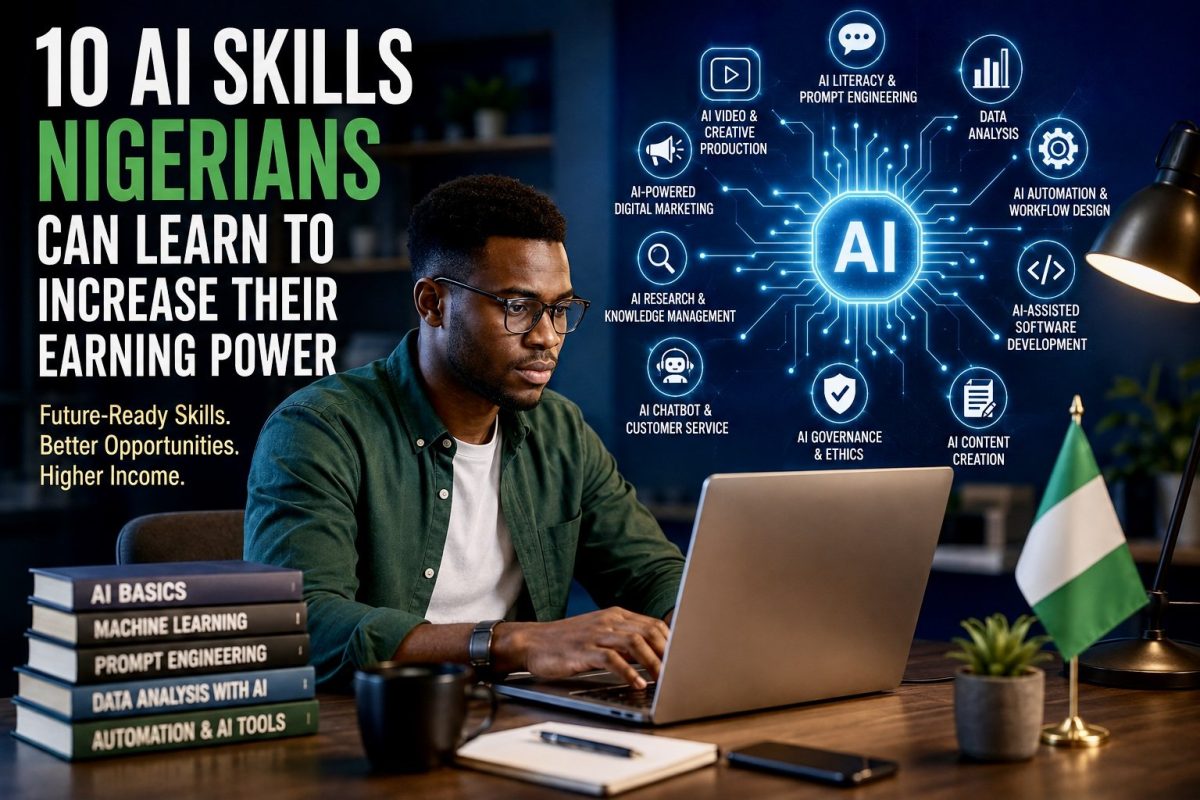
Nigeria’s labour market is entering a new phase in which the ability to use artificial intelligence is rapidly becoming a commercial advantage rather than a fashionable technology skill.
For millions of Nigerian graduates, professionals, entrepreneurs, freelancers and small-business owners, the important question is no longer whether artificial intelligence will affect their work. It is how quickly they can acquire the skills required to use AI to produce better work, serve more customers, reduce operating costs and compete for opportunities beyond Nigeria.
There is strong evidence that this shift is already under way.
The World Economic Forum’s Future of Jobs Report 2025 identified AI and big data as the fastest-growing skills over the next five years, ahead of networks and cybersecurity and technological literacy. It also found that 39 per cent of workers’ existing core skills are expected to change by 2030.
More importantly for Nigerians looking beyond the local job market, Upwork’s 2026 skills research found that demand for skills explicitly connected to applying AI to existing work increased by 109 per cent year-on-year in 2025. AI video generation and editing jumped 329 per cent, AI integration 178 per cent, AI data annotation and labelling 154 per cent, and AI chatbot development 71 per cent.
And the Nigerian opportunity is becoming harder to ignore.
A World Bank digital-skills blueprint disclosed on 18 August 2026 estimates that 28 million Nigerian workers will require digital competencies over the next decade, while warning that the country’s existing skilling system faces problems ranging from weak foundational digital literacy to fragmented training and financing.
Nigeria’s National Artificial Intelligence Strategy is even more ambitious. It sets a target of equipping at least 70 per cent of Nigeria’s young workforce aged 16–35 with AI-related skills and knowledge, explicitly linking AI talent development to employment and entrepreneurship.
But there is a major caveat.
Simply knowing how to type prompts into ChatGPT, Gemini or another AI application will not automatically make anyone more employable or better paid. The emerging premium is increasingly attached to people who can combine AI with a valuable business, technical or professional skill.
That is the real opportunity.
1. AI Literacy and Prompt Engineering
The most accessible entry point is AI literacy: understanding what generative AI can do, where it fails, how to structure instructions, how to evaluate outputs and how to integrate AI into everyday professional work.
Prompt engineering is one component of that broader skill.
A Nigerian accountant, journalist, lawyer, marketer, teacher, developer, researcher or business owner does not necessarily need to become a machine-learning engineer. But each can become substantially more productive by learning how to communicate effectively with AI systems.
That means learning how to provide context, define the desired output, establish constraints, supply examples, request different perspectives, verify factual claims and refine results through successive prompts.
LinkedIn reported that AI literacy was among the fastest-growing skills in 2025, while large-language-model proficiency was also rising rapidly, showing that AI capability is spreading beyond traditional technology jobs.
How it can make money: AI-literate professionals can offer productivity consulting, research assistance, virtual assistance, content support, training and AI-enhanced professional services.
The important distinction is that clients are unlikely to pay much simply because someone knows how to ask an AI model a question. They pay for the result.
2. AI-Assisted Data Analysis
Data is becoming more valuable, but raw data is not the same thing as useful information.
Businesses need people who can turn spreadsheets, sales records, customer information, survey results and financial data into decisions.
AI is making this work considerably more accessible.
A professional who combines Excel or Google Sheets with AI-assisted analysis can learn to clean datasets, identify trends, generate summaries, build dashboards, explain anomalies and turn complex numbers into management insights.
For more advanced learners, the progression can include SQL, Python, Power BI, Tableau, statistics and machine learning.
Upwork’s 2026 marketplace data still ranks data analytics among its most in-demand data-science skills, alongside data extraction, machine learning, data visualisation, data mining and data engineering.
How it can make money: Nigerian professionals can provide reporting and dashboard services to SMEs, financial advisers, retailers, logistics companies, schools, NGOs, research organisations and international businesses.
The opportunity is particularly attractive because many organisations have data but lack people who can interpret it.
3. AI Automation and Workflow Design
This may be one of the most commercially valuable AI skills for Nigerian entrepreneurs and freelancers.
AI automation involves connecting software tools so that repetitive tasks happen with little human intervention.
For example, a business could automate parts of its lead-generation process, customer follow-up, appointment booking, email responses, document processing, social-media publishing or internal reporting.
A person does not necessarily need to write complex software from scratch.
Modern automation platforms, APIs and AI services increasingly allow professionals to construct workflows using visual interfaces, while coding knowledge can take more advanced practitioners much further.
Upwork reported a 178 per cent increase in demand for AI integration in 2025. It also listed scripting and automation among the top 10 coding and web-development skills on its marketplace.
How it can make money: An automation specialist can charge companies to identify repetitive processes, design workflows, connect tools, build automations and maintain them.
This is particularly relevant in Nigeria, where small businesses frequently operate with lean teams. Saving a company several hours of administrative work each week can have a direct commercial value.
4. AI-Assisted Software Development
Nigeria already has a significant technology ecosystem, but the next advantage may belong to developers who learn how to work effectively with AI coding assistants.
This does not mean allowing AI to write an application blindly.
Strong developers will need to understand software architecture, databases, APIs, security, testing and debugging while using AI to accelerate coding, documentation and problem solving.
This distinction matters because AI-generated code can contain security vulnerabilities, logical errors and hidden dependencies.
The World Economic Forum ranks software and applications developers among the fastest-growing jobs towards 2030, alongside AI and machine-learning specialists and big-data specialists.
Upwork’s 2026 data also shows full-stack development, front-end development, back-end development, mobile-app development and scripting and automation remaining among the marketplace’s leading coding skills even as AI use expands.
How it can make money: Developers can build websites, internal business tools, mobile applications, AI-powered products, APIs, integrations and prototypes for Nigerian and international clients.
For a Nigerian developer competing globally, productivity can matter enormously. Faster development can mean more projects completed without necessarily working proportionally longer hours.
5. AI Content Creation, Editing and Repurposing
Content remains a huge commercial industry, but the economics are changing.
Businesses need blog posts, newsletters, product descriptions, social-media content, video scripts, presentations and marketing materials. AI can accelerate production, but clients still need human judgement to determine what is accurate, persuasive, culturally appropriate and commercially useful.
The winning skill is therefore not “AI writing”.
It is AI-assisted communication.
A competent writer can use AI for research organisation, outlining, ideation, headline testing, first drafts, editing and content repurposing while retaining responsibility for facts, voice and strategy.
Upwork continues to show strong demand for creative and marketing skills, while its 2026 data recorded a 329 per cent increase in AI video generation and editing and a 95 per cent increase in AI image generation and editing.
How it can make money: Writers, editors, social-media managers and communications professionals can package AI-enhanced services for businesses that need consistent content but cannot afford a large in-house team.
The biggest opportunity is likely to be in combining AI with industry knowledge — for example, AI-assisted financial content, property marketing, healthcare communications, education content or B2B technology writing.
6. AI Video, Image and Creative Production
The explosion of short-form video has created another major opportunity.
A Nigerian creative who learns AI-assisted video editing, image generation, motion graphics, presentation design, thumbnails, product visualisation and video repurposing can serve both domestic and international markets.
The numbers are striking.
Upwork reported that AI video generation and editing was its fastest-growing design and creative skill in 2026, with demand increasing by 329 per cent year-on-year. AI image generation and editing rose 95 per cent.
But the market is also becoming crowded.
Producing generic AI images is likely to become increasingly commoditised. The stronger opportunity will be for creatives who understand storytelling, branding, composition, audience psychology, editing and commercial objectives.
How it can make money: Services can include social-media reels, advertising creatives, product videos, corporate presentations, YouTube production, campaign visuals and digital advertising assets.
For Nigerian SMEs, restaurants, fashion businesses, property firms, churches, entertainment companies and consumer brands, the ability to produce professional visual content quickly can be commercially significant.
7. AI-Powered Digital Marketing and SEO
Marketing is moving from intuition alone towards increasingly data-assisted decision-making.
AI can help marketers research audiences, generate campaign ideas, analyse customer behaviour, personalise messages, conduct keyword research, identify content opportunities and produce multiple creative variations.
But successful marketing still requires human understanding of the market.
That is particularly important in Nigeria, where culture, purchasing power, language, geography, trust and consumer behaviour can differ dramatically between audiences.
Upwork’s 2026 data continues to rank social-media marketing, SEO, sales and business development, lead generation, search-engine marketing and marketing strategy among its most in-demand sales and marketing skills.
How it can make money: Professionals can sell AI-assisted SEO, content strategy, paid advertising support, email campaigns, lead generation and social-media management.
The commercial advantage is strongest when the practitioner can demonstrate measurable outcomes: more qualified leads, better search visibility, higher conversion rates or lower customer-acquisition costs.
8. AI Research, Fact-Checking and Knowledge Management
The internet is producing information faster than humans can comfortably process it.
As AI systems generate even more synthetic content, businesses will increasingly need people who can distinguish useful information from unreliable information.
This creates an opportunity for AI-assisted research and verification.
A skilled practitioner can use AI to organise large amounts of information, identify themes, prepare research briefs and generate preliminary summaries — while independently checking sources, dates, figures and claims.
This has applications in journalism, consulting, academia, market research, legal support, competitive intelligence and corporate strategy.
Upwork’s 2026 marketplace continues to rank general research services and market research among its leading customer-service and administrative skills.
How it can make money: Freelancers can sell research reports, competitor intelligence, literature reviews, market scans, due-diligence support and information management.
This is especially suitable for professionals who already possess strong writing, analytical or subject-matter skills.
9. AI Chatbot and Customer-Service Solutions
Businesses increasingly want to answer customer questions at any hour without building a large call centre.
That is driving demand for AI-enabled customer-service systems.
A learner does not necessarily need to build a foundation model. Instead, the commercial skill is understanding how to design conversational experiences, structure knowledge bases, connect AI assistants to business information and create escalation processes for situations that require human intervention.
Upwork reported a 71 per cent year-on-year increase in AI chatbot-development demand in its 2026 skills report.
How it can make money: Professionals can build or configure customer-support assistants for schools, hospitals, hotels, ecommerce businesses, property companies, financial-services providers and other organisations.
The Nigerian market is particularly interesting because many SMEs still manage customer enquiries manually through WhatsApp, social media and telephone calls.
The person who can turn those scattered enquiries into a structured AI-assisted customer-service operation has a clear commercial proposition.
10. AI Governance, Data Protection and Responsible AI
This is less glamorous than image generation or chatbots, but it could become one of the most valuable specialist areas.
As businesses use AI to process customer records, employee information, financial data and confidential documents, questions of privacy, security, copyright, bias, accountability and regulatory compliance become unavoidable.
Nigeria’s own National AI Strategy recognises that the AI ecosystem will require not only technical capabilities but also legal, business-model, communication, interaction-design, innovation-management and change-management skills.
The World Bank similarly warns that the AI divide is not simply an infrastructure problem. It identifies competency as a prerequisite for meaningful participation in AI-related jobs and highlights gaps in locally relevant skills and industry-aligned training.
How it can make money: Professionals with backgrounds in law, compliance, cybersecurity, information governance, risk management or corporate policy can specialise in AI-use policies, risk assessments, governance frameworks, employee guidelines and AI implementation procedures.
This is where existing professional expertise becomes particularly powerful.
The Bigger Nigerian Opportunity: Become an AI-Enabled Professional
The strongest finding from the current evidence is that Nigerians should resist the temptation to treat AI as a standalone career detached from everything they already know.
The future is more likely to reward AI plus expertise.
An accountant who understands AI is potentially more valuable than a person who knows AI tools but understands nothing about accounting.
A marketer who can deploy AI intelligently can compete more effectively than someone who merely generates AI copy.
A journalist who combines reporting, verification, research and AI-assisted analysis has a different value proposition from someone who simply asks a chatbot to write stories.
A software developer who understands AI integration, architecture and security can deliver more sophisticated solutions than an inexperienced prompt user.
Recent Upwork research reinforces this point. Its 2026 Future Workforce Index found that freelancers performing AI-related work earned 34 per cent more per hour than those not incorporating AI, while more complex AI-augmented work saw earnings rise 45 per cent year-on-year. The research points towards an emerging “AI orchestrator” — someone who combines AI tools with domain expertise, human judgement and measurable business outcomes.
That is arguably the most important lesson for Nigerian workers.
What Nigerians Should Learn First
Not everybody needs to master all 10 skills.
For a beginner, the sensible sequence is to learn AI literacy and prompting first, then combine it with an existing professional skill.
A writer might move into AI-assisted content and SEO.
An accountant might move into AI-powered data analysis and reporting.
A marketer might specialise in AI-assisted digital marketing and automation.
A developer might focus on AI integration and chatbot development.
A designer might specialise in AI video and creative production.
A lawyer or compliance professional might explore responsible AI, governance and data protection.
The objective should be to create a portfolio of evidence, not simply collect certificates.
An employer or international client is more interested in what a professional can actually produce.
A portfolio could include an automated business workflow, an AI-assisted dashboard, a chatbot prototype, a content campaign, a research report, a video campaign or an AI governance policy.
That evidence can then be used on LinkedIn, freelance marketplaces, personal websites and direct business pitches.
The Hidden Advantage: Nigeria’s Market Can Be the Training Ground
There is another reason Nigerians should take this opportunity seriously.
A professional does not need to wait for a foreign employer before practising.
Nigeria itself provides thousands of everyday problems that can be converted into AI projects.
A small retailer needs inventory analysis.
A school needs a customer-enquiry assistant.
A real-estate company needs faster property-content production.
A logistics company needs reporting automation.
An accountant needs document processing.
A media organisation needs research and content workflows.
A restaurant needs social-media creatives.
An SME needs lead generation.
Each problem can become a portfolio project.
The Nigerian market therefore offers something valuable to an aspiring AI professional: real users, real constraints and real business problems.
The Infrastructure Problem Cannot Be Ignored
There is, however, a danger in presenting AI skills as a magic solution to Nigeria’s employment challenge.
AI training cannot compensate for unreliable electricity, expensive internet access, limited devices, weak foundational education or inadequate access to quality training.
The World Bank’s 2026 Nigerian digital-skills blueprint explicitly identifies weak foundational digital literacy, training misalignment and fragmented governance and financing among the challenges facing the country’s skilling ecosystem.
A separate World Bank assessment of Nigeria’s digital-skills landscape also emphasises the importance of lifelong learning, noting that the skills required in the labour market will continue to change as technology evolves. It cites research showing positive links between digital skills, employment and earnings, while stressing that Nigeria still faces infrastructure and skills gaps.
This means the AI opportunity is both individual and systemic.
Individuals must upgrade their skills.
Employers must invest in training.
Training providers must focus more on practical outcomes.
Universities and vocational institutions must respond faster to technological change.
And policymakers must address the infrastructure and affordability constraints that prevent millions of Nigerians from participating fully in the digital economy.
The Bottom Line
Artificial intelligence is unlikely to create a simple world in which everyone who learns a few prompts suddenly becomes highly paid.
That is the wrong expectation.
The more realistic opportunity is much bigger: AI is becoming a force multiplier for people who already know how to solve problems.
The evidence is increasingly difficult to ignore. The World Economic Forum places AI and big data at the top of the global list of fastest-growing skills. LinkedIn has identified rapidly rising demand for AI literacy. Upwork’s 2026 data shows explosive growth in AI integration, AI video, AI image creation, data labelling and chatbot development. And Nigeria now has a national strategy and a new World Bank-backed digital-skills blueprint explicitly focused on building the human capital required for a digital economy.
For Nigerian workers, the message is straightforward.
Do not learn AI merely to say that you know AI.
Learn it to save a business money, increase sales, analyse information, create better products, automate repetitive work, solve difficult problems or reach customers in markets far beyond Nigeria.
That is where earning power is likely to reside.
The race is no longer simply between people who know AI and people who do not.
Increasingly, it is between people who know how to use AI and people who can turn that capability into value.
Follow us on our broadcast channels today!
- WhatsApp: https://whatsapp.com/channel/0029VawZ8TbDDmFT1a1Syg46
- Telegram: https://t.me/atlanticpostchannel
- Facebook: https://www.messenger.com/channel/atlanticpostng