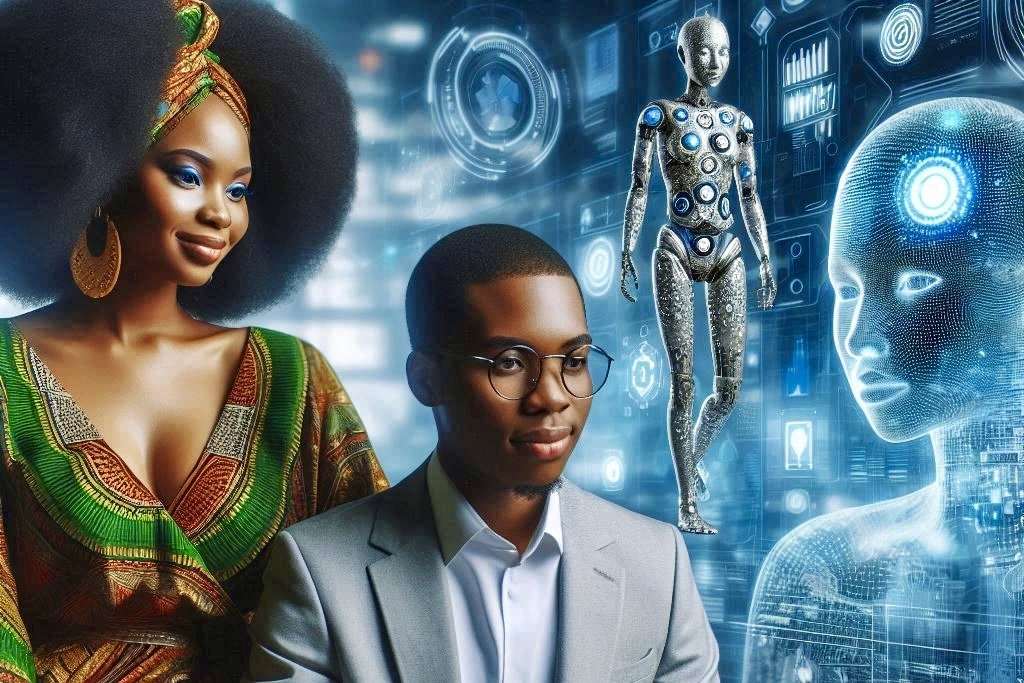
Generative artificial intelligence is moving from the technology pages into Nigerian workplaces.
A worker drafting a proposal with an AI assistant, a small business owner creating adverts in minutes, a customer-service team answering routine questions, and a developer generating code are no longer unusual examples. The technology is becoming part of everyday economic activity.
For Nigerian workers and businesses, the important question is no longer whether generative AI will arrive.
It is what happens to the people and companies that learn to use it well — and those that do not.
The shift is significant because generative AI can produce text, images, computer code, summaries, presentations, marketing material and other content from ordinary instructions. It can also analyse information and assist with tasks that previously required considerable time.
Nigeria is already positioning itself for this transition. The National Information Technology Development Agency has said responsible AI adoption, local talent, infrastructure and home-grown innovation are central to the country’s AI ambitions. NITDA has also highlighted agriculture, healthcare, education, finance and public services as areas where AI can create practical benefits.
But the technology also raises difficult questions about employment, skills, data privacy, accuracy and the future value of some types of work.
AI Is More Likely to Change Jobs Than Simply Eliminate Them
One of the biggest misconceptions about generative AI is that its arrival automatically means mass unemployment.
The evidence is more complicated.
The International Labour Organisation’s 2025 assessment found that one in four workers globally are in occupations with some degree of exposure to generative AI. Yet it concluded that most jobs are more likely to be transformed rather than made redundant, because human involvement remains necessary for many tasks.
The distinction is importamt in Nigeria.
A financial analyst may use AI to summarise financial statements but still have to interpret the numbers. A journalist can use it to organise information but remains responsible for verification. A lawyer may use AI to review documents while retaining responsibility for legal judgement. A marketer can generate ten campaign ideas quickly but still needs to know which one will resonate with Nigerian consumers.
The task changes.
The human role does not necessarily disappear.
The World Bank’s 2026 World Development Report makes a similar distinction for developing economies. It estimates that 4.5 per cent of existing jobs in developing economies are at risk of automation by generative AI, compared with 14.2 per cent in high-income economies. At the same time, it estimates that 16.2 per cent of jobs in developing economies could receive meaningful productivity gains from AI.
That suggests a particularly important opportunity for Nigeria.
The Nigerian Worker Is Entering a New Skills Race
Generative AI is likely to increase the value of workers who can combine professional knowledge with technology.
The accountant who understands AI-assisted financial analysis could have an advantage over an accountant who refuses to use it.
The salesperson who can use AI to research prospects, personalise proposals and analyse customer behaviour can potentially serve more clients.
The small-business owner who can generate product descriptions, promotional material and customer responses in minutes can operate with capabilities that previously required several people.
But simply knowing how to open an AI chatbot will not be enough.
The valuable skill will increasingly be knowing what to ask, what to trust, what to verify and what to do with the answer.
This is where Nigeria’s skills challenge becomes important.
A 2025 PwC survey of African workers found that 76 per cent believed generative AI improves work quality and 72 per cent expected productivity gains over the following three years. Yet only 35 per cent believed their current skills would remain relevant in three years.
That gap should concern employers and workers alike.
The message is not that everyone must become a software engineer.
It is that workers need to become increasingly comfortable working with intelligent digital tools.
Businesses Could Do More With Smaller Teams
For Nigerian businesses, particularly SMEs, this may be one of the most immediate effects of generative AI.
A small company may not have the money to employ a full-time copywriter, market researcher, customer-service specialist and data analyst.
AI can provide assistance across those functions.
A retailer can use AI to develop product descriptions and promotional campaigns.
A restaurant can create social-media content and customer-response templates.
A consultant can turn meeting notes into reports.
A recruitment company can organise CVs and prepare interview questions.
A startup can use AI coding assistants to speed up software development.
A manufacturer can use AI to help analyse operational data and prepare internal documents.
The World Bank says AI can help businesses in developing economies solve problems, analyse information and improve productivity. It also argues that developing countries do not necessarily need to build frontier AI systems themselves to benefit from the technology.
For Nigerian SMEs operating under pressure from inflation, energy costs, foreign-exchange volatility and limited access to capital, productivity gains could be particularly valuable.
But there is an important qualification.
AI does not automatically make a badly organised business efficient.
It can simply make bad processes faster.
The Biggest Opportunity May Be for Small Businesses
Generative AI could reduce some of the barriers that have traditionally prevented Nigerian entrepreneurs from competing beyond their immediate markets.
A one-person business can now create professional-looking marketing material without hiring an agency.
A freelancer can research foreign clients faster.
An online retailer can create multiple versions of product content.
An exporter can translate and adapt communications for international customers.
A Nigerian professional can use AI to improve proposals, presentations and business documentation.
This could create opportunities for businesses that previously lacked the resources to compete with larger firms.
McKinsey has identified generative AI as a major potential productivity opportunity for Africa, arguing that the continent has an opportunity to leapfrog in the adoption of emerging technologies.
For Nigeria, the opportunity is especially relevant because the country’s large population, entrepreneurial culture and expanding digital economy provide a substantial potential user base.
But AI Will Not Remove Nigeria’s Infrastructure Problems
There is a danger in discussing AI as though software alone can transform the economy.
It cannot.
Generative AI requires electricity, internet connectivity, devices, digital skills and access to appropriate data.
Nigeria continues to face constraints in several of these areas.
The World Bank’s 2026 report warns that developing countries need reliable electricity, internet access, skills, data and strong institutions to capture AI’s benefits. In Sub-Saharan Africa, it says nearly one-third of rural schools still lack reliable electricity and more than two-thirds lack dependable internet access.
That means Nigeria’s AI conversation cannot be separated from its broader digital infrastructure challenge.
An entrepreneur with an excellent AI strategy will still struggle if electricity and connectivity are unreliable.
Nigerian Businesses Also Face an AI Trust Problem
Generative AI can produce convincing information that is wrong.
That creates a serious business risk.
An AI-generated legal document can contain an error.
A marketing campaign can make an inaccurate claim.
A financial analysis can be based on incorrect assumptions.
A customer-service chatbot can provide the wrong answer.
An employee can also unknowingly expose confidential company information through an AI platform.
This is why AI adoption needs rules.
NITDA has placed responsible and ethical AI at the centre of Nigeria’s AI agenda, stressing transparency, accountability and public trust.
For businesses, that principle should translate into simple internal policies.
Employees should know what information can be entered into AI systems.
Sensitive customer information should receive appropriate protection.
Important AI-generated material should be checked by a human.
Companies should know which AI tools their employees are using.
And management should understand that an AI-generated answer is not automatically a verified answer.
Nigeria Has an Opportunity to Build Local AI
Another major issue is whether Nigerian users will remain dependent on AI systems designed primarily around foreign markets.
Nigeria’s linguistic and cultural diversity creates a strong argument for locally relevant AI.
NITDA has highlighted the development of M-ATLAS, an indigenous large language model initiative intended to better reflect Nigeria’s linguistic and cultural realities. The agency has also argued that Nigeria should move from being mainly a consumer of AI technology towards becoming a creator of AI solutions.
That distinction could become economically important.
Local AI systems could potentially serve Nigerian languages, businesses, institutions and datasets more effectively.
They could also create opportunities for Nigerian developers, researchers, data specialists and entrepreneurs.
The country’s opportunity is therefore not limited to using ChatGPT-style tools.
It extends to building products around uniquely Nigerian problems.
New Jobs Will Emerge Around AI
Every major technological shift destroys some tasks while creating others.
Generative AI is already creating demand for people who can deploy, manage, customise and govern AI systems.
Potential opportunities include AI product development, data management, AI training, automation consulting, AI-assisted marketing, cybersecurity, AI governance and industry-specific AI solutions.
There will also be demand for professionals who understand both AI and traditional industries.
A banker who understands AI is different from an AI engineer.
A lawyer who understands AI governance is different from a software developer.
A teacher who knows how to use AI effectively brings a different combination of skills.
That combination could become increasingly valuable.
The Worker Who Learns to Direct AI May Outperform the Worker Who Ignores It
The emerging workplace is unlikely to be a simple contest between humans and machines.
It may be a contest between workers who know how to use machines effectively and those who do not.
The World Bank says the immediate impact of AI in developing economies is more likely to complement workers than replace them, with early disruption concentrated in knowledge-intensive services.
That has a practical implication for Nigerian workers.
Learning AI should not be treated as a fashionable technology project.
It should be treated as a career skill.
Workers can begin with relatively simple applications:
- Research and information gathering
- Writing and editing
- Spreadsheet and data analysis
- Presentation development
- Customer-service assistance
- Marketing
- Coding
- Translation
- Administrative automation
- Business planning
The next step is to connect those tools to a person’s actual profession.
What Nigerian Businesses Should Do Now
Businesses do not need to transform themselves overnight.
They can begin with a small number of measurable problems.
Identify repetitive tasks.
Test AI on those tasks.
Measure the time saved.
Check the quality of the output.
Create rules around sensitive information.
Train employees.
Then expand the applications that produce measurable value.
This approach is consistent with the World Bank’s 2026 framework for developing economies: adopt, adapt and eventually advance. The report argues that countries can gain substantial benefits by adopting existing AI tools and adapting them to local needs rather than attempting immediately to build frontier AI systems.
For Nigerian SMEs, that could mean starting with a customer-service workflow rather than spending heavily on an ambitious AI platform.
The objective should be business value, not simply having an AI strategy.
The Real AI Divide May Be Productivity
The biggest economic divide created by generative AI may not ultimately be between companies that have AI and those that do not.
It could be between companies that use AI productively and those that merely experiment with it.
The same technology can produce dramatically different results depending on the quality of the business process, data, people and management surrounding it.
Nigeria therefore faces a choice about how it approaches the technology.
It can treat generative AI as another imported digital trend.
Or it can use it to address some of the country’s longstanding productivity problems.
The opportunity is substantial, but it is not automatic.
Workers will need new skills.
Businesses will need new processes.
Government will need effective infrastructure and governance.
And Nigerian developers will need opportunities to build technology around Nigerian realities.
Generative AI is not simply another software upgrade.
For the Nigerian economy, it could become a new layer of Productivity. if people learn how to use it before the technology learns how to do more of their work.
Follow us on our broadcast channels today!
- WhatsApp: https://whatsapp.com/channel/0029VawZ8TbDDmFT1a1Syg46
- Telegram: https://t.me/atlanticpostchannel
- Facebook: https://www.messenger.com/channel/atlanticpostng




Join the debate; let's know your opinion.