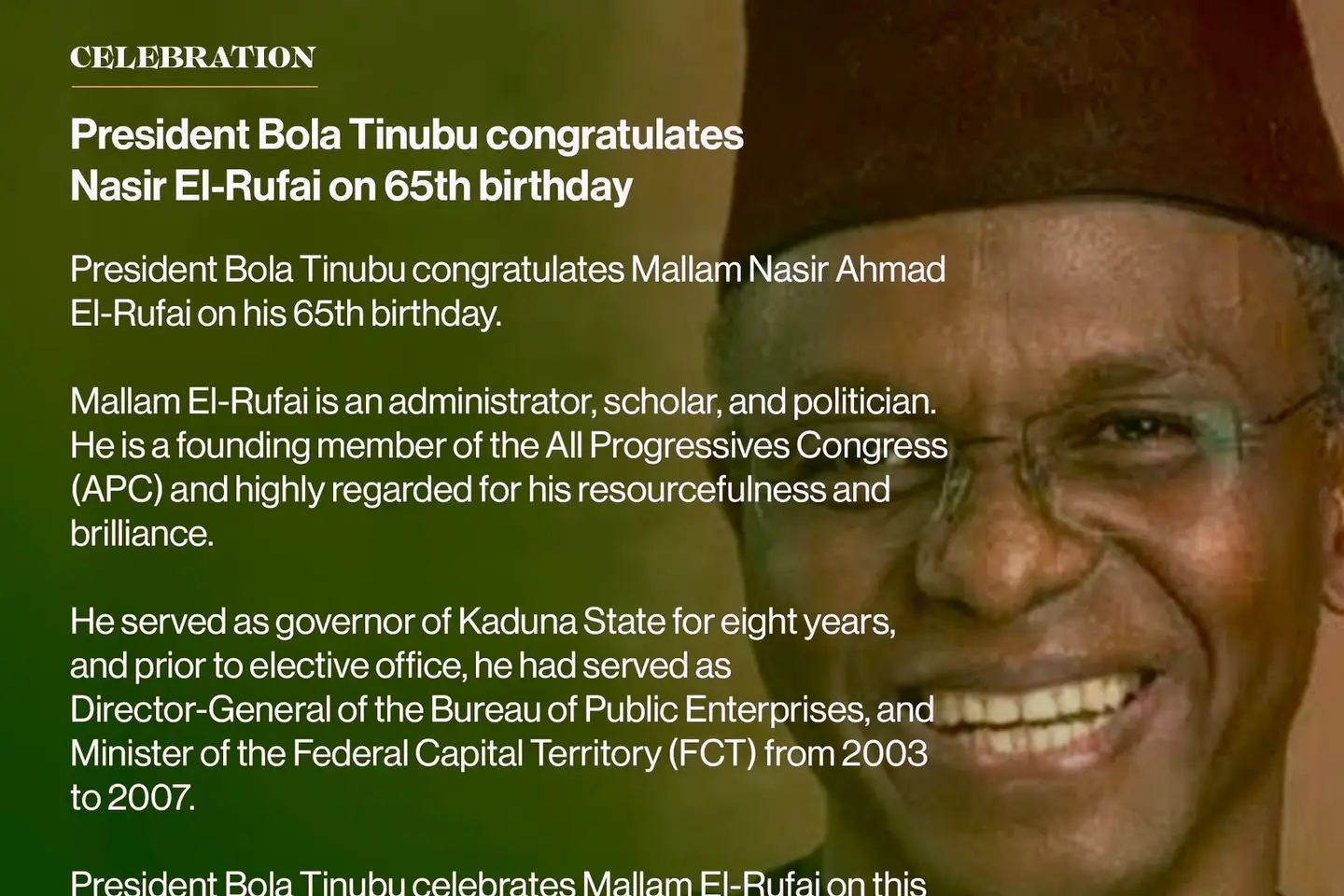
In a move that has sent ripples through Nigeria’s political landscape, President Bola Tinubu has officially congratulated former Kaduna State Governor Nasir Ahmad El-Rufai on his 65th birthday. Despite the well-documented and bitter feud that has simmered between the two political heavyweights, Tinubu’s congratulatory message appears as an unexpected gesture of magnanimity—a signal perhaps that, beneath the fierce rhetoric, there still exists a thread of mutual respect and historical collaboration.
A History of Collaboration and Conflict
Both Tinubu and El-Rufai have played pivotal roles in the evolution of modern Nigerian politics, particularly as founding members of the All Progressives Congress (APC). Their collaboration during the formative years of the party was instrumental in the electoral victories of 2015, 2019, and 2023—a period that reshaped the political architecture of Nigeria.
Tinubu, with his formidable political acumen, and El-Rufai, known for his much touted innovative governance in Kaduna State, were once united by a common vision: to challenge the established order and usher in a new era of democratic governance.
Yet, as is often the case in political alliances forged under intense pressure, fissures soon appeared. Divergent visions regarding party strategy, policy direction, and leadership style have since evolved into an entrenched feud that now colours every public interaction between the two figures.
While Tinubu has remained the stalwart patriarch of Nigerian politics, El-Rufai’s reformist zeal and his penchant for controversial, no-holds-barred commentary have made him a lightning rod for both praise and criticism. Their ideological differences have not only divided their supporters but have also ignited an internal battle for the soul of the APC.
The Birthday Greetings: A Diplomatic Overture?
The State House press release, issued by Special Adviser Bayo Onanuga on February 16, 2025, formally states:
“President Tinubu Congratulates Nasir El-Rufai on 65th Birthday”
“President Bola Tinubu congratulates Mallam Nasir Ahmad El-Rufai on his 65th birthday… The President acknowledges Mallam El-Rufai’s role in the dialogues leading up to the formation of the APC and his contributions to the success of the party in the three consecutive elections of 2015, 2019, and 2023. President Tinubu wishes El-Rufai good health and strength for continuous service to the nation.”
At first glance, the tone of the message is warm and respectful—a stark contrast to the caustic exchanges that have characterised recent political discourse between the two. Political observers, however, are quick to point out that this gesture might be less about personal amity and more about political expediency.
By publicly celebrating El-Rufai’s birthday, Tinubu appears to be extending an olive branch, or at least signalling a willingness to put differences aside for the greater good of the APC and the nation.
The Underlying Political Feud
Despite the cordial tone of the press release, the past few years have witnessed a palpable escalation in tensions between Tinubu and El-Rufai. Sources within the APC suggest that their dispute is rooted in more than just personal ambition. At its core, the feud represents a clash of ideologies and governance philosophies.
Tinubu, long hailed as the “Jagaban” of Nigerian politics, embodies the traditional, sometimes opaque, mechanisms of power—a style that emphasises patronage, subtle manoeuvring, and a network of entrenched alliances.
In contrast, El-Rufai has emerged as the party’s reformist icon, advocating for transparency, accountability, and a modernised approach to governance.
This ideological rift has been further compounded by policy disagreements. El-Rufai’s tenure as governor of Kaduna State was marked by ambitious reforms, many of which disrupted established power structures and triggered resistance from traditional elites.
His reformist zeal, though lauded by many as a breath of fresh air, has also alienated significant sections within the APC who favour continuity over change.
As such, the birthday greetings can be seen as a reminder of El-Rufai’s undeniable contributions to the party’s early successes—contributions that, despite current differences, remain part of the APC’s historical narrative.
A Strategic Move in the Face of Internal Dissent
Political analysts argue that Tinubu’s public congratulation is not merely an act of personal courtesy but a strategic manoeuvre aimed at bridging internal divides.
With the APC facing increasing factionalism and discontent among its grassroots, reuniting influential figures like Tinubu and El-Rufai could be key to maintaining a unified front, especially with the electoral challenges on the horizon.
Tinubu’s gesture may also serve as a subtle warning to his detractors: that the party’s internal conflicts, while inevitable, should not distract from the broader objective of national development.
In the context of Nigeria’s volatile political environment, where public sentiment can shift rapidly and alliances are continually tested, such symbolic acts carry significant weight.
By publicly recognising El-Rufai’s service and achievements, Tinubu is effectively reaffirming the notion that the APC’s success is built on the contributions of all its members, regardless of personal differences.
The Implications for Nigeria’s Political Future
This latest episode is more than a mere birthday greeting—it is a microcosm of the broader struggles within Nigerian politics today. The reconciliation, however tentative, between Tinubu and El-Rufai could signal the beginning of a new chapter for the APC.
If these two powerhouses can manage to navigate their differences, it might pave the way for a more cohesive political strategy that prioritises national interests over internal rivalries.
However, sceptics remain unconvinced. Many argue that the deep-seated ideological differences and personal ambitions that fuel their feud will not be easily resolved by a simple public congratulation.
The past few years have shown that when it comes to Nigerian politics, gestures of reconciliation are often short-lived and subject to the shifting sands of power dynamics.
Critics warn that unless there is a substantive dialogue addressing the root causes of their differences, the underlying tensions could resurface with renewed vigour, potentially undermining the party’s credibility and stability.
The Spectre of Political Realignment
Some political commentators suggest that Tinubu’s birthday message might be an early indication of an impending realignment within the APC.
With various factions jostling for influence, there is growing speculation that a broader reorganisation could be on the cards—a move that might see the establishment of new alliances or even the emergence of a more radical faction challenging the status quo.
In this light, Tinubu’s gesture is both a nod to the party’s founding principles and a subtle invitation to those who have long felt sidelined by the current power structure.
El-Rufai’s own political journey, from his tenure as Kaduna State governor to his roles in the federal government, reflects a commitment to reform and a willingness to challenge established norms.
His achievements in public sector reform and infrastructural development have won him both admirers and detractors. In recognising these contributions, Tinubu not only pays tribute to a former ally but also underscores the complex interplay between progress and tradition that continues to define Nigerian politics.
Conclusion: A Pivotal Moment in a Tumultuous Landscape
President Bola Tinubu’s birthday greetings to Nasir el-Rufai on the occasion of his 65th birthday offer a rare glimpse into the convoluted world of Nigerian political manoeuvring.
On the surface, the message exudes warmth and respect—a public celebration of a man who has been a crucial architect of the APC’s early successes. Yet beneath this veneer lies a narrative of enduring rivalry, ideological divergence, and strategic calculation.
For many within and outside the APC, this act is seen as a moment of cautious optimism—a signal that, despite personal enmities and political clashes, the larger goal of national unity might yet prevail.
As Nigeria hurtles towards an uncertain electoral future, the dynamics between Tinubu and El-Rufai will undoubtedly remain a key barometer of the nation’s political pulse. Whether this conciliatory gesture will herald a genuine thaw in relations or serve merely as a temporary salve for deeper wounds remains to be seen.
In a nation where political allegiances are as volatile as they are passionate, the Tinubu–El-Rufai saga is far from over. For now, however, the birthday message stands as a potent reminder of the power of symbolic gestures in shaping the contours of political discourse—and of the delicate balancing act that underpins Nigeria’s democratic journey.
Atlantic Post will continue to monitor developments in this ongoing political drama, providing incisive analysis and comprehensive coverage on every twist and turn in the Tinubu–El-Rufai narrative.