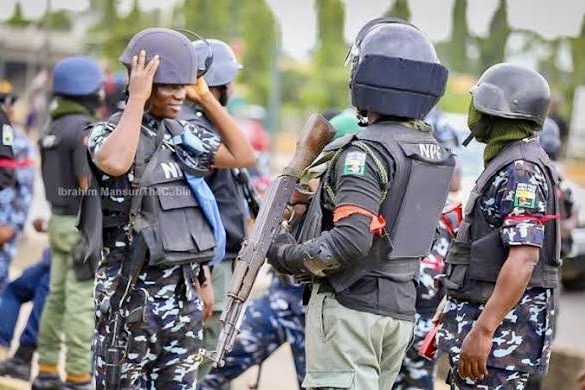
Deck: The reported killing of three officers in Gusau comes exactly a week after another deadly ambush claimed the lives of three policemen and other security personnel travelling with traders. The fresh attack raises urgent questions about patrol safety, intelligence-sharing and the protection of those charged with protecting Nigerians.
Three Nigerian policemen have reportedly been killed after armed men ambushed a night-patrol team in Gusau, the Zamfara State capital, renewing questions about the vulnerability of security personnel operating in one of the country’s most troubled states.
The attack allegedly occurred at about 2am on Saturday, 17 October 2026, in the Damba Division, while the officers were on routine patrol, according to a source who spoke to SaharaReporters on condition of anonymity.
The source said the attackers opened fire on the team, leaving its patrol vehicle riddled with bullets. A photograph published in connection with the incident reportedly shows the vehicle bearing the inscription, “DAMBA DIVISION, ZAMFARA STATE, DONATED BY: ZAMFARA STATE GOVT.”
As of the time of reporting, the Zamfara State Police Command had not publicly confirmed the incident or released an official account of the circumstances surrounding the officers’ deaths. Other Nigerian news outlets have carried similar reports, but the casualty figure and details remain subject to official verification.
The implications extend beyond another violent incident in Zamfara. When the personnel responsible for responding to armed attacks become victims themselves, questions arise about the safety of patrol operations, the quality of available intelligence and the speed with which reinforcements can reach officers under fire.
A Second Deadly Ambush in One Week
The reported killing in Damba comes seven days after another deadly attack in Zamfara, when gunmen ambushed a convoy of traders travelling under military escort towards Nasarawa market in Bukkuyum Local Government Area.
The traders were travelling from Gwashi when the assailants struck at about 2pm on Saturday, 10 October, according to reporting by Reuters cited by TheCable.
At least 20 people were reportedly killed. The victims included four soldiers, three police officers and an officer of the Nigeria Security and Civil Defence Corps (NSCDC), alongside 12 civilians. A military source told Reuters that 19 people were wounded.
If the reported Damba deaths are confirmed, the two attacks would mean that at least six police officers had been killed in separate incidents in Zamfara within seven days.
That possible toll is significant because the circumstances differ. In the earlier attack, security personnel were accompanying traders along a market route. In the latest incident, officers were reportedly conducting a night patrol in Gusau.
The available information does not establish whether the perpetrators were connected or whether the incidents shared a common operational pattern. Yet together, the reports highlight the continuing danger facing both security personnel and civilians moving through the state.
They also raise an uncomfortable question: how can ordinary residents be expected to feel safe travelling under security escort or going about their lives when armed groups can reportedly inflict heavy casualties on those assigned to protect them?
The Patrol Vehicle Raises Questions About Protection
The reported condition of the Damba patrol van warrants closer examination.
The photograph described by SaharaReporters identifies the vehicle as a state-government donation. That inscription establishes the reported source of the vehicle, but it does not establish its age, technical condition, armour specifications or suitability for operations in a high-risk environment.
Those distinctions matter.
A vehicle can be operational without offering meaningful protection against sustained gunfire. Equally, bullet holes alone cannot establish whether a vehicle lacked ballistic protection or whether the attackers possessed overwhelming firepower.
The relevant questions for the police and Zamfara State Government are therefore specific.
Was the patrol vehicle appropriately equipped for the threat level? Were the officers provided with suitable protective equipment and reliable communications? Did commanders have recent intelligence about armed groups operating around the division? Was an emergency response available, and how quickly could it have been deployed?
The circumstances of the reported ambush would need to be established through an official incident report and an investigation before responsibility for any operational deficiencies could be determined.
The vehicle’s government-donation inscription also brings public accountability into focus. Where public funds or state resources support policing, residents deserve to know whether equipment is fit for purpose, properly maintained and deployed according to operational needs.
A donated vehicle is not evidence of procurement failure. But neither should the fact of a donation end scrutiny of whether the equipment meets the demands placed upon it.
Gusau Faces Renewed Security Pressure
The latest report follows another attack in the Gusau area earlier in the week.
Punch reported on 16 October that Nigerian Army troops, working with local vigilantes, had repelled an attack on Fegin Mahe community in Gusau Local Government Area. The incident reportedly prompted residents to flee amid fears of further violence. Details of the casualties and damage were not immediately available.
The incidents point to a wider challenge for security operations in Zamfara: protecting communities while armed groups continue to threaten settlements, roads and other vulnerable locations.
Military operations have also continued. On 9 October, Channels Television reported that troops of Operation Fansan Yamma, working with police explosive-ordnance personnel, had located and destroyed three improvised explosive devices along the Magami–Dansadau road in Zamfara. The military also reported recovering 73 livestock abandoned by fleeing suspected terrorists during a separate operation.
These operations indicate that security forces are pursuing armed groups and disrupting some of their activities. But operational successes must ultimately translate into safer journeys, fewer attacks on communities and better protection for personnel in the field.
The reported Damba incident also highlights the importance of distinguishing between territory where security forces can operate and territory where residents can live and travel without persistent fear.
A Regional Security Strategy Faces Its Hardest Test
At a Northwest security summit hosted in Gusau on 19 August, Zamfara State Governor Dauda Lawal acknowledged that the crisis extended beyond isolated criminal incidents.
“The Northwest’s security crisis exceeds isolated crimes,” Lawal said, describing organised networks engaged in banditry, kidnapping and cattle rustling across state boundaries. He called for stronger intelligence-sharing, coordinated operations, inter-state surveillance and sustained disruption of the networks that support organised crime.
Inspector-General of Police Olatunji Rilwan Disu also stressed the importance of coordinated regional action at the summit.
“We have come together, we police together, we share intelligence together,” Disu said, pledging continued deployment of police personnel, capabilities and partnerships to improve security across the region.
The reported killing of the Damba officers makes the practical delivery of those commitments particularly urgent.
Intelligence-sharing must result in actionable warnings. Patrol plans must reflect the threats facing officers on the ground. Communications systems must allow teams under attack to request assistance. Investigations must also establish whether criminal groups are exploiting predictable deployments, intelligence gaps or weaknesses in emergency response.
These are questions for the police leadership and the wider security establishment, not conclusions that can be drawn from a single photograph or an anonymous account.
What the Authorities Need to Establish
The Zamfara State Police Command should publicly clarify whether the Damba attack occurred as reported, identify the confirmed casualties when appropriate and explain what is known about the circumstances.
An investigation should establish how the attackers approached the patrol team, whether advance intelligence was available, what communications were made during the incident and how the police responded afterwards. Any recovered evidence should be used to identify and apprehend those responsible.
The state government also has a legitimate oversight interest in understanding whether the patrol vehicle was appropriate for its assigned role and whether security personnel had the necessary equipment and support.
The investigation should not end with a casualty announcement. The public needs an account of what happened, what could reasonably have prevented the attack and what corrective action will follow.
There must also be care in describing the perpetrators. Although the incident has been attributed to bandits in initial reports, their identities and affiliations have not been established publicly. No group should be named as responsible without supporting evidence.
The Bigger Question Is Whether Protection Is Reaching the Front Line
For residents of Zamfara, the immediate concern is whether another attack will follow. For the police, it is whether officers can carry out routine duties without being exposed to avoidable risks. For the state and federal governments, it is whether security policy is producing measurable improvements in public safety.
The reported Damba ambush, following the deadly convoy attack and renewed violence around Gusau, leaves these questions impossible to ignore.
The deaths of three officers would represent not only a loss of trained personnel but also another test of the systems intended to protect the public. Their colleagues, local communities and the families of those killed deserve more than a promise of intensified operations.
They deserve verified answers, a credible investigation and evidence that lessons have been learnt.
Until the Damba incident is officially confirmed and its circumstances established, important details remain unresolved. But the broader challenge is already clear: security operations cannot be judged solely by the number of raids conducted or suspected criminals arrested. Their ultimate measure is whether the people and officers they are meant to protect are safer.
Follow us on our broadcast channels today!
- WhatsApp: https://whatsapp.com/channel/0029VawZ8TbDDmFT1a1Syg46
- Telegram: https://t.me/atlanticpostchannel
- Facebook: https://www.messenger.com/channel/atlanticpostng


Join the debate; let’s know your opinion.