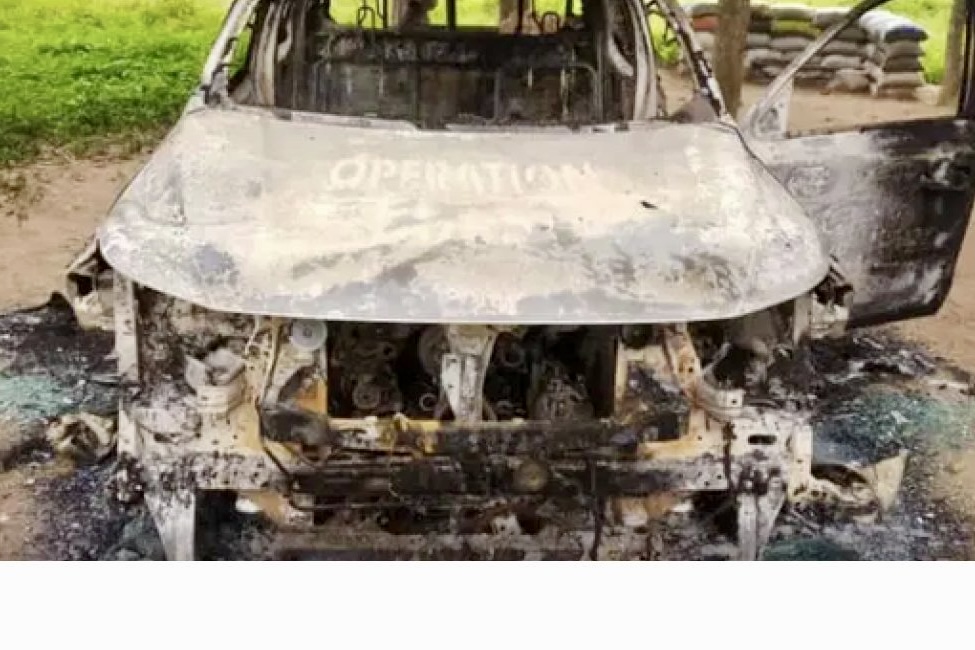
Attack on Operation Burst base in Igbeti raises fresh questions over the security of Oke-Ogun forest corridors after a series of deadly attacks and kidnappings in 2026.
IBADAN — A security base operated by the Oyo State Joint Security Taskforce, known as Operation Burst, came under attack in the Igbeti axis of Oorelope Local Government Area on Sunday, with suspected bandits reportedly opening fire on personnel and setting a patrol van ablaze.
A block within the security facility was also reportedly destroyed by fire during the assault.
Initial accounts said the attackers arrived in large numbers and attempted to overwhelm the personnel stationed at the base, raising fears that the objective may have gone beyond intimidation to the seizure of weapons and the elimination of security personnel.
The attack was reportedly repelled after personnel from sister security agencies were mobilised to reinforce the base.
The attackers subsequently fled.
No casualty was recorded, according to the command, while security authorities have intensified operations to identify and arrest those responsible.
The incident could not immediately be independently corroborated through a detailed official public statement at the time of publication. The account of the attack is therefore being treated as a developing security incident, with some details based on security and local sources.
Attack on a security post changes the threat
A direct assault on a security base carries a different security implication from a conventional roadside ambush or village raid.
The attackers were reportedly prepared to confront armed personnel inside a security facility.
“Preliminary inquiries revealed that the bandits allegedly stormed the base in large numbers and opened fire on security personnel with what was described as powerful weapons,” a source quoted in the report said.
“The attackers were also suspected of attempting to overrun the security post, kill the personnel stationed there and cart away their weapons.”
That account, if confirmed by investigators, would indicate an operation involving planning, intelligence gathering and confidence that the attackers could approach a security installation and sustain an armed assault long enough to cause damage.
The burning of a patrol vehicle and part of the base is also significant.
It potentially deprives the security team of mobility at precisely the point where rapid response is most important.
Why Igbeti matters
The Igbeti area sits within the wider Oke-Ogun security corridor, where roads, border communities and forest routes have come under increasing pressure from armed criminal groups.
Recent security incidents have demonstrated that the threat is not confined to isolated villages.
In June 2026, suspected bandits attacked travellers around the Igbeti-Kisi and Igboho-Igbeti corridors. One report said two people were killed in separate attacks, while several others were injured. Security agencies subsequently mobilised to clear affected routes and protect stranded motorists.
The Oyo State House of Assembly responded by demanding stronger security measures in Oke-Ogun and called attention to the recurring attacks on the Kishi-Igbeti and Igboho-Igbeti roads.
The lawmakers specifically warned about criminal activity around forest corridors connected to Old Oyo National Park, noting repeated incidents of kidnapping, killings and other crimes.
That history gives the latest attack on an Operation Burst base a wider significance.
It suggests that criminal groups operating around the forest corridor may be testing not only civilian routes but also the ability of security agencies to maintain forward positions.
Old Oyo forest belt remains a major security challenge
The security picture in the area has deteriorated sharply in 2026.
In January, armed bandits attacked the Old Oyo National Park at Oloka in Oriire Local Government Area, killing five forest rangers and other personnel.
The Oyo State Police Command later announced the arrest of seven suspected members of a 10-man gang allegedly involved in the attack.
According to the police account, the attackers arrived on motorcycles carrying sophisticated firearms and stormed the park office. Investigators said the gang’s reported objective was to free members who had earlier been arrested for alleged criminal activities in the park and neighbouring communities.
The federal government’s information service also reported that seven suspects had been arrested in connection with the attack following an intelligence-led operation.
The pattern is important.
The January attack targeted forest-security personnel.
The June attacks targeted travellers on major road corridors.
The latest reported incident has allegedly targeted a forward security base itself.
Taken together, those developments point to a security environment in which criminal groups can potentially move between forests, roads, villages and security-sensitive locations.
Kidnapping threat adds to the pressure
The forest belt has also featured prominently in kidnapping incidents.
In May 2026, pupils and teachers abducted from schools in Oriire Local Government Area were believed to have been taken into the Old Oyo National Park.
Governor Seyi Makinde subsequently disclosed that intelligence indicated the victims were being held within the park, whose difficult terrain spans about 2,500 square kilometres and creates serious operational challenges for conventional security forces.
That disclosure underlined a central problem.
A large forest environment can give armed groups concealment, multiple escape routes and the ability to cross administrative boundaries faster than security agencies can respond.
Saturday PUNCH also reported in May that forest and border corridors stretching across parts of the South-West were being exploited by criminal groups as infiltration and escape routes, identifying the Old Oyo National Park as one of the areas of concern.
Security infrastructure is already in place
The latest attack also raises questions about the effectiveness of existing investments in the area.
Oyo State has previously established a Forward Operating Base along the Kisi-Igboho-Igbeti axis to provide security coverage for forests around Oke-Ogun.
Government records also list the provision of operational vehicles to Operation Burst and other security agencies as part of efforts to strengthen the state’s security architecture.
In January 2024, the state government handed more than 100 vehicles to security agencies, including the police, Army, NSCDC, Operation Burst, Amotekun, NDLEA and other agencies. The government said the intervention was intended to improve mobility and response to criminal activity.
The reported burning of an Operation Burst patrol van therefore goes beyond property damage.
It raises a practical question over whether forward bases in high-risk locations have enough personnel, firepower, surveillance capability, communications equipment and rapid reinforcement capacity to withstand coordinated assaults.
The unanswered weapons question
One of the most sensitive details remains unresolved.
It was not immediately clear whether the attackers succeeded in taking any weapons or ammunition from the facility.
That question should be central to the investigation.
A successful seizure of weapons from a security base could have consequences far beyond the immediate incident.
It would potentially strengthen the attackers’ firepower and expose weaknesses in armoury security, personnel deployment and emergency response.
Investigators will also need to establish how many attackers were involved, the weapons used, how long the assault lasted, whether there was prior surveillance of the base and how the attackers escaped after reinforcement arrived.
Another critical issue is intelligence.
If the attackers were able to approach a known security position in large numbers and open fire, investigators will need to establish whether the movement was detected before the assault.
That is the difference between an isolated surprise attack and a potentially organised operation against a security installation.
Why the attack should concern businesses and communities
The implications extend beyond policing.
Oke-Ogun depends heavily on agriculture, road transport and movement between rural communities and commercial centres.
Persistent attacks on the Igbeti-Kisi and Igboho-Igbeti corridors can raise transport risks, discourage movement of goods, increase insurance and security costs and affect farmers who depend on access to remote areas.
The wider consequences can include higher costs for food distribution, reduced commercial activity and reluctance by private operators to invest in communities perceived as difficult to secure.
For residents, the greatest concern is the possibility that repeated attacks become normalised.
That is already visible in the rising demand for more patrols and stronger security measures across the affected communities. The Oyo Assembly has called for coordinated action involving conventional security agencies, state-backed outfits, vigilantes and local actors familiar with the terrain.
Police warning over unverified security claims
The security environment has also created fertile ground for misinformation.
In June, the Oyo State Police Command rejected claims that suspected Lukarawa terrorists had infiltrated forests around Ogbomoso and Old Oyo National Park, describing a viral video and accompanying voice note as old material recycled to create fear.
The command said intelligence assessments did not support the claim, while also saying security measures had been strengthened around vulnerable communities.
That distinction is important in reporting the latest incident.
The attack on the Operation Burst base should not automatically be presented as evidence of terrorist infiltration or linked to any particular armed group without evidence.
At this stage, the responsible description is that suspected bandits reportedly attacked the facility.
The questions investigators must answer
The most important unanswered questions are now straightforward.
Who planned the attack?
How many attackers were involved?
How did they approach the base without being stopped earlier?
What weapons were used?
Did any security personnel exchange fire with the attackers?
Were weapons or ammunition stolen?
How long did the attackers remain inside the perimeter?
Was there an intelligence failure?
And why was a security facility in an increasingly vulnerable corridor targeted at this particular time?
Answers to those questions will determine whether Sunday’s assault was an isolated criminal raid or part of a broader campaign to weaken security coverage around Oke-Ogun.
For now, the attackers have reportedly escaped.
The more immediate test for the authorities is whether they can be identified and arrested before another security post, road corridor or rural community comes under attack.
Follow us on our broadcast channels today!
- WhatsApp: https://whatsapp.com/channel/0029VawZ8TbDDmFT1a1Syg46
- Telegram: https://t.me/atlanticpostchannel
- Facebook: https://www.messenger.com/channel/atlanticpostng