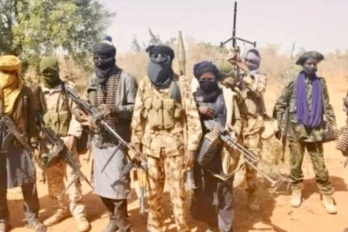
SOKOTO, Nigeria — A fresh wave of violence in Kebbe Local Government Area of Sokoto State has sent women, children and elderly residents fleeing their communities, deepening fears that armed groups are steadily tightening their grip on vulnerable rural settlements in the state.
Residents of Ungushi and adjoining communities were reportedly forced to abandon their homes after suspected bandits launched attacks that continued into Saturday night, with fleeing residents arriving in Kebbe town from about 8pm, according to conflict reporter Bakatsine.
The reported assault has also exposed the brutal economic dimension of banditry in north-western Nigeria. Local sources cited in the report said the attackers rustled more than 300 cattle and seven camels from Ungushi and Gwandi.
Several men were also reportedly killed, although the precise casualty figure remained unclear across the affected communities, including Ungushi, Maikurfuna and Gwandi, as of Sunday.
Two injured residents, identified as Usman Umar Margai and Sani Abdullahi Gwandi, were reportedly receiving treatment at the General Hospital after sustaining gunshot wounds. More displaced residents were said to be arriving in Kebbe on Sunday morning.
The scale of the displacement is particularly disturbing because the immediate victims were not simply fleeing a violent incident; they were abandoning homes, farms, livestock and livelihoods in the middle of the rainy season.
Families Flee Into the Rain
The human story behind the latest attack is perhaps more revealing than the headline numbers.
According to the report, many of those who fled Ungushi spent the night in the rain after escaping the attackers. Women, children and elderly people were among those displaced, turning what began as an armed raid into a rapidly developing humanitarian emergency.
That detail matters.
For rural families in Sokoto, livestock is not merely property. Cattle frequently represent accumulated family wealth, agricultural capital, food security and, in many cases, a household’s principal economic asset. The reported loss of more than 300 cattle and seven camels therefore represents a significant financial blow to already vulnerable communities.
The latest attack also illustrates how insecurity can produce displacement without requiring the wholesale occupation of a town. Once armed groups can enter a community, attack residents, steal livestock and leave before meaningful intervention arrives, residents can become effectively displaced even when their houses remain standing.
Bakatsine said in an earlier Saturday-night alert: “Bandits are currently in Ungushi community, Kebbe LGA of Sokoto State. Security assistance is needed in the village and surrounding communities.”
The warning provides an important timeline: the attack was not simply reported after it had ended. A public alert was issued while the assault was reportedly underway, highlighting the urgency of the situation and the importance of the response window available to security agencies.
Casualty Figures Remain Unclear
One of the most important caveats surrounding the latest incident is the uncertainty over casualties.
The conflict reporter’s account said several men were killed, but did not provide a definitive number. The identities of the two wounded victims receiving treatment were disclosed, but independent confirmation of the overall casualty figure was not immediately available in the sources reviewed for this report.
That distinction is important in reporting Nigeria’s security crisis, where early casualty figures can change considerably as displaced residents return, hospitals receive the injured and communities account for missing persons.
Atlantic Post could not independently verify the reported death toll at the time of publication.
The same caution applies to attribution. The latest assault has been described as an attack by suspected bandits. While Kebbe has experienced attacks by armed criminal groups and Lakurawa militants in recent months, it would be premature to conclusively attribute this particular assault to a named organisation without an official identification by security authorities.
Kebbe Has Already Been a Security Flashpoint
The latest violence did not occur in an isolated vacuum.
Kebbe LGA has already witnessed serious attacks this month. On 4 August 2026, The PUNCH reported that the Sokoto State Police Command confirmed an attack by Lakurawa militants on Girkau community in the same local government area.
The attack left a police officer and two civilians dead, while several other people were injured. Two security vehicles — one belonging to the police and another to the Sokoto State Community Guard Corps — were reportedly burnt.
Sokoto police spokesman Ahmed Rufai confirmed the attack and said security operatives had engaged and repelled the attackers.
“It is unfortunate that we lost one of our men during the attack,” Rufai said, adding that officers responded to a distress call and mobilised to the community.
He also confirmed: “They burnt two vehicles, one belonging to the police and the other to the Sokoto State Community Guard Corps.”
Residents, however, described an atmosphere of mounting fear and claimed they had repeatedly alerted security agencies to suspicious movements in the area before the Girkau attack.
One community leader told The PUNCH: “What happened in Girkau is heartbreaking.” The resident said attacks were becoming too frequent and that people were living in fear. Another resident said the community had previously reported suspicious movements but feared those warnings had not translated into sufficient security presence.
That sequence of events makes the latest attack in Ungushi, Gwandi and Maikurfuna particularly significant.
It suggests that the security challenge facing Kebbe is not a one-off incident but part of a continuing pattern of armed incursions into rural settlements.
Only a Day Earlier, Kebbe Town Was Attacked
The timing is even more troubling.
On 15 August 2026, The Sun reported that suspected bandits had attacked Kebbe town itself, with the attackers reportedly moving through sections of the community, looting shops and taking phones, food items and petrol.
A resident told the newspaper that the attackers arrived on motorcycles and were heavily armed.
“They came on motorcycles armed with sophisticated guns. I counted over 200 motorcycles,” the resident said.
The resident alleged that the attackers also went to the Divisional Police Headquarters and attacked a military base on the outskirts of town.
A security source cited by The Sun said four soldiers were feared dead during the confrontation, while additional troops and an Air Force jet were reportedly deployed. However, Sokoto police spokesman DSP Ahmad Rufa’i confirmed the attack while describing it as “terrible”, but did not disclose casualty details at the time the report was filed.
That discrepancy reinforces the need for careful verification.
There is already evidence that Kebbe has become a contested security corridor where armed groups can mount bold attacks against communities and, according to multiple accounts, put pressure on security positions themselves.
A Pattern of Livestock Theft and Rural Displacement
The reported theft of more than 300 cattle and seven camels is also consistent with a wider pattern across Sokoto in which livestock rustling is not merely an accompanying crime but an important component of the insecurity economy.
In July, the Sokoto State Police Command said coordinated operations conducted between May and July had led to the recovery of 689 rustled domestic animals, alongside the rescue of kidnapped victims and arrests of suspected kidnappers, bandits and collaborators.
The command’s Commissioner of Police, Hayatu Hassan Shaffa, said security operations had targeted banditry, kidnapping and cattle rustling across several local government areas.
Police also reported separate successes in June and July, including the recovery of 137 cattle after two bandit attacks were foiled in Tureta Local Government Area.
Those figures demonstrate both sides of the security equation.
Government forces are recovering significant quantities of rustled livestock, but criminal groups continue attempting large-scale raids. The persistence of the attacks indicates that enforcement successes have yet to translate into enduring security for many remote communities.
Echoes of an Earlier Kebbe Displacement Crisis
The names Ungushi, Gwandi and Maikurfuna also carry an unsettling history.
In September 2022, the International Organization for Migration’s Displacement Tracking Matrix documented an earlier attack on Gwandi and Maikurfuna villages in Ungushi ward, Kebbe LGA.
The IOM recorded that the attacks affected 1,780 people and displaced 1,766 residents, with victims fleeing to the Sobon Gari area and the UBE Tudu Wada Primary School in Kebbe East. The assessment recorded 14 fatalities and 20 injuries.
The recurrence of the same communities in security reporting years later is significant.
It suggests that the structural vulnerabilities that allowed armed groups to terrorise these settlements have not been fully eliminated.
The geography also matters. Ungushi, Gwandi and Maikurfuna are established settlements within Kebbe, rather than anonymous locations far removed from formal government structures. Official and electoral records identify Ungushi and Gwandi among the communities of Kebbe LGA.
The ‘Ghost Village’ Problem
The consequences extend far beyond any single attack.
A detailed PUNCH investigation published in July found that more than 30 villages in Danchadi District of Bodinga LGA, Sokoto State, had been deserted following repeated bandit attacks. The report described abandoned farms, emptied houses, stolen livestock and families scattered across neighbouring communities.
The report quoted the District Head of Danchadi, Alhaji Lirwanu Mafaran, as saying:
“My people are living in fear and confusion. Some women are still searching for their husbands after the attacks.”
That is the broader danger now confronting Kebbe.
If attacks continue at a frequency that makes farming, herding, trading and raising children too dangerous, displacement can become permanent.
Communities then cease to function economically.
Fields go uncultivated. Livestock is lost or sold cheaply. Rural markets shrink. Schools become inaccessible. Health facilities become harder to staff. Young people migrate. The criminal economy expands into the vacuum.
The result is a vicious cycle in which insecurity creates poverty, poverty increases vulnerability and vulnerability makes further attacks easier.
Security Forces Facing a More Mobile Threat
Another concern is the apparent mobility of the attackers.
The 15 August attack on Kebbe town, as reported by The Sun, involved large numbers of motorcycles, while earlier operations elsewhere in Sokoto have shown that armed groups can exploit forests, remote roads and community-level intelligence gaps to evade pursuit.
The Nigerian military has continued offensive operations against armed groups in the North-West. In May, troops of Operation FANSAN YAMMA reported killing suspected Lakurawa fighters in Sokoto and recovering weapons and rustled livestock after responding to attacks in Tangaza Local Government Area.
But the operational challenge is considerable.
Security agencies are expected simultaneously to secure isolated villages, escort vulnerable communities, respond to distress calls, protect military and police positions, pursue attackers and prevent livestock from being moved through difficult terrain.
The latest Kebbe incident suggests that the attackers remain capable of exploiting gaps between these responsibilities.
What the Fresh Attack Reveals
The most important question emerging from Kebbe is not simply how many cattle were stolen.
It is why residents continue to be forced to flee after repeated warnings and previous attacks.
The answer will require more than occasional reinforcement after an attack has occurred.
Rural communities need persistent intelligence-led patrols, rapid-response capability, stronger community-security coordination and the ability to track armed groups across local government and state boundaries.
Livestock recovery operations are valuable, but they remain reactive unless the networks supporting the rustling economy are dismantled.
The same applies to displacement.
It is not enough to move frightened families into safer towns after an attack. The state must ultimately restore conditions that allow those residents to return home without facing another raid.
For the families arriving in Kebbe after spending the night in the rain, that long-term solution remains painfully distant.
Security Authorities Must Answer the Hard Questions
The latest attack raises several urgent questions for the security establishment.
Were distress calls received while the attack was still underway?
How quickly were tactical teams deployed?
Were intelligence units tracking unusual armed movement around Ungushi and adjoining communities?
What measures are being taken to prevent the stolen cattle and camels from being moved through established escape corridors?
How many people have been displaced?
How many residents remain unaccounted for?
And, crucially, how many security personnel are now deployed to protect the affected communities?
Those questions require concrete answers, not generic assurances.
The experience of Kebbe shows that the cost of insecurity cannot be measured solely in corpses.
Every abandoned village, stolen cow, destroyed shop, closed school and displaced child represents another erosion of state authority.
Until rural communities can sleep without listening for gunfire or preparing to flee at night, claims of security progress will remain difficult to reconcile with the reality confronting residents on the ground.
As of 16 August 2026, the latest reported attack had produced displacement, injuries and major livestock losses, while the definitive casualty count and official attribution of the perpetrators remained unclear.
For now, one grim fact stands out: once again, women, children and elderly residents are paying the immediate price of Nigeria’s prolonged struggle against armed banditry.
And in Kebbe, they are running for safety from communities that have already endured this nightmare before.
Follow us on our broadcast channels today!
- WhatsApp: https://whatsapp.com/channel/0029VawZ8TbDDmFT1a1Syg46
- Telegram: https://t.me/atlanticpostchannel
- Facebook: https://www.messenger.com/channel/atlanticpostng