Six Islamic clerics travelling to Talata Mafara for a prayer gathering linked to President Bola Tinubu’s 2027 re-election campaign were abducted in broad daylight, exposing another major security breach in Zamfara. Police say six imams were taken along the Dakko–Damri feeder road, while the Army says no cleric was abducted at Senator Abdul’aziz Yari’s residence.
Six Islamic clerics have been abducted in Zamfara State while travelling to Talata Mafara for a special prayer gathering associated with President Bola Tinubu’s 2027 re-election campaign, the state police command has confirmed.
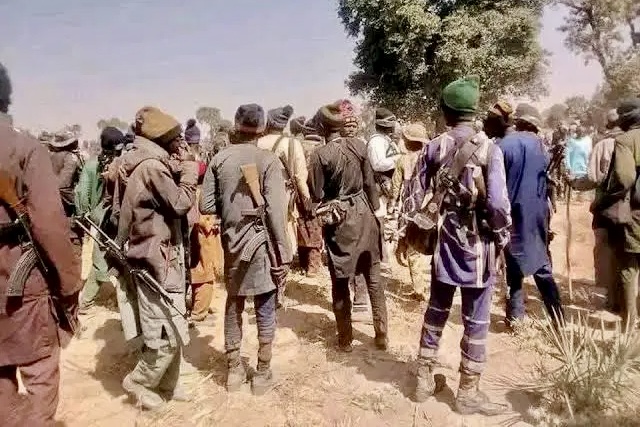
The abduction occurred at about 11:30am on Saturday, September 12, when armed bandits ambushed the vehicle carrying the clerics along the Dakko–Damri feeder road in Bakura Local Government Area.
The development has raised immediate questions about security around a politically significant gathering involving large numbers of Islamic scholars, and about the ability of security agencies to protect travellers on roads that have repeatedly come under attack.
It also exposes a striking discrepancy in the early accounts of the incident.
While an earlier report identified five clerics as missing after they travelled towards Senator Abdul’aziz Abubakar Yari’s residence, the Zamfara Police Command subsequently confirmed that six imams were abducted. The command has not released their names.
Police confirm six abducted
Zamfara Police spokesman Yazid Abubakar said the attackers were armed and had mounted an ambush along the rural feeder road.
“The assailants laid an ambush along the Dakko–Damri feeder road and intercepted the vehicle conveying the victims,” Abubakar said.
According to the police, all six victims were identified as imams and were travelling towards Talata Mafara when they were seized.
The response began after police received the report. The Divisional Police Officer in Bakura mobilised personnel, including the Vigilante and Crime Response Unit, alongside other security agencies.
Abubakar said the security teams began an intensive search, combing surrounding bushes for the victims and pursuing the perpetrators.
The police also appealed to residents to provide credible information that could help locate the abducted clerics.
The Commissioner of Police, Ahmed Bello, has directed the rescue teams to intensify the operation and deploy available resources towards securing the victims’ release, according to the command.
As of Sunday, September 13, there was no official confirmation that any of the six had been rescued.
What happened to the five names previously reported?
The first reports of the incident were more specific but also produced a different victim count.
SaharaReporters initially reported that five clerics were feared abducted in connection with the prayer gathering and named Imam Yahuza, identified as the First Jumma’at Imam in Dogon Madacci; Magawata Abdullahi, the Second Jumma’at Imam in Dogon Madacci; Malam Shehu Dakko; Imam Bala Fagon; and Na’ibi Tasi’u of Tungar Nagudai.
Those identities have not been independently confirmed by the police.
The police statement confirms six imams were abducted but does not identify them. That distinction matters.
It means the five names circulating publicly should not yet be presented as the definitive identities of the victims.
The difference between five reported victims and six officially confirmed victims also raises a further question: is one additional imam yet to be identified, or were the initial accounts based on incomplete information from people at the gathering?
That issue remains unresolved.
Army corrects where the abduction happened
The Nigerian Army has sought to draw another important line around the incident.
Lieutenant Colonel Olaniyi Osoba, Acting Deputy Director, Army Public Relations, 8 Division, Nigerian Army/Sector 2, Operation FANSAN YAMMA, said reports that clerics had been abducted at Yari’s residence were misleading.
“We wish to categorically refute the claim and set the record straight that no cleric was abducted at Senator Yari’s Residence,” the Army said.
The Army said intelligence reports indicated that people were abducted while travelling from the Sububu forest axis in Bakura Local Government Area towards Talata Mafara.
That clarification is significant because an abduction inside or immediately around the residence of a serving senator and national campaign chief would have represented a substantially different security failure from an attack on a rural road.
The Army said troops, working with other security agencies and local intelligence networks, had intensified efforts to rescue the victims.
It also warned against what it called “sensationalised narratives and unverified information” that could cause panic or compromise tactical operations.
The most defensible position therefore remains this: six people travelling towards Talata Mafara were abducted, police identify them as imams, but the Army has not established that the attack occurred at Yari’s residence.
Why the political connection matters
The incident has acquired political significance because the clerics were reportedly travelling to a large prayer gathering associated with Tinubu’s bid for another term in office.
About 1,000 Islamic scholars were reportedly invited to the gathering, according to the initial reports. The gathering was described as a prayer session for peace and for the success of Tinubu’s 2027 re-election bid.
The location also carries political weight.
Yari, a former Zamfara governor and serving senator, was named Director-General of the All Progressives Congress Presidential Campaign Council for Tinubu’s 2027 campaign in August.
That makes the incident more than a conventional rural kidnapping story.
It places a serious security incident directly alongside one of the emerging political mobilisation structures for the 2027 presidential election.
The contrast is stark.
A gathering reportedly intended to mobilise religious support for a presidential candidate was taking place while clerics travelling to it were being intercepted by armed men on a road in one of the country’s most persistent banditry theatres.
The episode raises a question that goes beyond this single kidnapping: how secure can political mobilisation be in parts of northern Nigeria where armed groups can still stop vehicles in daylight on feeder roads?
Zamfara’s roads remain a critical vulnerability
The latest attack was not an isolated incident.
On August 25, eight travellers were killed and another eight abducted after armed men attacked commercial vehicles along the Gusau–Funtua Federal Highway in Tsafe Local Government Area.
The police said the attackers blocked the highway and opened fire on motorists and passengers. Security forces later engaged the assailants, with police reporting that 17 suspected bandits were killed.
Earlier in August, troops also reported foiling separate abduction attempts in Zamfara and rescuing seven civilians along the Gurusu–Anka route after terrorists abandoned their captives and fled.
These incidents reveal a recurring pattern.
Security agencies may respond effectively after an attack begins, but the continuing ability of armed groups to establish ambushes along roads shows that the state still faces a difficult challenge in preventing attacks before they happen.
For ordinary residents, commercial drivers, traders, farmers and travellers, the risk is particularly acute on rural roads and feeder routes where police and military presence is thinner.
The bigger security question
The kidnapping of six clerics is also a reminder that banditry in Zamfara does not respect social status, occupation or religious standing.
The victims were not described as politicians, security officials or wealthy businessmen.
They were religious scholars travelling for a public gathering.
That matters because kidnappers who can confidently ambush a vehicle transporting Islamic clerics in broad daylight demonstrate that the underlying security problem remains deeper than isolated attacks on particular communities.
It also raises questions about intelligence.
If a gathering of roughly 1,000 Islamic scholars was expected in Talata Mafara, security planners had reason to anticipate unusual movement into the area.
The critical issue is whether intelligence agencies knew the roads being used by participants, whether risk assessments were conducted, and whether adequate escort or route security was considered for travellers coming from vulnerable areas.
There is currently no public evidence demonstrating that such safeguards were planned or, if planned, implemented.
That does not establish negligence by any particular agency.
It does show why the rescue operation should not be the only security response under scrutiny.
Political events now face a security test
Nigeria’s 2027 presidential election is scheduled for January 16, 2027, according to the Independent National Electoral Commission.
The closer the country moves towards the election, the greater the movement of politicians, religious leaders, campaign organisers and supporters across states will become.
In insecure areas, that movement can create predictable targets.
A political gathering can reveal the location and movement of large groups of people. Religious events can have similar characteristics.
The Zamfara incident therefore carries implications beyond the fate of the six abducted clerics.
Political parties and security agencies will increasingly have to confront a practical question: how do they conduct large-scale mobilisation without exposing participants to kidnapping and attack?
That challenge becomes even more serious when political events are held in areas where major roads and rural routes have already recorded repeated attacks.
What remains unanswered
Several important questions were still unanswered on Sunday.
Why was a vehicle carrying six clerics able to travel on a known high-risk route without adequate protection?
Were security agencies aware that hundreds of scholars were travelling towards Talata Mafara?
Who organised transport for the clerics?
Were the identities of participants registered before their movement?
Did the police, Army or other security agencies receive advance intelligence about possible attacks around the gathering?
Were the five individuals named in the initial reports among the six victims confirmed by police?
And most importantly, can authorities rescue all six without further loss of life?
Those questions deserve answers because the incident sits at the intersection of two national concerns: Nigeria’s worsening kidnapping crisis and the increasingly intense political mobilisation ahead of the 2027 election.
The immediate test
For now, the immediate priority is the safe return of the six abducted imams.
The Zamfara Police Command says its rescue operation is ongoing. The Army says it is working with other security agencies and local intelligence networks.
But the incident will ultimately be judged not only by whether the victims are found.
It will also be judged by whether the security agencies can establish how the attackers knew where to strike, why the road remained vulnerable and what changes will be made to prevent another convoy of civilians from being intercepted in broad daylight.
For Zamfara residents, another promise to intensify patrols will mean little if the same roads remain open to armed ambushes.
For politicians preparing for 2027, the message is equally stark.
A campaign gathering may be politically important.
But in parts of Zamfara, simply reaching the gathering can still be a matter of life and death.
Follow us on our broadcast channels today!
- WhatsApp: https://whatsapp.com/channel/0029VawZ8TbDDmFT1a1Syg46
- Telegram: https://t.me/atlanticpostchannel
- Facebook: https://www.messenger.com/channel/atlanticpostng