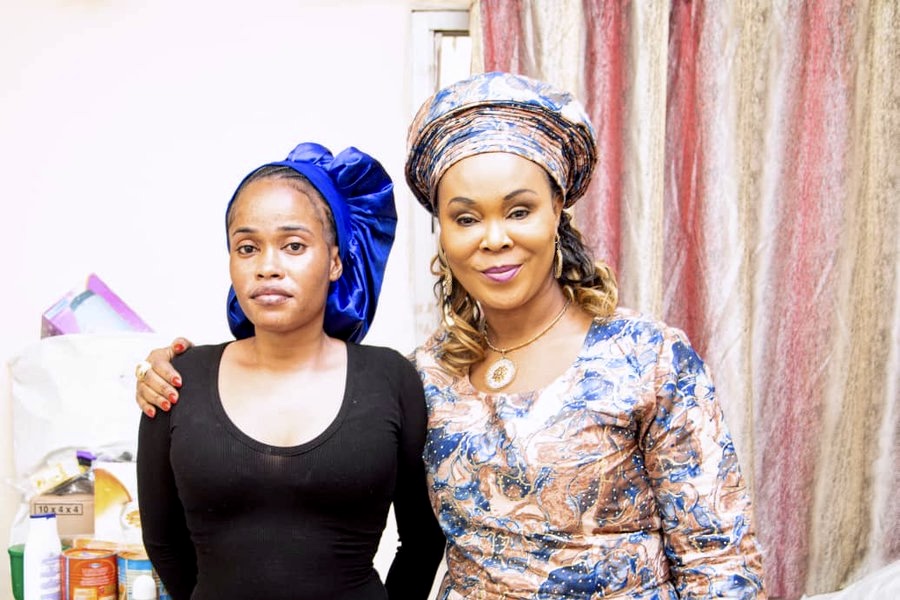
A former soldier who accused senior military officers of sexual harassment has reportedly been arrested, but conflicting accounts of her transfer, the absence of disclosed charges and unanswered questions about the alleged arrest order leave a critical gap in the public record.
The reported arrest of former Nigerian soldier Ruth Ogunleye has reopened a contentious case involving allegations of sexual harassment, military accountability and the treatment of personnel who seek redress against their superiors.
A report published by SaharaReporters on Monday, 26 October 2026, said Ogunleye had been taken into custody and transferred from Lagos while awaiting trial. But the report contains conflicting information about her destination and does not identify the specific offence she is alleged to have committed.
The report also attributes the arrest to an order from Defence Minister Christopher Gwabin Musa, a claim that has not been independently substantiated in the material reviewed by Atlantic Post. No arrest warrant, charge sheet, court order or official statement confirming that allegation was identified during this review.
The questions are particularly significant because Ogunleye previously accused senior military officers of failing to address her sexual-harassment complaints. The Nigerian Army subsequently rejected the central allegation against one of the officers she named and discharged her from service on medical grounds.
The latest report does not establish whether her reported arrest is connected to that controversy or to an entirely separate matter.
Kaduna or Abuja? The First Questions Concern Her Whereabouts
SaharaReporters’ account contains a discrepancy that requires clarification.
Its opening paragraphs state that Ogunleye was transferred from Lagos to a prison in Kaduna State. But a quotation attributed to the unnamed source says she was moved to an Abuja prison.
These are materially different accounts of where she is being held. The report does not explain the discrepancy or identify the custodial authority responsible for her transfer.
There is also no publicly identified charge against her in the report. It says she is awaiting trial but does not name the court, state when she is expected to be arraigned or explain the alleged offence.
These omissions is significant. An arrest is not a conviction, and an assertion that someone is awaiting trial does not establish that a charge has been filed or that a court has ordered their continued detention.
The Nigerian Constitution provides safeguards for people who are arrested or detained, including the right to be informed in writing, within 24 hours, of the facts and grounds for their arrest or detention. It also protects the right to consult a legal practitioner and requires that a detained person be brought before a court within a reasonable time, subject to the constitutional provisions governing detention.
The authorities have yet to provide the information necessary for the public to assess the reported arrest against those standards.
Defence Minister Musa Named in an Unverified Arrest Claim
The claim that Musa ordered Ogunleye’s arrest is one of the most consequential elements of the report.
Musa, a retired general, became Minister of Defence after serving as Chief of Defence Staff from 2023 until October 2025. Ogunleye had previously alleged that he failed to intervene effectively when she sought assistance over the conduct of a senior officer.
In an interview monitored by SaharaReporters in September 2024, she described her attempts to obtain help from senior military figures.
“I sought intervention from people like General C. G. Musa, the current Chief of Defence Staff. I told him. I told so many officers. I sought redress but nothing was done because he is my senior, and nobody was ready to give me a listening ear,” she said.
Her account remains an allegation about how her complaint was handled. It does not, by itself, prove wrongdoing by Musa or establish a connection between him and the reported arrest.
Equally, the allegation that the minister ordered her arrest cannot be treated as established fact simply because it appears in a report attributed to an unnamed source.
The central questions are whether an arrest actually occurred, which authority carried it out, what legal grounds were relied upon and whether Musa had any role in the decision.
As of publication, Atlantic Post had not independently verified the reported arrest or located an official confirmation of the alleged ministerial order.
What Happened to Ogunleye’s Sexual-Harassment Complaint?
The controversy began publicly in January 2024, when Ogunleye accused Colonel I.B. Abdulkareem of sexual harassment and alleged intimidation and maltreatment by senior officers.
She also named Colonel G.S. Ogor and Brigadier General I.B. Solebo in allegations concerning her treatment within the military. She claimed that her difficulties intensified after she rejected what she described as unwanted sexual advances.
The allegations included claims that she was denied opportunities, intimidated and subjected to treatment she did not consent to. Those claims were contested through the Army’s subsequent investigation and were not established as proven misconduct.
The Nigerian Army said it investigated the allegations through the Nigerian Army Corps of Military Police.
Addressing journalists in September 2024, then Director of Army Public Relations, Major General Onyema Nwachukwu, said the investigation had examined the available facts, testimonies and evidence.
He declared:
“The investigation concluded that Colonel IB Abdulkareem did not commit the offence of sexual harassment as alleged by ex-Private Ruth Ogunleye. The findings were definitive and based on an objective evaluation of the available information.”
The Army also said Ogunleye had been recommended for discharge on medical grounds in 2022 and that medical assessments informed its decision to discharge her from service in 2024.
Its conclusion cleared Abdulkareem of the allegations investigated by the military. It did not erase the need for accuracy, transparency and proper procedure in any subsequent criminal matter involving Ogunleye.
Ogunleye Challenged the Investigation’s Findings
Ogunleye disputed the Army’s handling of the case and questioned whether the investigation had adequately considered her evidence.
In September 2024, she told the Foundation for Investigative Journalism that she had made several attempts to obtain redress. She alleged that her complaints were not properly addressed and that the investigative board did not adequately seek evidence or hear witnesses.
She said:
“When my redress got to the board, they just viewed me as someone who should come, talk and leave. I was expecting that they would ask for my evidence. They did not ask for witnesses or evidence. They just decided to allow the matter to die.”
Her account was her own description of the proceedings and does not independently establish that the investigation was manipulated.
In October 2024, she appealed to then Chief of Army Staff Lieutenant General Taoreed Lagbaja for a review of the findings. She said she believed someone might have interfered with the investigation’s outcome and expressed concern about the reputational consequences of the Army’s statements about her mental health. She also apologised for some of her earlier comments about the Army chief.
Musa, who was Chief of Defence Staff at the time, said a review was possible but expressed confidence that the findings would not change.
“Review — of course — it’s possible to have a review. I’m sure it will not come out any different. That I can guarantee you,” he said in an October 2024 interview with ARISE NEWS.
That statement concerned the possibility of reviewing the earlier investigation. It is not evidence that Musa ordered the reported arrest in October 2026.
Section 179 and the Right to Seek Redress
Ogunleye previously referred to Section 179 of the Armed Forces Act as part of her efforts to seek redress.
The provision establishes a procedure through which serving soldiers, ratings and aircraftmen can complain when they believe they have been wronged. It provides for complaints to commanding officers and further escalation under specified circumstances. It also states that a serving member must not be penalised for making a complaint in accordance with the section, provided the complaint does not contravene the Act.
The provision is relevant to understanding Ogunleye’s account of seeking redress while in service. It does not, by itself, establish that her original allegations were true or resolve the legal basis of any current arrest following her discharge.
That distinction is essential. A complaint must be investigated fairly, while any separate allegation against the complainant must also be supported by evidence and pursued through lawful procedures.
Neither an accusation against a superior nor a disputed internal investigation should substitute for proof in a subsequent criminal proceeding.
What the Authorities Must Clarify
The reported arrest now presents a separate set of questions.
First, which agency arrested Ogunleye? The available report does not identify the officers or authority responsible.
Second, what offence is she alleged to have committed? No specific charge was disclosed in the account reviewed for this report.
Third, where is she being held? The discrepancy between Kaduna and Abuja needs a clear answer.
Fourth, has a court authorised her remand, and when is she expected to appear before it?
Finally, did Musa direct or approve the arrest, as the unnamed source alleged? That claim requires direct confirmation from the minister or the relevant authorities.
SaharaReporters reported that it contacted Army spokesperson Colonel Appolonia Anele for clarification, but she did not answer its calls or respond to its message. The report did not contain a substantive response from the Defence Ministry or identify a court document confirming the arrest.
The absence of an official response does not prove that the allegation against the minister is true. It does, however, leave important questions unanswered.
The Nigerian Army has already published its findings on the earlier sexual-harassment complaint. If a separate criminal case now exists, the public interest requires clarity about its legal basis, rather than speculation that it is connected to the previous dispute.
Likewise, if the reported arrest did occur, the authorities should provide an accurate account of the circumstances and make Ogunleye’s legal status clear.
The central issue is no longer simply what happened to a former soldier who accused her superiors of harassment. It is whether the authorities can establish, transparently and lawfully, what has happened to her now.
Until the arrest, the charges, the place of detention and the alleged ministerial involvement are independently confirmed, the case remains one of serious allegations and unanswered questions.
Follow us on our broadcast channels today!
- WhatsApp: https://whatsapp.com/channel/0029VawZ8TbDDmFT1a1Syg46
- Telegram: https://t.me/atlanticpostchannel
- Facebook: https://www.messenger.com/channel/atlanticpostng



Join the debate; let’s know your opinion.