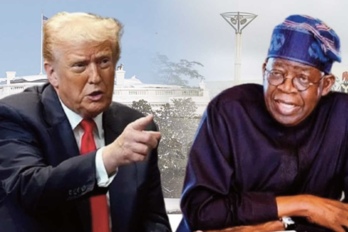
The Presidency on Wednesday fired a blunt political broadside at former Vice President Atiku Abubakar, accusing him of “reporting the President of Nigeria to US President Donald Trump and members of the US Congress” and describing the move as undignified, self-defeating and incompatible with statesmanship.
In a State House statement signed by Bayo Onanuga, Special Adviser to the President on Information and Strategy, the Tinubu administration said Atiku’s alleged lobbying effort in the United States over a 1993 civil forfeiture matter amounted to a reckless attempt to “rewrite history for personal gain.”
The statement, issued on July 23, 2026, arrived at a politically sensitive moment: the same State House platform also published a separate note saying Mr Trump had praised President Bola Tinubu for his “decisive leadership” and his resolve “to tackle the issues plaguing Nigeria, especially the violence affecting Christian communities.”
The Presidency’s decision to pair praise from Washington with a sharp rebuke of Atiku was no accident. It was a calculated attempt to frame Tinubu as internationally validated while casting his most persistent political rival as an outsider seeking foreign rescue.
At the centre of the row is the Presidency’s claim that Atiku’s US lobbyists have submitted petitions to Mr Trump and the US State Department concerning a long-closed civil forfeiture case from 1993.
The State House said the matter had been “resolved over 30 years ago in the United States” and had “no criminal conviction or finding of guilt.”
The statement also insisted that Nigerians had already settled the issue at the ballot box in February 2023 and at the Supreme Court, adding that the verdict “stands.”
That legal framing is important. Civil forfeiture is not the same as a criminal conviction, and the Presidency leaned heavily on that distinction while arguing that reviving the case was politically motivated rather than legally consequential.
The political message was even harder: Nigeria, the statement declared, is “a sovereign nation, not a satellite of any foreign power.” In other words, the administration wants this fight seen less as a legal complaint and more as an attempt to internationalise a domestic grudge match.
The Presidency went further by attacking the method, not merely the motive. It said that while lobbying is legitimate in American politics, using paid foreign agents “to peddle discredited documents against a sitting Nigerian President” is not advocacy but an attempt to undermine sovereignty.
That language reflects a familiar Nigerian political pattern: when a domestic contest gets ugly enough, it is often recast as a battle for national dignity, with the opponent portrayed as having crossed a patriotic red line.
But the statement did not stop at defending Tinubu. It swung back at Atiku’s own history in the United States, citing the William Jefferson bribery scandal and a 2010 US Senate investigation chaired by Senator Carl Levin.
The official US record is relevant here. The FBI says its investigation into former Congressman William J. Jefferson uncovered at least 11 distinct bribery schemes, and the Justice Department’s sentencing memorandum in the Jefferson case referred to an “extraordinary and historically unprecedented agreement to bribe the then-sitting Vice President of Nigeria, Atiku Abubakar.”
The State House also invoked the Senate Permanent Subcommittee on Investigations’ report, Keeping Foreign Corruption Out of the United States: Four Case Histories, which examined how some politically exposed persons used US lawyers, realtors, bankers, escrow agents, lobbyists and other professionals to move suspect funds and bypass anti-money-laundering safeguards.
The Presidency’s decision to cite that report was meant to suggest that Atiku has no moral high ground in a transatlantic corruption row. Yet the report itself was about broader systemic abuse, not a final judicial determination on every person mentioned in the political retelling of it.
That nuance is important because the presidency’s statement reads as both a legal counter-attack and a political character assault. It accused Atiku of harbouring ambitions shaped not only by power but by a desire for “diplomatic immunity” and to evade possible legal issues abroad.
It also revived criticism of his vice-presidential role in Nigeria’s privatisation era, alleging that national assets were sold to cronies for “peanuts” and that the resulting job losses and unpaid salaries and pensions are only now being addressed by Tinubu’s government.
These are not new political themes; they are long-running campaign weapons repackaged for the 2027 cycle.
The sharper strategic question is why the Presidency chose this moment to detonate the issue so loudly. One answer lies in the broader media war around Tinubu’s image.
For Tinubu, the immediate benefit is narrative control: the Presidency is trying to turn a potentially awkward foreign-policy talking point into evidence of strength, sovereignty and international acceptance.
For Atiku, the risk is obvious: the more the row becomes about old US files, lobbyists and corruption memories, the easier it is for the Presidency to define him as yesterday’s man still fighting yesterday’s battles.
That said, in Nigerian politics, old files are never truly dead; they are simply waiting for the right election cycle, the right headline and the right audience.
At the end of the day, this is not only a quarrel about a petition. It is a proxy war over legitimacy. The Tinubu camp wants to make foreign lobbying look unpatriotic. Atiku’s side, by contrast, appears intent on keeping international scrutiny alive and disruptive.
With 2027 approaching, both camps are fighting to define who is respectable, who is compromised, and who owns the moral centre of the Nigerian state. The loudest voices are no longer speaking only to voters. They are speaking to history, to Washington and, increasingly, to the algorithm.
Follow us on our broadcast channels today!
- WhatsApp: https://whatsapp.com/channel/0029VawZ8TbDDmFT1a1Syg46
- Telegram: https://t.me/atlanticpostchannel
- Facebook: https://www.messenger.com/channel/atlanticpostng