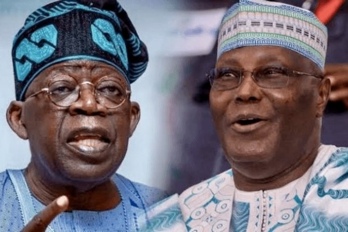
ABUJA, Nigeria — Atiku Abubakar’s media office has thrown fresh petrol on President Bola Tinubu’s long-running US drug-forfeiture controversy, insisting that no amount of official spin can erase the paper trail around the 1993 case.
The statement, issued on Wednesday, 23 July 2026, accused the presidency of “whitewashing” a matter that, it argued, remains alive because of the records generated in the United States and the continuing interest of campaigners and litigants abroad.
The immediate trigger was a rebuttal from the Tinubu camp, delivered through presidential media aide Bayo Onanuga, who dismissed the renewed scrutiny as an old issue with no legal consequence.
The presidency has repeatedly argued that the documents being discussed are decades old and do not amount to a fresh indictment. In April 2025, Onanuga said: “There is nothing new to be revealed.”
He also maintained that the FBI and DEA reports referenced in the case had been in the public domain for more than 30 years and “did not indict the Nigerian leader.”
But Atiku’s media office is clearly trying to keep the pressure on. In the statement reproduced by the presidency’s critics, the office said the attempt to wave away the issue “essentially admits that Tinubu indeed faced investigation on narcotics trafficking” and challenged the administration to explain why it was “blocking” efforts to unravel what it described as the contents of the president’s FBI and DOJ files.
The statement also framed the matter as one of institutional integrity, arguing that the presidency is an office that should reflect the soul of the nation, not drag Nigeria’s image through scandal.
The latest escalation is not happening in a vacuum. In July 2026, a Washington-based lobbying firm hired by Atiku under a reported 12-month, $1.2 million contract said it had begun sharing more than 60 pages of US Department of Justice material with members of the Trump administration, Congress and senior congressional staff.
The firm said the documents concern allegations linked to a heroin-trafficking investigation spanning the late 1980s and early 1990s, and it circulated a chronology of the 1993 civil forfeiture case involving Tinubu.
That move matters because the case is not merely a social-media talking point. Earlier reporting and court records have long pointed to a 1993 civil forfeiture involving $460,000 linked to Tinubu.
OCCRP reported in 2024 that it had been 31 years since Tinubu, then a private citizen, forfeited the money to US authorities after an investigation tied him to alleged drug trafficking in Chicago.
The legal pressure also has a more recent chapter. In April 2025, US District Judge Beryl Howell ruled that the FBI and DEA should lift their “Glomar” responses and release investigative records connected to Tinubu, saying the existence of the material had already been acknowledged in the 1993 civil forfeiture case.
The Guardian reported that the presidency brushed aside the ruling as old news, while the court’s reasoning sharpened public curiosity over what those files may contain.
That is why Atiku’s latest intervention is politically calibrated as much as it is legal. By reopening the case now, the opposition camp appears to be doing two things at once: keeping Tinubu on the defensive at home, and internationalising the dispute in Washington at a moment when Nigeria’s relationship with the United States remains politically sensitive.
Reuters reported only this week that President Tinubu has been receiving warmer signals from Donald Trump, with a letter from July 6 praising Nigeria’s efforts on violence against Christians and highlighting a joint security working group between both countries.
For Tinubu, that creates a delicate contradiction. On one hand, the presidency wants to project stability, deepen security cooperation and attract investment. On the other, it is being forced to respond to a recurring allegation that refuses to die because the underlying US documents keep resurfacing.
Onanuga’s line that “nothing new” exists may still play well with loyalists, but the latest lobbying push suggests the opposition believes the issue is far from exhausted.
The deeper political lesson is that this row is no longer just about a forfeiture case from the early 1990s. It is about narrative power. Atiku’s camp wants to frame the presidency as evasive, defensive and afraid of disclosure. The Tinubu camp wants to frame the opposition as desperate, recycled and obsessed with political damage.
The result is a familiar Nigerian pattern: a historical allegation becomes a live political weapon every time the country moves closer to an election cycle.
What makes this round more combustible is the international stage. The involvement of a US lobbying firm, Congress and Trump-era officials gives the story a bigger geopolitical edge than a normal domestic press exchange.
It also means the fight is now being waged in the language of foreign influence, federal records, FOIA litigation and reputational risk — terms that can travel far beyond Nigeria’s partisan trenches.
For now, the presidency insists there is no fresh bombshell. The opposition insists the file is still open. And until the US records are either fully released or conclusively closed, the Tinubu drug-case row is likely to remain one of the most persistent and politically dangerous shadows hanging over Aso Rock.
Follow us on our broadcast channels today!
- WhatsApp: https://whatsapp.com/channel/0029VawZ8TbDDmFT1a1Syg46
- Telegram: https://t.me/atlanticpostchannel
- Facebook: https://www.messenger.com/channel/atlanticpostng



