Nigeria’s anger over renewed anti-foreigner violence in South Africa burst into the open on Tuesday as Senator Adams Oshiomhole urged the Senate to consider drastic economic retaliation, including the withdrawal of licences held by South African companies in Nigeria and the nationalisation of MTN.
His intervention came as Abuja confirmed that at least 130 Nigerians in South Africa had asked to be repatriated under a government-assisted return scheme, after fresh protests and fears of escalating hostility towards foreigners.
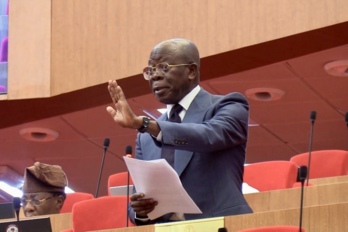
The Edo North senator framed the issue not as a routine diplomatic complaint but as a test of reciprocity and national dignity. In a charged plenary contribution, he said, “If you hit me, I’ll hit you. I think it is appropriate in diplomacy. It’s an economic struggle.”
He also dismissed what he saw as emotional but ineffective reactions in the chamber, saying, “I don’t want this Senate to be shedding tears, to sympathise with those who have died. We didn’t come here to share tears.”
Oshiomhole’s line of attack was deliberately economic. He argued that Nigeria should stop treating South African firms as untouchable while Nigerians face repeated assaults abroad, and he singled out MTN and DStv as symbols of that imbalance.
Punch reported that he proposed Nigeria should nationalise MTN and revoke its licence, while also calling for DStv’s licence to be withdrawn.
His point, stripped to its political core, was that a country which tolerates violence against its citizens should not assume open access to another’s market without consequences.
The timing sharpened the politics. Reuters reported that protests in Pretoria and Johannesburg last week demanded tougher action against illegal immigration, with demonstrators claiming undocumented migrants were placing pressure on jobs, security and public services.
Nigerian authorities say the situation has already become severe enough for 130 citizens to seek repatriation, while the Foreign Ministry has also demanded access to autopsy reports, post-mortem files and legal processes in connection with the deaths of two Nigerians allegedly assaulted by security officials last month.
Reuters said Nigeria wants “appropriate disciplinary and prosecutorial action” where wrongdoing is established.
This is not an isolated flare-up. Reuters also reported that South African authorities had already promised to crack down on xenophobic attacks after Ghana and other African countries protested over violent incidents targeting their nationals.
That wider continental pattern matters, because it suggests the problem is no longer being viewed in Abuja as a one-off street disturbance but as a recurring political and security crisis for African citizens working or trading in South Africa.
What gives Oshiomhole’s warning extra force is the commercial footprint of the companies he named. Reuters’ company profile describes MTN Group as a mobile network operator with South Africa and Nigeria as core segments, while listing its headquarters in Johannesburg.
Reuters also describes MultiChoice, owner of DStv, as a South African pay television company. In other words, the senator was not firing at faceless entities. He was targeting major South African corporate assets that are deeply embedded in Nigeria’s telecoms and media markets.
That is why his remarks should be read as more than rhetorical theatre. They reveal a hardening mood inside Nigeria’s political class, where the instinct to condemn xenophobia is increasingly colliding with demands for forceful leverage.
The House of Representatives had already condemned the latest wave of attacks and urged immediate protective measures, according to Punch, showing that pressure is building across the National Assembly for a stronger state response.
Yet the real question is whether Nigeria wants symbolic retaliation or a coherent strategy that protects its citizens abroad while preserving the economic interests of its own economy at home.
The MTN threat may therefore be less about an imminent shutdown than a warning shot. Still, it exposes a longstanding contradiction in Nigeria South Africa relations.
Abuja wants respect for its citizens and acknowledgement of Nigeria’s historic role in the anti apartheid struggle. South Africa, meanwhile, is under pressure at home from unemployment, migration politics and anti foreign rhetoric.
Between those pressures sits a dangerous gap where Nigerians become vulnerable and diplomacy becomes reactive rather than preventive. Oshiomhole has forced that gap back onto the national agenda. Whether the Senate turns the noise into policy remains the next test.
Follow us on our broadcast channels today!
- WhatsApp: https://whatsapp.com/channel/0029VawZ8TbDDmFT1a1Syg46
- Telegram: https://t.me/atlanticpostchannel
- Facebook: https://www.messenger.com/channel/atlanticpostng