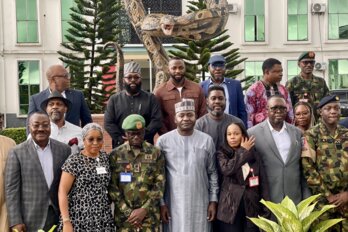
Port Harcourt was once again thrust into the centre of Nigeria’s energy security conversation on June 29 as oil and gas stakeholders, military commanders, security chiefs, community leaders, traditional rulers and executives of the International Oil Companies and Local Oil Companies gathered with the Honourable Minister of Defence, Gen CG Musa, in a meeting that placed the protection of critical gas infrastructure at the top of the national agenda.
The meeting, described as a strategic engagement on oil and gas security, came at a time when the federal government is working to safeguard production, stabilise transmission lines and reduce the costly disruptions caused by sabotage, vandalism and community conflict across the Niger Delta.
At the heart of the discussions was a forceful and detailed briefing by Engr. (Mrs) Grace Ihuoma Osaretin, the Special Adviser on Niger Delta and Energy Security to Nigeria’s National Security Adviser Nuhu Ribadu, who framed the moment as an opportunity to shift from reaction to prevention, and from isolated responses to coordinated national action.
“We are gathered today to review the operational realities of our critical gas transmission lines,” she told the meeting. “Time is of the essence, so I will go straight to the core. This briefing focuses on our progress, our current operational bottlenecks, and the strategic interventions required to strengthen production assurance.”
Her remarks set the tone for an engagement that was not merely ceremonial, but practical, urgent and deeply tied to Nigeria’s economic and security survival.
Stronger Protection, Better Results
Osaretin said the federal government and its security partners had made measurable progress in reducing disruption along key gas corridors, especially through improved collaboration with frontline commands, the Working Committee on Gas and the deployment of non-kinetic security measures.
According to her, these measures have begun to deliver results on the ground.
“Honourable Minister, Sir, we are making significant progress in mitigating infrastructure sabotage through closer synergy with frontline commands, the Working Committee on Gas, and the implementation of new non-kinetic security strategies,” she said. “As a result, we have recorded an 80 to 90 per cent reduction in downtime along vulnerable segments, particularly the GTS 4 Line.”
That assessment pointed to an important shift in the way authorities are now approaching energy infrastructure protection. Instead of relying only on force, the strategy is increasingly combining intelligence, coordination, community interface and rapid response arrangements to preserve the flow of gas and keep production stable.
For operators who depend on uninterrupted transmission, that reduction in downtime is significant. For the government, it suggests that sustained security coordination can translate directly into improved production assurance, fewer losses and better national revenue performance.
Production Assurance at the Core
Osaretin stressed that improved pipeline availability has already helped keep throughput moving across the GTS network, thanks to the combined efforts of the Working Committee on Gas, the Joint Inter Agency Response Framework, Operation Delta Safe, other security agencies and the production teams of the oil companies.
“Thanks to improved pipeline availability, the Working Committee on Gas, the Joint Inter Agency Response Framework, Operation Delta Safe (OPDS), other relevant security agencies, and the IOC production teams have been able to sustain throughput across the GTS network,” she said.
That cooperation, she suggested, is now central to Nigeria’s ability to defend critical energy assets and maintain the steady output required for domestic supply, industrial demand and broader economic stability.
Her message was that security and production can no longer be treated as separate conversations. In the Niger Delta, where oil and gas infrastructure sits beside communities, waterways and sensitive political interests, the safety of assets now depends on a wide ecosystem of relationships. That includes government commanders, corporate operators, host communities and local leadership structures.
From Reactive Response To Proactive Partnership
Osaretin was also blunt about the scale of the challenge that remains. While acknowledging the progress already made, she said production activities are still exposed to inefficiency and avoidable cost because of persistent vandalism and infrastructure compromise.
“Companies continue to expend more resources than necessary due to persistent vandalism and infrastructure compromise,” she said, explaining that the breach of critical physical assets continues to weigh on operational efficiency and investor confidence.
Her solution was a deliberate move away from crisis management and towards a structured public private partnership capable of producing lasting results.
“Our objective today is to transition from reactive measures to a cohesive, proactive strategy,” she said. “We are not merely holding a dialogue; we are establishing a fortified public private partnership.”
The language was unmistakably strategic. The committee, she said, is expected to streamline practical initiatives, strengthen joint operational capacity and sustain gas transmission production targets.
This is where the meeting in Port Harcourt carried broader national significance. It was not only about the immediate safety of pipelines. It was about whether Nigeria can build a durable architecture for protecting one of its most important revenue streams in a region that has long been vulnerable to criminal interference, grievance driven unrest and infrastructure attacks.
Security Alone Is Not Enough
A central point in Osaretin’s remarks was that the government cannot do the work alone. She made clear that the state will continue to provide the security umbrella required for operators to function, but that companies must also take responsibility for the human and social side of asset protection.
“We recognize that the Government cannot secure these assets in isolation,” she said. “Under the security architecture led by the Honourable Minister of Defence, supported by the Armed Forces, Operation Delta Safe (OPDS) and other relevant security agencies, the Government remains committed to providing the security umbrella required for oil and gas companies to operate optimally.”
She then called on operators to go further in their engagement with host communities, especially through specialised private firms with proven experience in Alternative Dispute Resolution and community relations.
“In return, we seek the unwavering collaboration of all operators in engaging specialized private companies with proven expertise in Alternative Dispute Resolution (ADR) and community engagement to strengthen relationships with host communities and enhance the protection of critical national assets,” she said.
That appeal went to the heart of Nigeria’s long running challenge in the Niger Delta, where disputes around employment, compensation, environmental damage and local participation have often created openings for sabotage, illegal tapping and wider insecurity.
By stressing ADR and community engagement, Osaretin effectively argued that security infrastructure must be matched by social trust. In her view, the most sustainable protection model is one that includes dialogue, local ownership and early conflict resolution.
A National Test Of Coordination
The Port Harcourt meeting also highlighted the growing importance of inter agency coordination in Nigeria’s security and energy framework. With the Defence Ministry, military formations, security agencies and industry stakeholders all represented, the session reflected a recognition that gas transmission protection is now a national security priority, not a narrow sectoral issue.
Osaretin concluded with a reminder that technology and policy, on their own, are not enough.
“Finally, hardware and policy represent only half the battle,” she said. “Our ultimate success depends on our collective commitment to collaboration, coordination, and decisive action.”
That closing line captured the spirit of the engagement. It was a call for discipline, continuity and shared responsibility in a sector where delays, sabotage and fragmented responses can translate quickly into lost output and wider economic pain.
For Nigeria, the stakes are high. Gas is central to power generation, industrial growth and revenue diversification. Any interruption in transmission has ripple effects across the economy. That is why the assurances, warnings and strategic demands voiced by Osaretin in Port Harcourt carry weight beyond the meeting hall.
The message from the gathering was clear. Nigeria’s energy assets can be protected, but only if government, security forces, operators and host communities work as one. The progress recorded on the GTS 4 Line suggests that the model is already working in parts. The task now is to deepen it, formalise it and sustain it before sabotage and insecurity regain the upper hand.
In that sense, the Port Harcourt meeting was more than a routine stakeholder engagement. It was a declaration that the defence of Nigeria’s oil and gas infrastructure must become a shared national mission, guided by coordination, trust and decisive action.
Follow us on our broadcast channels today!
- WhatsApp: https://whatsapp.com/channel/0029VawZ8TbDDmFT1a1Syg46
- Telegram: https://t.me/atlanticpostchannel
- Facebook: https://www.messenger.com/channel/atlanticpostng