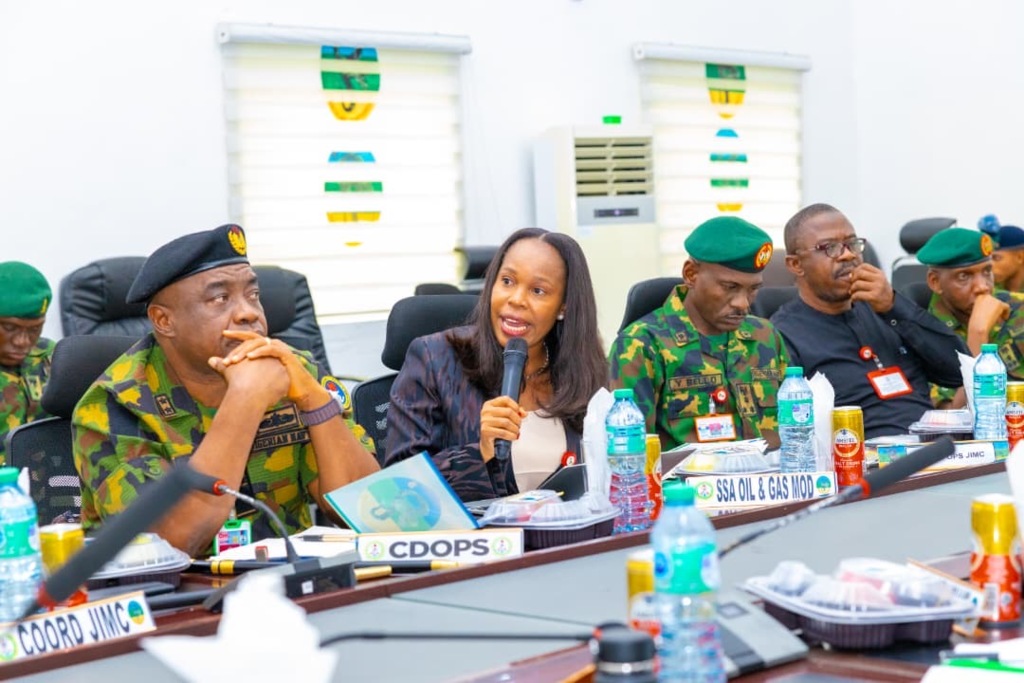
PORT HARCOURT, Nigeria — On June 29, 2026, the headquarters of the 6 Division of the Nigerian Army (Bori Camp), Port Harcourt hosted a high-level summit on oil and gas security, bringing together Defence Minister General Christopher Musa (retired) and stakeholders from industry, communities and the military.
Also on the podium were the General Office Commanding 6 Division of the Nigerian Army and Land Component Commander Joint Task Force (South South), Operation Delta Safe (Maj Gen. Emmanuel Emekah), Joint Task Force Commander of Operation Delta Safe (OPDS) (Rear Admiral Oladipo), Garrison Commander 6 Division (Gen. A. A. Bello), Coordinator of Joint Intelligence Monitoring Centre of Operation Delta Safe, and other senior security officials.
In his opening remarks, Defence Minister Musa reiterated that “effective security management requires strong collaboration among government institutions, the private sector and local communities”, framing the day’s discussion on oil and gas critical asset security.
Mounting Threats to Nigeria’s Gas Infrastructure
Nigeria’s gas bulk transmission line and pipelines corridors face relentless threats. Security briefings at the meeting listed a litany of challenges: unsigned Standard Operating Procedures (SOPs) and non-compliance with the Petroleum Industry Act; collusion by unscrupulous contractors or insiders in sabotage; rampant vandalism and oil theft; abandoned or ageing facilities; and ballooning costs of operations with insufficient equipment.
Emerging tactics were highlighted, for example a June 15 attack in Abua/Odual (Rivers State) using explosives, which underscores the need for modern tracking and surveillance devices.
Observers note that these issues reflect a deeper “critical infrastructure resilience” problem. As one analysis put it, Nigeria must “review and reset the relationships between Government, oil companies and communities” to halt vandalism.
Nigeria’s pipelines have been repeatedly attacked. Recent reports credit Nigeria’s improved oil output to “enhanced stakeholder engagement, stronger community participation” alongside security measures.
The oil and gas operators in attendance notes that there’s enhanced production and thanked the security operative for their support in achieving this result. According to them, these successes did not happen by chance: they reflect coordinated action by industry, security agencies and host communities.
The Senior Special Adviser to the Defence Minister on Oil & Gas and Economic Integration, Dr Scholar Emenike Aiyeola, delivered a landmark presentation arguing that military force alone is insufficient.
She noted that countries facing similar challenges (like Colombia and Mexico) have found success by blending kinetic operations with intelligence-led policing, advanced surveillance technology, and sustained community partnerships.
Quoting international experience, Dr Emenike Aiyeola observed that “security must be viewed as a permanent and integrated system rather than a series of reactive responses”; essentially, managing risk through governance and trust, not just guards.
The Senior Special Adviser insisted that the most secure pipeline is not necessarily the one protected by the greatest number of security personnel, but the one whose host communities recognise it as a strategic national asset in which they have a vested interest.
This echoed calls for a “whole-of-society” approach seen elsewhere: a U.S. report on Colombia’s Cano-Limon pipeline notes that improved Army–community relations have reduced attacks there.
The Defence Minister’s Senior Special Adviser stressed continuous engagement: security cannot be an occasional meeting but a constant dialogue. She reiterated that host communities and local leaders must become genuine partners.
In her words, “Our security agencies continue to shoulder enormous responsibilities… It is imperative that military efforts are complemented by sustainable non-kinetic strategies.”
She urged oil operators to partner with community-relations experts to build trust, gather intelligence, and peacefully resolve conflicts before they turn violent.
The meeting ended with concrete commitments. Dr Scholar Emenike Aiyeola outlined a four-point action plan for the Defence Ministry and industry:
1. Intelligence-driven security: Shift from reactive incident response to a proactive, systematic approach. The military will “continue to work with stakeholders to sustain an intelligence-driven approach” to threats, as recommended by Osaretin.
2. Advanced surveillance technology: Accelerate deployment of drones, sensors and monitoring systems along pipelines for early warning. This follows NUPRC’s recent emphasis on “advanced technologies, including drone surveillance” to patrol Nigeria’s gas network.
3. Institutionalise stakeholder engagement: Make “extensive” collaboration with communities, companies, and government a permanent pillar of security policy. This mirrors the National Upstream Petroleum Regulatory Commission’s new framework to “galvanise stakeholders” into a governance structure for sustainable security.
4. Resilience metrics: Establish measurable indicators beyond troop deployments, such as reduced disruptions, uninterrupted flow rates, and higher community cooperation. The goal is to tie security efforts to actual outcomes; echoing industry calls for transparency and accountability in protection efforts.
These pledges resonate with previous concerns expressed by industry leaders that criminals even impersonate government task forces to loot pipes, inflicting “significant economic losses, weaken[ing] national development and undermining investor confidence.” They reaffirmed coordinated action with security agencies to dismantle theft syndicates.
Rear Admiral Oladipo himself lauded Operation Delta Safe’s unique integration of army, navy and air assets “to ensure comprehensive security coverage” of the oil fields. Such institutional buy-in across agencies and sectors suggests that the Senior Special Adviser’s proposals are meeting receptive ears.
Conclusion: Toward a Resilient Oil & Gas Critical Assets Ecosystem
Nigeria’s gas bulk transmission line and oil pipeline security is no longer seen purely as a military problem. Stakeholders widely acknowledge that protecting this critical national infrastructure is an economic imperative, and its safeguard underpins government revenue, investor confidence, and community livelihoods.
Communities leaders recommended, in strong terms, that operators should duly engage host communities for long sustainable relationship and trust. The community leaders also recommended that the operators should fulfil their own part of all agreements.
All stakeholders thanked the Honourable Minister of Defence for taking time to convene the high level meetings and expressed willingness to work with the operators. They agreed with the Minister that trust is very essential for long time security of Nigeria’s critical infrastructure.
The Port Harcourt discussions reflected a decisive policy shift: embrace technology and intelligence and empower local communities as only this combined strategy will stem recurrent disruptions.
In the Defence Ministry’s words, Nigeria now aims for a “proactive, collaborative, intelligence-driven and sustainable”security architecture that turns all critical oil and gas infrastructure) into shared assets, not flashpoints.
He said it’s only trust that can help Nigeria improve its production, and advised that the country should take advantage of the Iran Straits of Hormuz quagmire to ramp up production beyond 1.8 million barrels per day.
Follow us on our broadcast channels today!
- WhatsApp: https://whatsapp.com/channel/0029VawZ8TbDDmFT1a1Syg46
- Telegram: https://t.me/atlanticpostchannel
- Facebook: https://www.messenger.com/channel/atlanticpostng