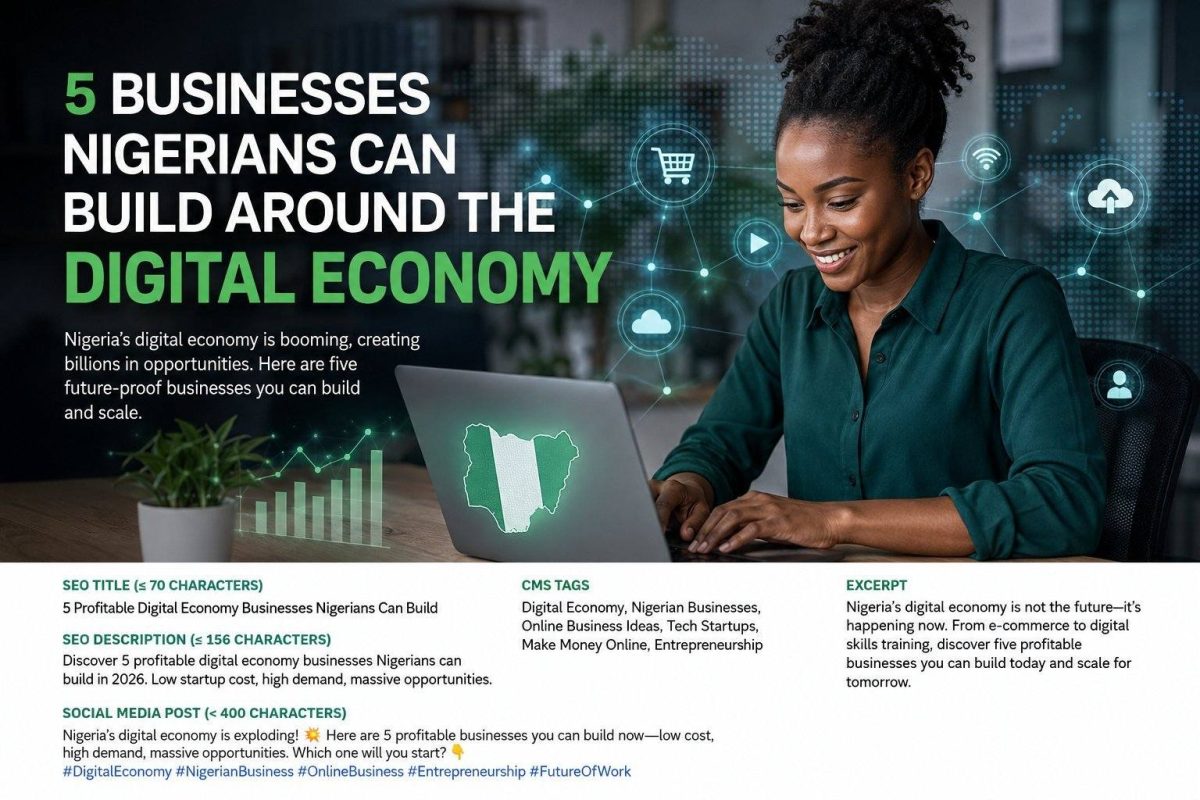
Nigeria’s digital economy has reached a point where the biggest opportunity may no longer be in building another flashy technology company.
It is in solving ordinary Nigerian problems with digital tools.
The opportunity is enormous. Nigeria’s active internet subscriber base reached about 157 million in May 2026, according to figures attributed to the Nigerian Communications Commission (NCC), up from roughly 154.3 million a month earlier.
The National Bureau of Statistics (NBS) also reported that the Information and Communication sector contributed 10.59 per cent of Nigeria’s real GDP in Q1 2025, while growing by 7.40 per cent year-on-year in real terms.
Those numbers matter because they tell a larger story: digital activity is no longer confined to software developers and telecommunications companies. It is increasingly embedded in banking, retail, education, transport, advertising, professional services and the daily operations of small businesses.
And that creates a new class of Nigerian entrepreneur.
The person who can identify a problem, connect customers through a phone, automate a process, process digital payments, sell knowledge online or help businesses comply with increasingly complex digital rules may have a business opportunity that did not exist on the same scale a decade ago.
The challenge is that Nigeria’s digital economy is simultaneously expanding and becoming more competitive.
Broadband access is improving, but a significant digital divide remains. In July 2026, broadband penetration was reported at 55.67 per cent, still below the country’s 70 per cent target. The IFC has likewise identified broadband and fibre infrastructure as one of the areas with strong potential for private investment because businesses, governments and consumers are demanding more digital services.
So where are the practical opportunities for Nigerians in 2026?
Here are five businesses that deserve serious attention.
1. AI and Digital Automation Services for SMEs
One of the most commercially attractive opportunities is also one of the least glamorous: helping existing Nigerian businesses become digital.
Thousands of small and medium-sized enterprises still rely heavily on WhatsApp, spreadsheets, manual bookkeeping, paper records, individual staff members and repetitive administrative processes.
They do not necessarily need a million-dollar software platform.
They need somebody who can walk into a business and say: “This process can be automated.”
That creates room for an AI and digital automation agency.
An entrepreneur with the right skills can help businesses automate customer enquiries, appointment booking, inventory alerts, invoice generation, marketing content, customer follow-ups, internal knowledge bases and basic reporting.
A small retail business, school, clinic, estate agency, hotel, restaurant or professional services firm could become a client.
The business model is attractive because the entrepreneur does not need to manufacture physical products. Revenue can come through setup fees, monthly retainers, software implementation charges and training.
Nigeria’s digital policy direction is also moving towards wider technology adoption. NITDA’s mandate for digital economy development includes transforming businesses towards digital models and markets, promoting digital goods and services, and expanding digital literacy and technology adoption.
The real competitive advantage, however, will not be knowing how to use an AI chatbot.
It will be understanding a particular industry.
An entrepreneur who specialises in automating customer service for Nigerian schools, for example, has a clearer commercial proposition than somebody advertising themselves simply as an “AI expert”.
The emerging opportunity is therefore AI as a business service, not AI as a buzzword.
2. Niche E-Commerce and Social Commerce
Nigeria’s e-commerce opportunity is often misunderstood.
The mistake is assuming that an entrepreneur has to build the next Jumia.
That is unnecessary.
The more realistic opportunity for many small businesses is niche commerce.
Think locally sourced fashion, specialised food products, beauty products, spare parts, home equipment, children’s products, agricultural inputs or culturally specific products sold through a combination of websites, WhatsApp, Instagram, TikTok and other digital channels.
Nigeria had an estimated 107 million internet users in 2025, according to DataReportal figures cited in recent reporting, giving businesses one of Africa’s largest potential online audiences.
Yet access to customers is only half the challenge.
Trust, payment, delivery, returns and customer service frequently determine whether an online business survives.
That means the successful digital retailer of 2026 will probably not simply be the person with the prettiest Instagram page.
It will be the business that can reliably answer five questions:
Where is the product?
How quickly will it arrive?
How can I pay?
What happens if I do not like it?
Can I trust the seller?
This is where social commerce becomes powerful.
A customer may discover a product through a short video, ask questions on WhatsApp, receive a payment link and have the item delivered without ever visiting a conventional online marketplace.
Digital payments are already deeply embedded in Nigeria’s economic system. The Central Bank of Nigeria launched Payments System Vision 2028 in June 2026 with a focus on interoperability, security, inclusion, innovation, trust and collaboration.
The lesson for entrepreneurs is simple: do not build an online shop merely because online shopping sounds fashionable.
Build a specialised distribution business that uses digital channels to reduce the cost of finding and serving customers.
3. Merchant-Tech and Fintech Support Businesses
Nigeria’s fintech story is so big that entrepreneurs can easily assume the only way to participate is to build another payment app.
That is one of the most dangerous assumptions in the sector.
The more interesting opportunity for many entrepreneurs may be to build businesses around the fintech ecosystemrather than trying to become a regulated financial institution themselves.
That can include merchant onboarding services, financial reconciliation tools, payment analytics, digital accounting, fraud-awareness services, customer support systems, financial education, business dashboards and software that helps small firms understand their cash flow.
The scale of the underlying market is unmistakable.
NIBSS said in August 2026 that the rollout of the National Payment Stack had recorded 26.55 million transactions worth ₦1.4 trillion across 48 participating institutions.
NIBSS describes the new infrastructure as an ISO 20022-compliant system designed to modernise Nigeria’s payments ecosystem and bring payments, identity and data capabilities closer together.
That creates opportunities beyond the payment transaction itself.
Businesses need software to reconcile transactions.
Merchants need better records.
Small companies need to understand their digital sales.
Customers need support.
Financial businesses need stronger fraud controls.
And digital platforms need secure, reliable infrastructure.
But there is a crucial warning here.
Entrepreneurs entering financial technology cannot casually operate regulated payment activities without understanding the licensing and regulatory requirements.
The CBN’s 2026 reforms have placed greater emphasis on fraud monitoring, authentication, consumer protection and control over instant payments.
For new entrants, therefore, the smarter path may be to build technology or services that support regulated players and merchants, rather than rushing into heavily regulated financial activities.
The money can still be substantial.
4. Digital Skills, Online Education and Career Training
Nigeria’s demographic profile is creating another structural opportunity: the market for practical digital skills.
The old model of education—learn first, find a job later—is increasingly being challenged by an economy in which employers want demonstrable skills.
That is opening space for specialised online education businesses.
But there is already a warning for entrepreneurs here.
The market does not need another generic “learn digital marketing in 30 days” course.
It needs outcome-based education.
A business can specialise in teaching Nigerians how to perform a specific job, earn a specific certification, serve a specific industry or win work from a specific market.
Examples include AI-assisted bookkeeping, cybersecurity fundamentals, data analysis, digital sales, software testing, cloud support, customer-service operations, video production and specialised freelance services.
NITDA has identified digital literacy, talent development, emerging technologies and digital entrepreneurship as central parts of Nigeria’s digital-economy agenda.
The commercial opportunity is therefore not simply selling lessons.
It is selling economic outcomes.
A training company that can demonstrate that graduates have built portfolios, obtained certifications, won freelance contracts or secured employment will have a stronger proposition than one selling certificates alone.
There is another opportunity hidden inside this market: corporate digital training.
Nigerian banks, schools, hospitals, manufacturers, retailers and professional firms increasingly need workers who can use AI, cloud systems, digital customer-service tools and data platforms.
That creates room for business-to-business training programmes sold on annual contracts.
For an entrepreneur with credibility and specialised expertise, the market can be significantly more valuable than selling low-cost courses one student at a time.
5. Cybersecurity, Data Protection and Digital Compliance
The final opportunity may become one of the most important—and most underestimated.
As Nigerian businesses move online, they collect more customer information.
Names.
Phone numbers.
Addresses.
Payment information.
Customer preferences.
Employee records.
Business intelligence.
The more valuable that data becomes, the more valuable its protection becomes.
The Nigeria Data Protection Act 2023 established the legal framework governing the processing and protection of personal data and created stronger institutional oversight through the Nigeria Data Protection Commission (NDPC).
By 2025, the NDPC said it had deepened enforcement and compliance monitoring and rolled out a national data-protection certification programme aimed at producing trained compliance professionals.
That means an entirely new category of service businesses is emerging.
They can help organisations map what data they collect, create privacy policies, establish internal procedures, conduct assessments, train employees, improve data governance and prepare documentation for compliance.
Some businesses may eventually qualify to operate as licensed Data Protection Compliance Organisations (DPCOs), subject to the applicable requirements. NDPC describes DPCOs as entities licensed to provide training, auditing, consulting and related data-protection compliance services.
Cybersecurity adds another layer.
A small Nigerian company may not be able to employ a full-time security team, but it may still need secure passwords, staff awareness training, backup procedures, access controls, phishing protection and incident-response planning.
That creates a business opportunity for specialist service providers.
It is also one of the few digital businesses in which credibility, certification and professional discipline can create a formidable barrier to entry.
The Bigger Opportunity Is Not Technology. It Is Problem-Solving.
What these five businesses have in common is revealing.
None requires an entrepreneur to invent the internet.
None requires building a telecommunications network.
None requires competing directly with the biggest Nigerian fintech companies.
The opportunity is sitting one layer below the headlines.
Nigeria’s digital economy is increasingly becoming infrastructure for ordinary commercial activity.
A shop owner wants more customers.
A school wants better administration.
A restaurant wants repeat orders.
A professional wants more clients.
A company wants to reduce paperwork.
A merchant wants accurate financial records.
A business wants to protect customer data.
A young Nigerian wants a skill that can generate income locally or internationally.
The entrepreneur who can solve those problems with technology has a market.
What Could Stop These Businesses From Succeeding?
Opportunity does not automatically translate into profit.
Nigeria’s entrepreneurs still face expensive connectivity, infrastructure gaps, unstable operating costs, low consumer purchasing power and trust problems.
The broadband challenge remains particularly important. Despite rising penetration, only a fraction of households and businesses have access to fast fixed connectivity. The NCC has highlighted the need for accelerated fibre-to-the-home deployment, while the IFC has identified fibre infrastructure as a significant investment opportunity.
There is also the problem of digital fraud.
As more Nigerians transact online, businesses must treat cybersecurity as a core operating cost rather than an optional extra.
And then comes regulation.
Fintech, payments, data protection and other parts of the digital economy operate within increasingly sophisticated regulatory frameworks.
The most dangerous entrepreneur may therefore be the one who thinks regulation can be dealt with later.
In 2026, compliance is becoming part of the product.
The Nigerian Entrepreneur’s Best Strategy in 2026
The evidence suggests that the biggest opportunity is not necessarily to build an app and hope millions of Nigerians download it.
A more resilient strategy is to start with a specific customer, a specific problem and a recurring source of revenue.
Start narrow.
Solve one painful problem.
Use existing platforms where possible.
Charge customers early.
Automate what can be automated.
Measure customer acquisition costs.
Build trust.
Then expand.
A Lagos entrepreneur may start by automating customer service for 10 clinics. A university graduate in Enugu may build a specialised online training business for data analysis. A trader in Kano could create a niche digital-commerce operation connecting local producers with buyers nationwide. A technology professional in Abuja might build a compliance service for small companies struggling with data protection.
The digital economy makes it possible to start small and sell beyond one’s immediate physical location.
That may be its greatest economic promise.
Bottom Line
Nigeria’s digital economy is already large enough to create serious businesses—but the winning entrepreneurs are unlikely to be those chasing technology for its own sake.
They will be the people who understand Nigerian consumers, Nigerian businesses and Nigerian constraints well enough to use technology as a tool for solving them.
The five opportunities stand out because they sit where demand and digital transformation are converging:
AI and automation services.
Niche e-commerce and social commerce.
Merchant-tech and fintech support.
Digital education and skills training.
Cybersecurity and data-protection services.
Nigeria’s digital economy is still developing, which means the market is far from mature.
For entrepreneurs, that is not a weakness.
It may be the opportunity.
Atlantic Post’s assessment: In the next phase of Nigeria’s digital economy, fortunes may be made less by inventing entirely new technologies than by applying existing technologies to the millions of inefficiencies still embedded in everyday Nigerian commerce.
Follow us on our broadcast channels today!
- WhatsApp: https://whatsapp.com/channel/0029VawZ8TbDDmFT1a1Syg46
- Telegram: https://t.me/atlanticpostchannel
- Facebook: https://www.messenger.com/channel/atlanticpostng