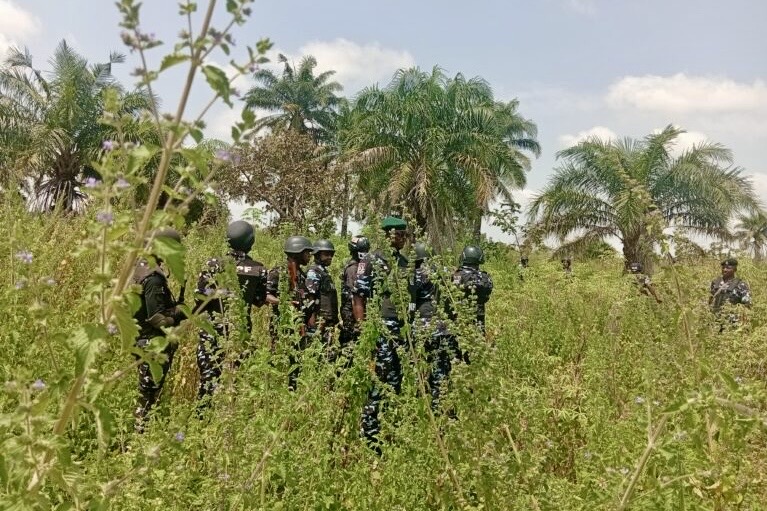
The police operation will continue until December, but previous arrests in Doma and the Alagye forest corridor raise a harder question: can security forces dismantle kidnapping networks and keep communities safe after the raids end?
Nasarawa’s latest forest operation will be judged not by the number of officers deployed but by whether kidnappers lose the ability to abduct, conceal and ransom victims after security forces leave.
The Nasarawa State Police Command has launched a special operation targeting bandits, kidnappers, armed robbers and other suspected criminals operating from forests across the state. The exercise began around Alagye Forest in Doma Local Government Area, with tactical squads, anti-kidnapping operatives and intelligence personnel assigned to identified security flashpoints.
Commissioner of Police Shetima Jauro Mohammed said the operation followed a directive from Inspector-General of Police Olatunji Disu and was intended to restore lasting peace.
The operation is scheduled to continue until the end of December. To coordinate the deployment, the command has divided the state into three operational sectors covering Lafia, Akwanga and Keffi.
It is an extensive security commitment. Yet the announcement leaves important questions unanswered: how many criminal camps have been identified, what intelligence links the targeted locations to kidnapping incidents, and how will the police establish whether the operation has reduced the threat?
Nasarawa residents need more than the assurance that officers have entered the forests. They need evidence that the networks behind the abductions are being dismantled.
Doma’s Forests Have Been the Scene of Previous Operations
The choice of Alagye Forest is significant because the Doma area has featured in previous police investigations involving suspected kidnappers.
In August 2025, police reported the arrest of an alleged kidnapping kingpin during a clearance operation in Doka Forest, Doma. According to the command, the suspect subsequently led detectives to a hideout near Alagye village, where officers recovered firearms, ammunition and other items.
That operation demonstrated the potential value of intelligence-led forest searches. Investigators were able to move from an arrest to a location allegedly associated with a criminal operation.
But the subsequent launch of another broad forest offensive raises a different question: what happened to the wider networks associated with such hideouts?
The earlier arrest does not establish that the same suspects or criminal groups remain active in Alagye. Nor does it prove that the previous operation failed. It does, however, highlight the need to distinguish between capturing individual suspects and dismantling the infrastructure that enables kidnapping.
A forest camp can be abandoned, relocated or rebuilt. A more durable result requires investigators to establish who supplies weapons, moves victims, provides information about potential targets and collects ransom payments.
Those connections are not necessarily all located in the forest.
Ransom Networks Cannot Be Defeated by Forest Searches Alone
Kidnapping is not merely a problem of physical hideouts. It is also a criminal business sustained by intelligence, communications, movement and the expectation that relatives will pay to secure the release of victims.
A forest clearance operation can disrupt a gang’s ability to hold captives. It may also recover weapons, identify escape routes and provide leads for further arrests.
But unless investigators follow those leads, the operation risks addressing the place where the crime is concealed without fully addressing the system that makes it profitable.
A previous case in Nasarawa illustrates the distinction.
In September 2025, police announced the arrest of two suspected kidnappers linked to threats against residents of Doma and Lafia. The command said the suspects had demanded ₦3 million from threatened residents and allegedly extorted between ₦6 million and ₦7 million from different individuals.
The arrests were reported as part of an investigation into ransom-related threats made by telephone.
The case illustrates why the fight against kidnapping cannot be restricted to remote terrain. An operation focused on forest corridors must also be supported by financial investigations, telephone and digital evidence lawfully obtained, intelligence-sharing and the identification of suspected facilitators.
These investigations must establish individual responsibility through admissible evidence. A person’s presence in a forest, possession of an item or association with another suspect is not, by itself, proof of kidnapping.
The Nigeria Police Force therefore faces a two-part challenge: disrupt the immediate capacity of armed groups to hold and move victims, while building cases capable of taking alleged offenders and their accomplices through the criminal justice system.
A Pattern of Arrests and Attacks Raises the Stakes
The security challenge in Doma has not disappeared from public reporting.
In May 2026, police reported the arrest of eight suspected kidnappers following an armed attack in Rukubi community, also in Doma LGA. The incident reportedly involved two people abducted from separate residences.
The arrests were a significant operational development. But an arrest figure alone cannot establish whether the wider threat has diminished. That requires information about the suspects’ alleged roles, the evidence recovered, the status of the abducted victims and the progress of investigations.
Nasarawa’s wider security record also shows why the operation matters beyond Doma.
A July 2026 incident involved the abduction of three students of the Federal University of Lafia. Police later reported rescuing one of the students during a search-and-rescue operation.
Such incidents reinforce the need for preventive intelligence and rapid responses, particularly around residential communities and locations where people may be vulnerable to attack.
The European Union Agency for Asylum, citing Armed Conflict Location & Event Data (ACLED), recorded 109 security incidents resulting in 183 fatalities in Nasarawa between January 2024 and December 2025. Those figures cover security incidents broadly, not kidnapping alone, and should not be presented as a count of kidnapping victims.
Meanwhile, ACLED’s September 2026 assessment of Nigeria’s wider kidnapping crisis found that mass abductions had declined from their 2025 peak but remained above pre-2025 levels. Its analysis also identified ransom payments as an important source of revenue for armed bandit groups.
The national figures do not prove that every criminal group in Nasarawa operates in the same way. They nevertheless underscore a central point: removing a hideout is not the same as removing the financial incentives and operational links that sustain kidnapping.
Three Sectors, One Test of Coordination
The Nasarawa command has divided the operation into three sectors.
Sector A, covering Lafia, is led by ACP Lamidu Alkali, Squadron Commander of MOPOL 58, Lafia.
Sector B, covering Akwanga, is headed by ACP Kadir Umar, Squadron Commander of MOPOL 38, Akwanga.
Sector C, covering Keffi, is led by ACP Olobekga Saligo, Squadron Commander of MOPOL 69, Toto.
Deputy Commissioner of Police in charge of Operations Sanusi Jidda will coordinate activities across the three sectors.
The arrangement creates a defined command structure. Whether it translates into effective coverage will depend on factors not fully explained in the announcement, including how intelligence is shared, how quickly teams can respond to distress calls and how operations are coordinated where suspected criminal movements cross sector boundaries.
The assignment of personnel to three zones is an administrative step, not proof of operational effectiveness.
Police leadership will need to ensure that intelligence gathered in one sector can be acted upon elsewhere without delay, while
Follow us on our broadcast channels today!
- WhatsApp: https://whatsapp.com/channel/0029VawZ8TbDDmFT1a1Syg46
- Telegram: https://t.me/atlanticpostchannel
- Facebook: https://www.messenger.com/channel/atlanticpostng



Join the debate; let’s know your opinion.