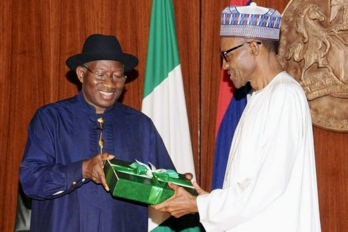
In May 2015, outgoing President Goodluck Jonathan won global praise for a peaceful handover to Muhammadu Buhari after a hard‑fought election. Buhari himself thanked Jonathan’s “statesmanship,” saying he hoped the act “will become the standard of political conduct” in Nigeria. Even U.S. President Obama “applauded [Jonathan] for peacefully conceding” the election. But today, as security collapses across Nigeria, some activists argue that Jonathan’s generosity may have emboldened insurgents.
In a widely‑shared May 2026 Facebook post, former Texas mayor Mike Arnold lauded Jonathan as “gentle, thoughtful, [and] prayerful”but questioned whether the ex‑leader would stand up to the country’s bloodshed.
Arnold pointed to grim statistics – “More than 185,000 Nigerians have been killed. 125,000 of them Christians. 60,000 of them peaceful Muslims…” – alleging a torrent of violence, church burnings (19,000+), and “10 to 12 million” people driven from their homes since 2015.
These claims went unverified even by National Post Africa, which reported Arnold’s figures and noted it “could not independently verify” them.
Examining the Numbers: Deaths Since 2015
Arnold’s critique hinges on the human cost of Nigeria’s security crisis. But the best available data suggest his totals may be overstated by an order of magnitude. Independent trackers record thousands, not hundreds of thousands, of deaths annually.
For example, investigative group HumAngle (citing Council on Foreign Relations data) found that 12,795 people died in 2015, Nigeria’s bloodiest year in recent memory, and 10,398 in 2021.
It noted that 2021’s toll was “the worst” since 2016. In 2019 a Global Rights report documented 3,188 total deaths (2,707 civilians, 481 security personnel) nationwide.
Amnesty International, tracking Nigeria specifically, reported roughly 2,000 killed in 2020 and 10,217 killed in just two years (2023–25) under President Tinubu. These data underscore a tragic reality – Nigeria has one of the world’s deadliest conflicts – but fall far short of Arnold’s 185,000 figure.
- Confirmed fatalities (selected years): 2015 ≈12,800; 2016 ≈5,748; 2017 ≈4,638; 2019 ≈3,188; 2020 ≈2,000; 2021 ≈10,398.
- Regional tolls: Boko Haram/ISWAP operations remain deadly (601 killed Feb–Oct 2020 alone. Bandit and militia violence in 2023–25 killed 6,896 in Benue and 2,630 in Plateau (over two years).
- Global context: An Institute for Economics & Peace study noted Nigeria’s terrorism‑related deaths dropped in 2019 but remain high: Boko Haram has caused “over 37,500 combat-related deaths and over 19,000 deaths from terrorism since 2011” in the region. This includes neighboring countries, underscoring the wider Sahel crisis.
In short, credible sources count tens of thousands killed from 2015–2025, not hundreds of thousands. Arnold’s numbers (185k total, 125k Christians, 60k Muslims) appear to mirror an Intersociety report covering 2009–2025, not 2015 onward.
Even that NGO’s timeline began in 2009 (when Boko Haram emerged). No independent agency records 185,000 Nigerian deaths since 2015. Thus analysts caution that Arnold’s raw totals may conflate periods or sources.
Displacement and Destruction
Arnold decried “10 to 12 million Nigerians displaced from their ancestral lands.” In reality, the UN and Nigerian authorities report a far lower figure. As of April 2026, UNHCR and IOM data show about 3.7 million internally displaced persons (IDPs) in Nigeria, plus roughly 139,000 refugees abroad. Even counting returnees, the total forcibly displaced population is ~3.84 million.
This is millions below the ten‑million mark. The discrepancy likely stems from conflating all-time numbers or including refugees; still, it underscores Arnold’s tendency toward dramatic figures.
The human toll goes beyond numbers. Repeated raids have razed entire villages. The International Society for Civil Liberties (Intersociety) estimates jihadists “caused estimated 1200 Christian churches to be razed … yearly,” totaling 19,100 churches from July 2009 to Sept 2025. (Other monitors report similar scales – one Catholic NGO cited 18,000 churches lost since 2009.)
Many of these attacks took place during the Buhari era (2015‑2023), when militants expanded from the northeast into central and northwestern states. Arnold’s figure of 19,000 destroyed churches since 2015 thus appears to be a restatement of the 2009‑2025 total; in 2015‑2025 alone the toll would be roughly half that.
Mass violence has left grim scenes. Journalists and rights groups have documented mass graves and massacres across the Middle Belt. For example, one analysis records mass burials of 375 victims at Dogo Nahawa (2010) and 120 at Yelwata (2025), illustrating the scale of brutality.
In many northeast and Middle Belt towns, burned-out churches and bullet-ridden classrooms stand as mute testimony. In Yelwata, Niger State, survivors unearthed a freshly dug communal grave in 2025. These tragedies mirror what Amnesty calls “mass killings” and widespread terror in states like Benue and Plateau.
Meanwhile, armed groups have enslaved and starved communities. Boko Haram and militia gangs routinely abduct villagers. In 2020 alone, Amnesty notes, 601 people were killed by Boko Haram from February–October, and “thousands more… abducted and subjected to rape and forced marriages”.
These kidnappings amount to the “mass slavery” Arnold described. Displaced farmers, unable to tend their fields, face hunger. Amnesty warns of a “looming humanitarian crisis” as refugees can no longer cultivate crops2Already, the raids have uprooted entire farming communities – in just two years of conflict (2023–25), 450,000 people fled Benue alone and 65,000 from Plateau.
Concession vs. Conflict: What If?
Arnold’s post emphasizes President Jonathan’s 2015 plea – “my ambition is not worth the blood of any Nigerian.” That line became symbolic of Nigeria’s peaceful transfer, quoted by every news anchor and admired across Africa. Arnold acknowledges it “burnished [Jonathan’s] stature as an elder statesman. Yet he argues Jonathan treated the election as a personal ambition issue, rather than a “life and death” battle against Islamist extremism.
In Arnold’s view, Nigeria needed “a fighter… a man who will stand in the gap and wage war on the darkness,” not a leader to “lay down the fight in the name of peace”. He bluntly asks whether Jonathan will “stand” for Nigerians if he returns in 2027, or “step aside.”
That rhetorical question has sparked debate. Some analysts counter that even at its peak in 2015, Boko Haram held territory in Borno and Chad, and required coalition force to dislodge.
Indeed, major offensive campaigns in 2015–16 (with Chadian and Cameroonian help) drove Boko Haram from its strongholds, only for an ISWAP offshoot to regroup later. But neither Jonathan nor Buhari ever halted the militia spread in the northwest and middle belt. By 2022–2023, armed “bandits” and Islamist cells were overrunning farms and killing thousands of farmers and civilians.
Criticism is not new: Jonathan’s supporters say he kept Christians safer during his tenure, pointing out that Boko Haram was still active under him, whereas Buhari’s campaigns met with fresh splintering. Buhari’s defenders reply that Jonathan’s military was corrupt and under‑resourced, so the menace would have persisted.
What’s indisputable is the loss of life and stability since 2015 has been staggering. Tens of thousands of Nigerians have died in attacks and communal violence. Millions have fled their homes, and whole districts remain under de facto insurgent control.
News outlets and NGOs have chronicled daily horrors: villages cut off, aid workers kidnapped, women and girls abducted, and Christian communities wiped out. Even foreign governments have noticed; for example, a 2025 NGO report bluntly labeled Nigeria “the global epicenter of violent Christian persecution,” citing 30 Christians killed per day in that year.
Amid this devastation, Arnold’s broad brush of “Christian versus Muslim” casualties is itself contested. ACLED and Open Doors data show that while many Christians are targeted, Muslims (especially unaligned villagers) also suffer; in some recent years, bandit raids have killed more Muslim villagers than Christians. Indeed, even in outright battles, many Boko Haram and ISWAP fighters killed in 2020s were Muslim. In short, the conflict has taken its toll across Nigeria’s diverse communities.
Looking Forward: Accountability and Answers
Mike Arnold’s Facebook question – “Are you that man?” – echoes a broader yearning in Nigeria for strong leadership against extremism. Nigerians facing massacres and kidnapping want assurance that political leaders will prioritize security over politicking.
Goodluck Jonathan’s defenders remind us he chose national peace over power in 2015, an act lauded globally. But the opposite case – that choosing peace opened the door to more violence – is an argument pushing Jonathan, if he returns, to detail “What will you do differently?” in 2027.
In answering that, Jonathan (or any candidate) will face scrutiny. Data show that despite huge military budgets, armed groups have only grown more brazen. Tens of thousands have indeed “been killed and forgotten,” as Arnold mourns, but much of the record must be carefully tallied.
Independent monitors confirm a deadly spiral of violence but put the decade’s death toll in the low tens of thousands – still a national crisis. And while Jonathan’s famous concession spared an immediate bloodbath in 2015, it cannot retroactively change what happened since. Nigerians – Christian and Muslim alike – simply demand effective security now.
As the body counts and displacement figures above make clear, the blood is already on the ground. Any leader, old or new, must answer whether they can stop the bleeding. Nigeria’s future rests on transparent facts and firm action – not just on narratives of the past.
Follow us on our broadcast channels today!
- WhatsApp: https://whatsapp.com/channel/0029VawZ8TbDDmFT1a1Syg46
- Telegram: https://t.me/atlanticpostchannel
- Facebook: https://www.messenger.com/channel/atlanticpostng