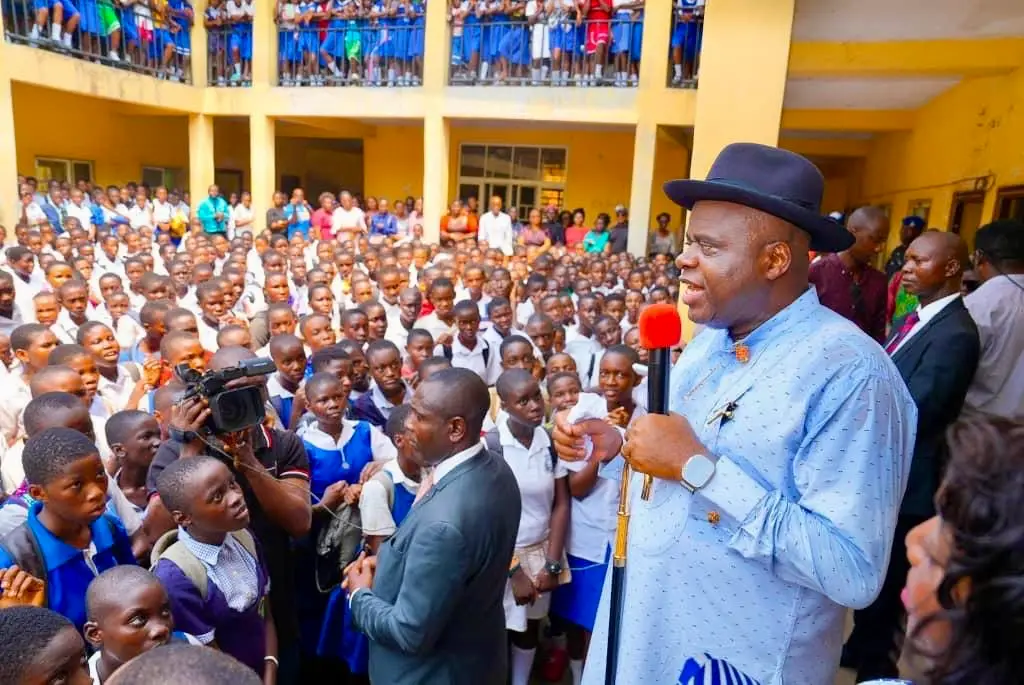
Governor Douye Diri’s unscheduled school visits expose alarming infrastructure decay in Bayelsa’s public schools. This detailed report critically analyses his bold interventions and calls for urgent, systemic educational reforms.
Overview
In a dramatic unscheduled inspection that has sent shockwaves through Bayelsa’s educational circles, Governor Senator Douye Diri has raised serious concerns over the dilapidated state of public school facilities.
The governor’s surprise visits to Saint Jude’s Girls Secondary School in Amarata-Yenagoa and the Ijaw National Academy in Kaiama have not only exposed a stark gap between the government’s budgetary promises and on-ground realities, but have also reignited debates about systemic neglect in the state’s education sector.
A Hands-on Approach Amid Systemic Failings
Governor Diri, himself a former teacher, made no attempt to hide his displeasure when he observed the deplorable conditions plaguing some of Bayelsa’s public schools.
“I have been to Saint Jude’s and I am here at the Ijaw National Academy. I am not satisfied with what I have seen,” he declared during his visit.
His words resonated with a sense of urgency, as he warned, “If schools that are in the urban, motorable areas are in this state, how would those in the rural, riverine communities be like?”
This direct intervention is reflective of the governor’s proactive, hands-on leadership style—a stark contrast to past administrations.
Critics argue that his unscheduled inspections are a clear signal of his intent to hold government officials accountable for maintaining essential infrastructure, despite a record of hefty budgetary allocations that have seemingly failed to translate into tangible improvements.
Budgetary Promises vs. Ground Realities
In his address at the Ijaw National Academy, Governor Diri lamented the disconnect between the state’s education budget and the visible neglect of school facilities. Despite the allocation of substantial funds, the physical infrastructure remains in a state of disrepair.
The governor’s rebuke highlights an uncomfortable truth: there exists a significant discrepancy between policy pronouncements and the everyday experiences of students and teachers.
The governor’s directive to Commissioner for Education, Dr Gentle Emelah, to immediately rehabilitate the deteriorating structures is not just a remedial measure—it is an unequivocal demand for systemic reform.
This move comes at a time when reports from various media outlets have frequently spotlighted infrastructural decay in Bayelsa schools, particularly in urban centres that should ostensibly set the standard for their rural counterparts.
Teaching from the Classroom: A Symbol of Commitment
Perhaps the most striking moment of the visit was when Governor Diri returned to the classroom at the Ijaw National Academy to teach a lesson in Government—a subject critical to the forthcoming West African School Certificate Examination (WASCE).
This act served as a powerful symbolic gesture, reinforcing his commitment not only to infrastructure but also to the quality of education itself. It is a reminder that effective education is built on the dual pillars of physical facilities and dynamic, responsive teaching.
His unscheduled visits are intended to serve as both a diagnostic tool and a morale booster. By directly engaging with the educational environment, the governor is positioning himself as a champion of reform who is willing to personally witness the shortcomings of the state’s educational system and take decisive action.
An In-depth Analysis of the Challenges
The governor’s criticisms are rooted in a broader narrative that has long plagued Bayelsa’s education system. Analysts point to several systemic challenges:
Inadequate Infrastructure Maintenance: Despite large-scale budgetary provisions, many schools continue to suffer from chronic neglect. The state’s infrastructure woes are not limited to isolated incidents but are symptomatic of a larger failure in maintenance and oversight.
Disparity Between Urban and Rural Schools: Governor Diri’s remarks underscore the disparity between the conditions of schools in motorable urban areas and those in remote riverine communities. Rural schools, often forgotten in policy implementation, face even more dire circumstances.
Impact on Student Performance: The link between infrastructural decay and poor academic performance has been well documented. Dilapidated classrooms, incomplete facilities such as dining halls and sporting areas, and a lack of essential learning materials can demotivate students, hinder concentration, and ultimately compromise educational outcomes.
Short-term Fixes vs. Long-term Solutions: While the governor’s immediate directives aim to address the visible decay, critics argue that sustainable improvement requires a thorough re-evaluation of current budgetary allocations, procurement processes, and oversight mechanisms. Without structural changes, similar issues are likely to recur.
The Political and Social Implications
Governor Diri’s intervention is not occurring in a political vacuum. His actions have ignited discussions among educational stakeholders, parents, and opposition figures.
Many have hailed his unscheduled visits as a long-overdue commitment to accountability and transparency in the education sector. However, sceptics caution that without deeper reforms, such gestures may prove to be cosmetic rather than transformative.
Political commentators have noted that this bold move may also be interpreted as a strategic effort to solidify his public image as a reformist leader.
In an era where public trust in government institutions is waning, demonstrable actions—such as personally inspecting schools and teaching in the classroom—carry significant political capital.
Looking Forward: Policy Recommendations and Urgent Reforms
In light of the governor’s unscheduled visits and his pointed criticisms, several policy recommendations have emerged:
Enhanced Monitoring and Accountability: Establish independent oversight committees to regularly audit the condition of school facilities and ensure that allocated funds are used effectively.
Equitable Distribution of Resources: Ensure that rural and remote schools receive as much attention and funding as urban institutions. A focused intervention in these areas could significantly improve overall educational outcomes.
Sustainable Maintenance Plans: Implement long-term maintenance schedules rather than relying on ad hoc repairs. This would involve periodic reviews, community involvement, and better training for school administrators.
Teacher Empowerment and Support: As the governor himself demonstrated by returning to the classroom, there must be ongoing investment in teacher training and development to complement infrastructural improvements.
Transparent Budgeting Processes: Strengthen the financial management systems within the Ministry of Education to prevent misallocation or underutilisation of funds earmarked for school infrastructure.
Conclusion: Catalyst for Transformative Change
Governor Diri’s unscheduled visit to Bayelsa State schools has shone an unflinching light on the systemic decay of public school infrastructure—a problem that has long been the Achilles’ heel of the state’s education sector.
His pointed criticisms and immediate directives underscore a leadership style that demands accountability and results.
While the governor’s actions are commendable, they also serve as a clarion call for deeper, more sustainable reforms that will ensure all Bayelsa students have access to a safe, conducive learning environment.
As Bayelsa grapples with these infrastructural challenges, the governor’s hands-on approach may well become the catalyst for the transformative change that the state’s education system so desperately requires.
Atlantic Post remains committed to delivering incisive, well-researched news reports that challenge the status quo and inspire change in Nigeria’s education system.